Parashat Vayechi · Yehuda & Yosef — The Two Pillars of Mashiach · Sefer Bereshit · 5786
Why Yehuda merited kingship and Yosef the first messianic role: the qualities of Efraim and Menashe, the secret of the children's blessing, and the difference between returning in teshuva and fleeing from sin.
Yehuda & Yosef — The Two Pillars of Mashiach
According to the teaching of Rav Acher Cohen
Why Yehuda merited kingship and Yosef the first messianic role: the qualities of Efraim and Menashe, the secret of the children's blessing, and the difference between returning in teshuva and fleeing from sin.
According to the teaching of Rav Acher Cohen · Yehuda & Yosef — The Two Pillars of Mashiach · Sefer Bereshit · 5785
The blessing “like Efraim and Menashe” honors two virtues: absence of jealousy and Jewish faithfulness in exile.
Efraim, the younger, is blessed before the firstborn Menashe, yet shows no jealousy — the exact opposite of Yosef's brothers.
Yehuda merits kingship through three qualities: admitting his faults, taking responsibility, and doing teshuva.
Yehuda “goes down” and returns (teshuva); Yosef “was brought down” and flees sin (resistance) — hence Mashiach Ben David and Mashiach Ben Yosef.
Reuven loses the birthright because his good intentions stayed hidden, while Yosef receives the double portion for his uprightness.
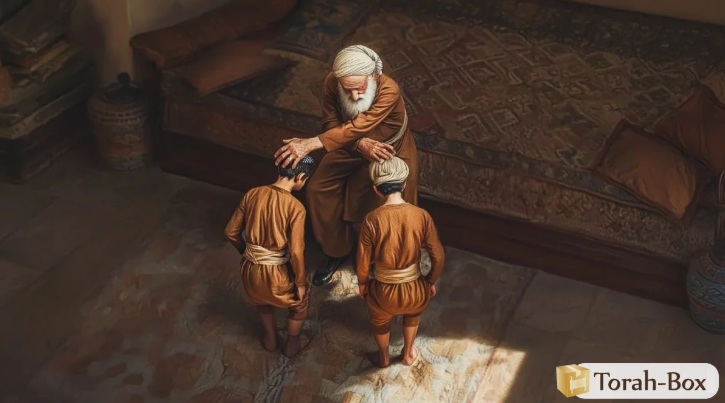
Every Friday night, we place our hands on our children's heads and bless them with these words:
יְשִׂמְךָ אֱלֹהִים כְּאֶפְרַיִם וְכִמְנַשֶּׁה — “May God make you like Efraim and Menashe.”Bereishit 48:20
Why them? Why not bless our children “like Avraham Avinu” or “like Yaakov”? What was so special about these two sons of Yosef, born and raised in Egypt?
Two rare qualities Our Sages reveal that Efraim and Menashe possessed two extraordinary virtues that set them apart from everyone else: a complete absence of jealousy, and the ability to remain fully Jewish in a hostile environment.
2 The Absence of Jealousy
Let us remember: Yaakov's sons hated Yosef. They could not even speak to him peacefully, and jealousy nearly destroyed the entire family.
Now Yosef brings his two sons before Yaakov for the blessing. Yaakov crosses his hands: he places his right hand — the more important one — on Efraim, the younger, and his left hand on Menashe, the firstborn.
No bitterness The firstborn sees his younger brother preferred. And yet — no complaint, no bitterness, no “why him and not me?” This is the exact opposite of what happened between Yosef and his brothers.
That is why we bless our children in their name: that they too may know how to live without jealousy.
3 Remaining Jewish in a Land of Impurity
Where did Efraim and Menashe grow up? In Egypt — “Eretz hato'evot,” the land of abominations. With no Torah, no yeshiva, no Jewish community, as sons of the viceroy, surrounded by luxury and Egyptian culture.
And yet, when Yaakov beholds them, what does he see? Two tzaddikim — two righteous men who kept their Jewish identity fully intact, without the slightest compromise.
“If I bless the people of Israel, I want them to be like these two: able to remain Jewish even in the worst conditions, and to live without jealousy among themselves.”
4 The Secret of “Bani Hem”
When Yaakov asks “Mi eleh?” — Who are these? — Yosef answers:
בָּנַי הֵם אֲשֶׁר נָתַן לִי אֱלֹהִים בָּזֶה — “They are my sons, whom God has given me here.”Bereishit 48:9
The Midrash teaches that Yaakov saw prophetically the generations to come. The word “Bani” (בני) forms the initials of three descendants: ב — ben Nevat (Yarov'am); נ — bin Nun (Yehoshua); י — Yishai (the father of David).
A father does not reject Yaakov perceived that among this lineage would also arise problematic figures like Yarov'am. But Yosef replies: “Even if they are not all perfect, they are my sons. A father does not reject his children.”
5 Why Yehuda Merited Kingship
Yaakov begins to bless his sons. Reuven enters: reproach. Shimon and Levi: reproach again. Yehuda trembles — what awaits him? And then, a surprise:
יְהוּדָה אַתָּה יוֹדוּךָ אַחֶיךָ — “Yehuda, you — your brothers shall pay you homage.”Bereishit 49:8
Three royal qualities 1. He knows how to admit his mistakes: with Tamar he publicly declared “Tzadka mimeni” — she is more righteous than I. 2. He knows how to take responsibility: “Anochi e'ervenu” — I will be guarantor for Binyamin. 3. He knows how to do teshuva: he sold Yosef, then knew how to return, repair and stand as guarantor.
6 The Difference Between Yehuda and Yosef
The text reveals a subtle but fundamental difference, in two almost identical verbs:
וַיֵּרֶד יְהוּדָה — Yehuda went down from his brothers. וְיוֹסֵף הוּרַד מִצְרָיְמָה — Yosef was brought down to Egypt.Bereishit 38:1 / 39:1
Two paths of tikun Yehuda went down on his own: he fell, he sinned with Tamar, yet he knew how to return. He embodies teshuva. Yosef was brought down by force, through no fault of his own; facing Potiphar's wife, he knew how to flee from sin. He embodies resistance to temptation.
7 Mashiach Ben Yosef and Mashiach Ben David
From these two paths flow our two Mashiachs, two complementary missions:
First, to resist Mashiach Ben Yosef comes first. He represents the one who knows how to resist evil, who does not fall, who stays upright under trial. He prepares the ground.
Then, to raise up Mashiach Ben David, descendant of Yehuda, comes afterward. He represents the one who knows how to bring others back in teshuva, who raises those who have fallen and repairs the breaches.
First, not to fall; then, to know how to raise those who have fallen.
8 The Tragedy of Reuven
Reuven, for his part, had good intentions: he wanted to save Yosef from the pit, and the Torah testifies that he planned to return him to his father. So where was his problem?
Intentions left unspoken Reuven never expressed his intentions. He said “throw him into this pit” but never dared to say “I want to save him.” He hesitated; he did not follow through. Yehuda, by contrast, spoke: “let us sell him.” It was not ideal, but he took a stance, took responsibility, and later repaired it.
Reuven lost the bechora, the birthright, because of this. Hidden good intentions do not count: one must know how to express and own them.
9 Yosef's Double Inheritance
The Torah says the firstborn receives a double portion. Yet Yosef was not the firstborn — Reuven was! And still, Efraim and Menashe are counted as two full tribes: Yosef thus receives two portions.
The right transferred Reuven lost his birthright through lack of initiative and speech. Yosef received it because he knew how to stay upright, resist his trials, and maintain his identity in the very heart of Egypt.
ברוך ה' לעולם אמן ואמן!
🎯 Test yourself
Five questions. Click an answer.
1
Which two qualities of Efraim and Menashe justify the Friday-night blessing?
Our Sages stress that they had no jealousy and remained fully Jewish in Egypt.
2
What does Yaakov do with his hands when blessing Yosef's sons?
Yaakov crosses his hands, placing the right — the more important — on Efraim the younger, and Menashe shows no jealousy.
3
According to the Midrash, which initials are contained in the word “Bani” (בני)?
“Bani” forms the initials of Yarov'am ben Nevat, Yehoshua bin Nun and Yishai (father of David).
4
Which difference in verb distinguishes Yehuda's “descent” from Yosef's?
“Vayered Yehuda” (he went down himself, then returned) versus “Yosef hurad” (was brought down, blamelessly) — teshuva versus resistance.
5
Why did Reuven lose the birthright despite his good intentions?
Reuven wanted to save Yosef but never said so nor followed through; hidden good intentions do not count.
Result
📅 7 Days in the Footsteps of Yehuda and Yosef
Sunday
Sunday: tonight, or next Shabbat, truly bless your children (or a loved one) “ke-Efraim u-khe-Menashe” with full intention.
Monday
Monday: notice one person whose success stirs jealousy in you, and sincerely bless them in your heart.
Tuesday
Tuesday: like Yehuda, admit a recent mistake out loud instead of justifying it.
Wednesday
Wednesday: in an unclear situation, take a stance and state your intentions plainly — don't freeze like Reuven.
Thursday
Thursday: name a recurring temptation and prepare a “flee” strategy (Yosef), not a negotiation.
Friday
Friday: strengthen one point of Jewish identity in an unsupportive setting — a word, a gesture, an owned berakha.
Shabbat
Shabbat: reach out to someone who has “fallen,” encourage them without judging, in the way of Mashiach Ben David.
Four Practical Steps
🏠
Shalom Bayit — The Mouth at Home
My covenant of peace — peace begins at home. Reveal a Shalom Bayit card.
🔢
Gematria — Rav Ménaché
Shalom, Mashiah, Yisamech — secrets of the letters by Rav Ménaché zatsal.
Every week, straight to your inbox. No spam. One-click unsubscribe.
🕯️ Dedicate This Shiur
Dedicate this shiur for the days of Bein HaMetzarim — in memory, for healing or for success.
Guardians of the Rift
A spiritual thriller · David Goldberg
Forty-nine gates open — the fiftieth hides in a single moment. An ancient secret resurfaces, and one man stands between the rift and the world. Drawn from Talmud and Kabbalah.