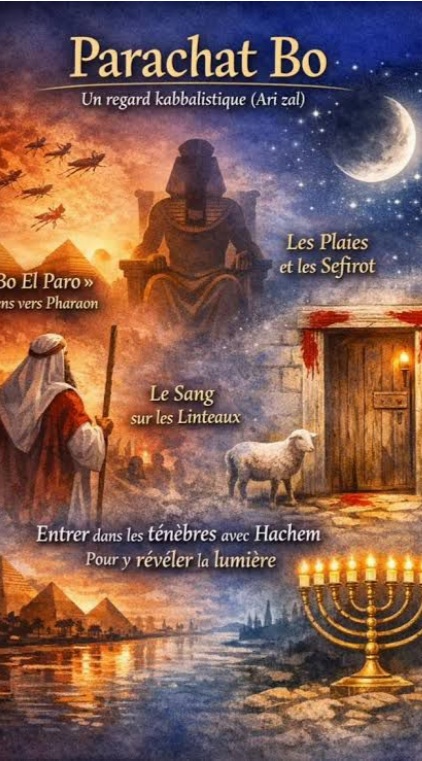
The Torah calls those leaving Egypt "armies of Hashem" (צִבְאוֹת ה׳) rather than "children of Israel": a secret hides behind this term.
The final Noun of "תַּעַבְדוּן" (= 50) teaches that the purpose of the Exodus was to receive the Torah 50 days later at Sinai.
חָרוּת (with a Tav) does not come from "engraving" (with a Tet) but from חוֹר, "hole": the Tablets were pierced clean through.
Since Adam's sin, the sparks of holiness scattered and gathered in Egypt; Israel, the elite unit descended from Avraham, was sent to extract them.
By "emptying" Egypt of its sparks, Israel became "Bené Horin," the hole makers; one who studies Torah does the same, and the pierced Matza perpetuates the memory.
After the plague of the firstborn, the Torah describes the Exodus with an unexpected military term.
"On this very day, all the armies of Hashem left the land of Egypt."
At the burning bush, Hashem had already revealed the purpose of the redemption.
"You shall serve God on this mountain."
Conclusion: the entire purpose of the Exodus was to receive the Torah at Mount Sinai.
Pirkei Avot describes the Tablets of the Law with an enigmatic word.
To understand, we must go back to the original sin.
Where did most of these sparks go? To Egypt, for it was "עֶרְוַת הָאָרֶץ," the lowest part of the earth. Through its power of impurity, it drew the majority of the sparks to itself.
The mission: to repair Adam's sin and rectify the world, an elite unit had to be sent into Egypt to extract these sparks and elevate them.
This "special unit" was built progressively, through a sifting of the generations.
Avraham begets Yitzchak and Yishmael, but Yishmael is removed. Yitzchak begets Yaakov and Esav, but Esav is removed. Yaakov begets 12 sons, all pure: "his bed was complete" (מיטתו שלמה).
From these 12 tribes descend the 70 souls who go down to Egypt to accomplish the mission.
They multiplied extraordinarily and filled the land — ready to accomplish their mission of extraction.
"Hashem gave the people favor in the eyes of Egypt, and they emptied Egypt."
Extraordinary revelation: "בְּנֵי חוֹרִין" does not only mean "children of the free" in the classical sense. They are literally those who make holes (חוֹרִים).
How did they make these holes? By emptying (רוֹקְנוּ) Egypt of its sparks of holiness.
That is why the Torah says "יָצְאוּ כָּל צִבְאוֹת ה׳." It was not only the children of Israel who left, but also the sparks of holiness they extracted. These sparks are the true "armies of Hashem."
Now we understand the Mishna: "one who engages in Torah study" is a בֶּן חוֹרִין.
One who studies Torah accomplishes exactly the same action as our ancestors in Egypt: he extracts the sparks of holiness from material reality. He "makes holes" in the world to release the hidden light.
Some teach that this is one of the reasons the Matza is pierced with holes: to remind us that we "holed" Egypt's soil by extracting all its sparks of holiness.
Every Passover, when eating the Matza, we recall our mission: to be "Bené Horin," those who pierce materiality to release the divine light.
🎯 Test yourself
Five questions. Click an answer.
Result
Shalom Bayit — The Mouth at Home
My covenant of peace — peace begins at home. Reveal a Shalom Bayit card.
Gematria — Rav Ménaché
Shalom, Mashiah, Yisamech — secrets of the letters by Rav Ménaché zatsal.
🔢 Gematria CourseAll Parashot
All shiurim of M. Yéhouda Himi — from Bereshit to Devarim and the festivals.
📚 All ParashotBooks
Torah wisdom in thriller format — Éditions Gueoula.
Guardians of the Rift
Forty-nine gates open — the fiftieth hides in a single moment. An ancient secret resurfaces, and one man stands between the rift and the world. Drawn from Talmud and Kabbalah.
📖 Read the free excerpt · Book $9.90