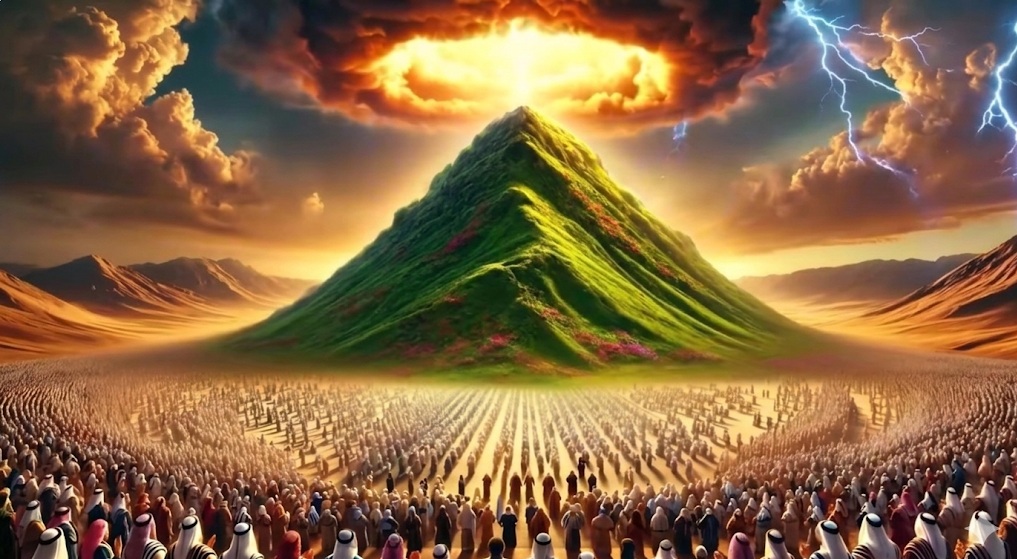
Karnei Hod — The Radiance of Moses' Face
Parashat Ki Tissa · Karnei Hod — The Radiance of Moses' Face · Sefer Shemot · 5786
Three secrets of Ki Tissa: who wrote the tablets, what karan truly means, and the mystery of the veil.
Karnei Hod — The Radiance of Moses' Face
A shiur by M. Yéhouda Himi
Three secrets of Ki Tissa: who wrote the tablets, what karan truly means, and the mystery of the veil.
A shiur by M. Yéhouda Himi · Karnei Hod — The Radiance of Moses' Face · Sefer Shemot · 5785

It was G-d — not Moses — who engraved the Ten Words on both the first and the second tablets; for the second, Moses only brought the stones.

The word karan means rays of divine light (Karnei Hod), not horns: Michelangelo's horned statue rests on a mistranslation.

The rays of light came from ink left in the quill — tied to the missing Yod of anav and the small Aleph of Vayikra: Moses' humility itself created his radiance.

Moses removed the veil to speak with G-d and to teach Torah, wearing it only in ordinary daily life — out of humility, since the light was merely a tool for transmission.

On his final day Moses appeared unveiled; Israel's 600,000 souls saw his full Sinai light — a spark that still lives in every Jewish soul.

📖 Full Text
1 Who Wrote the Second Tablets?
A mistake carried for a lifetime Who truly engraved the words on the second tablets of the Law?

When Moses breaks the first tablets, G-d commands: "Carve for yourself two stone tablets like the first ones." Moses carves, Moses brings — but who writes?

וַיֹּאמֶר ה׳ אֶל מֹשֶׁה פְּסָל לְךָ שְׁנֵי לֻחֹת אֲבָנִים כָּרִאשֹׁנִים וְכָתַבְתִּי עַל הַלֻּחֹת אֶת הַדְּבָרִים אֲשֶׁר הָיוּ עַל הַלֻּחֹת הָרִאשֹׁנִים אֲשֶׁר שִׁבַּרְתָּShemot 34:1
Vechatavti "And I will write" — I, the Holy One, will write. Not Moses.

Yet later it says: "He was there with G-d forty days… and he wrote upon the tablets the words of the covenant." Many wrongly conclude Moses wrote.

וַיְהִי שָׁם עִם ה׳ אַרְבָּעִים יוֹם וְאַרְבָּעִים לַיְלָה לֶחֶם לֹא אָכַל וּמַיִם לֹא שָׁתָה וַיִּכְתֹּב עַל הַלֻּחֹת אֵת דִּבְרֵי הַבְּרִית עֲשֶׂרֶת הַדְּבָרִיםShemot 34:28

The verse must be split in two: "He was there with G-d forty days… without eating or drinking" — that is Moses. "And He wrote upon the tablets" — that is G-d. Moses himself confirms it in Deuteronomy, in direct speech: "and I Myself will write" (Devarim 10:1–2), then "He wrote upon the tablets like the first writing" (Devarim 10:4) — the same Author.

For the first tablets, G-d provided the stone and inscribed it. For the second, Moses provides the stone — but G-d still engraves the Ten Words with His own hand.

So what was Moses doing all forty days and nights, both times? He was writing the whole Torah, dictated by G-d from Bereshit, and from that point on according to what unfolded around him.

2 Horns or Rays of Divine Light?

At the end of the parasha, as Moses descends Sinai with the tablets, it is written:

וּמֹשֶׁה לֹא יָדַע כִּי קָרַן עוֹר פָּנָיו בְּדַבְּרוֹ אִתּוֹShemot 34:29

Michelangelo — following early translations — rendered karan as "horns," and sculpted Moses horned like a beast. This is a fundamental error: karan comes from Karnei Hod — radiance, a halo, divine light. Not horns.

Where did the light come from? How did Moses receive these rays of glory?
When Moses finished writing the Torah, a little ink remained in the quill; he passed it over his forehead, and from that ink his rays of glory were formed.

But where did that leftover ink come from, since G-d had given him exactly the amount needed? Here lies the secret.

The missing Yod In "Moses was exceedingly humble (anav)" (Bamidbar 12:3), Moses refused to write the full word anayv — it felt like boasting. He wrote anav, without the Yod. That missing Yod is the leftover drop of ink.
The small Aleph In Vayikra 1:1, Moses wanted to write vayikar (a chance encounter, as with Bilam). G-d refused: "With evildoers I appear by chance; with you, by intent." The compromise: a small Aleph — and from its leftover ink the rays were formed.
The lesson Anava — genuine humility — is not weakness: it is the spiritual vessel that draws down divine light. Moses' self-effacement is precisely what gave him his radiance.
3 The Veil — The Counterintuitive Truth
When did Moses wear the veil? Most assume: when speaking to the people he removed it; alone, he put it on. The truth is the reverse.
וַיְכַל מֹשֶׁה מִדַּבֵּר אִתָּם וַיִּתֵּן עַל פָּנָיו מַסְוֶהShemot 34:33

He finished speaking to them, then put on the veil. So while he spoke to the people: no veil.

וּבְבֹא מֹשֶׁה לִפְנֵי ה׳ לְדַבֵּר אִתּוֹ יָסִיר אֶת הַמַּסְוֶה עַד צֵאתוֹ... וְרָאוּ בְנֵי יִשְׂרָאֵל אֶת פְּנֵי מֹשֶׁה כִּי קָרַן עוֹר פְּנֵי מֹשֶׁה וְהֵשִׁיב מֹשֶׁה אֶת הַמַּסְוֶה עַל פָּנָיוShemot 34:34–35
The real rule Before G-d — no veil. While teaching the people — no veil. In ordinary daily life — veil on the face.

Why? Out of humility. The divine light was not his own: it was a tool to transmit the Torah. The moment teaching ended, he covered it.

After the sin of the Golden Calf, Israel had fallen; they could not bear even the reflected light of Moses' face. When he taught, he removed the veil so they might receive the light of Sinai, and through it Torah and awe of Heaven. For thirty-eight years Moses walked among them veiled — a class began, he uncovered; it ended, he covered again.

4 Moses' Farewell — A Light for All Eternity
וַיֵּלֶךְ מֹשֶׁה וַיְדַבֵּר אֶת הַדְּבָרִים הָאֵלֶּה אֶל כָּל יִשְׂרָאֵלDevarim 31:1

On the last day of his life — age 120 — Moses entered every tent to bid farewell: "See you soon, I am leaving today," says the Midrash.

But this time, unveiled. Every child, every mother, every father saw the full divine light he had received at Sinai.

600,000 souls The 600,000 souls of Israel — whose reincarnations we all are — merited, on Moses' final day, to behold his divine light.

Every Jew who returns to G-d is kindled by that very spark his soul once perceived in Moses' soul. The light received at Sinai lives on — in every Jewish neshamah. May we merit the complete redemption, speedily in our days — amen.

🎯 Test yourself

Five questions. Click an answer.

1
According to the shiur, who engraved the Ten Words on the second tablets?
"Vechatavti" — "and I will write" — refers to G-d; Moses only carves and brings the stones.
2
What is the real difference between the first and second tablets?
First tablets: G-d supplies stone and writes. Second: Moses brings the stone, but G-d still engraves the Ten Words (Ramban).
3
Why did Michelangelo depict Moses with horns?
Karan means rays of light (Karnei Hod); early translations wrongly rendered it as "horns."
4
Where, according to the Midrash, did Moses' rays of light come from?
A little ink remained — tied to the missing Yod of anav / the small Aleph — which Moses passed over his forehead.
5
When did Moses wear the veil?
He removed the veil to speak with G-d and to teach; he wore it in ordinary life, out of humility.

Result

📅 Seven-Day Programme — Parashat Ki Tissa
Sunday
Sunday: Read Shemot 34:1 and 34:28 and spot the difference — who said "and I will write"?
Monday
Monday: Study Devarim 10:1–4, Moses' own testimony that G-d engraved the tablets.
Tuesday
Tuesday: Open the Ramban on Shemot 34:1 and study his distinction between the first and second tablets.
Wednesday
Wednesday: Look at Vayikra 1:1 in a Chumash and notice the small Aleph — what does it symbolize?
Thursday
Thursday: Study Bamidbar 12:3 — anav written without the Yod — and ask: what should I hide in humility, what must I reveal for others?
Friday
Friday: Read Shemot 34:33–35 on the veil and prepare a short dvar Torah on Karnei Hod.
Shabbat
Shabbat: Share the dvar Torah at the table — remove the veil, transmit the light received at Sinai.
Four Practical Steps
🏠

Shalom Bayit — The Mouth at Home

My covenant of peace — peace begins at home. Reveal a Shalom Bayit card.

🔢

Gematria — Rav Ménaché

Shalom, Mashiah, Yisamech — secrets of the letters by Rav Ménaché zatsal.

🔢 Gematria Course
📝

Torah Study

Dig deeper into the Baal HaTurim and Rashi on Parashat Devarim.

📝 Beith Hamidrach
📚

All Parashot

All shiurim of M. Yéhouda Himi — from Bereshit to Devarim and the festivals.

📚 All Parashot
📕

Books

Torah wisdom in thriller format — Éditions Gueoula.
🌙

Dream Interpretation

Did you dream? Check the meaning according to Rav Almoli.

🌙 Dreams
🎬

Videos

Video shiurim on the festivals, the Menorah and the secrets of the Mishkan.

🎬 Videos
💡

Idea Box

An idea, a remark, a suggestion for the site? Share it with us.

💡 Idea Box
🤝

Maasser

Give your Maasser and take part in spreading Torah.

🤝 Maasser
📨 Get the Weekly Shiur
Every week, straight to your inbox. No spam. One-click unsubscribe.
🕯️ Dedicate This Shiur
Dedicate this shiur for the days of Bein HaMetzarim — in memory, for healing or for success.
🧱 Wall of Dedications →
Guardians of the Rift

Guardians of the Rift

A spiritual thriller · David Goldberg

Forty-nine gates open — the fiftieth hides in a single moment. An ancient secret resurfaces, and one man stands between the rift and the world. Drawn from Talmud and Kabbalah.

📖 Read the free excerpt · Book $9.90