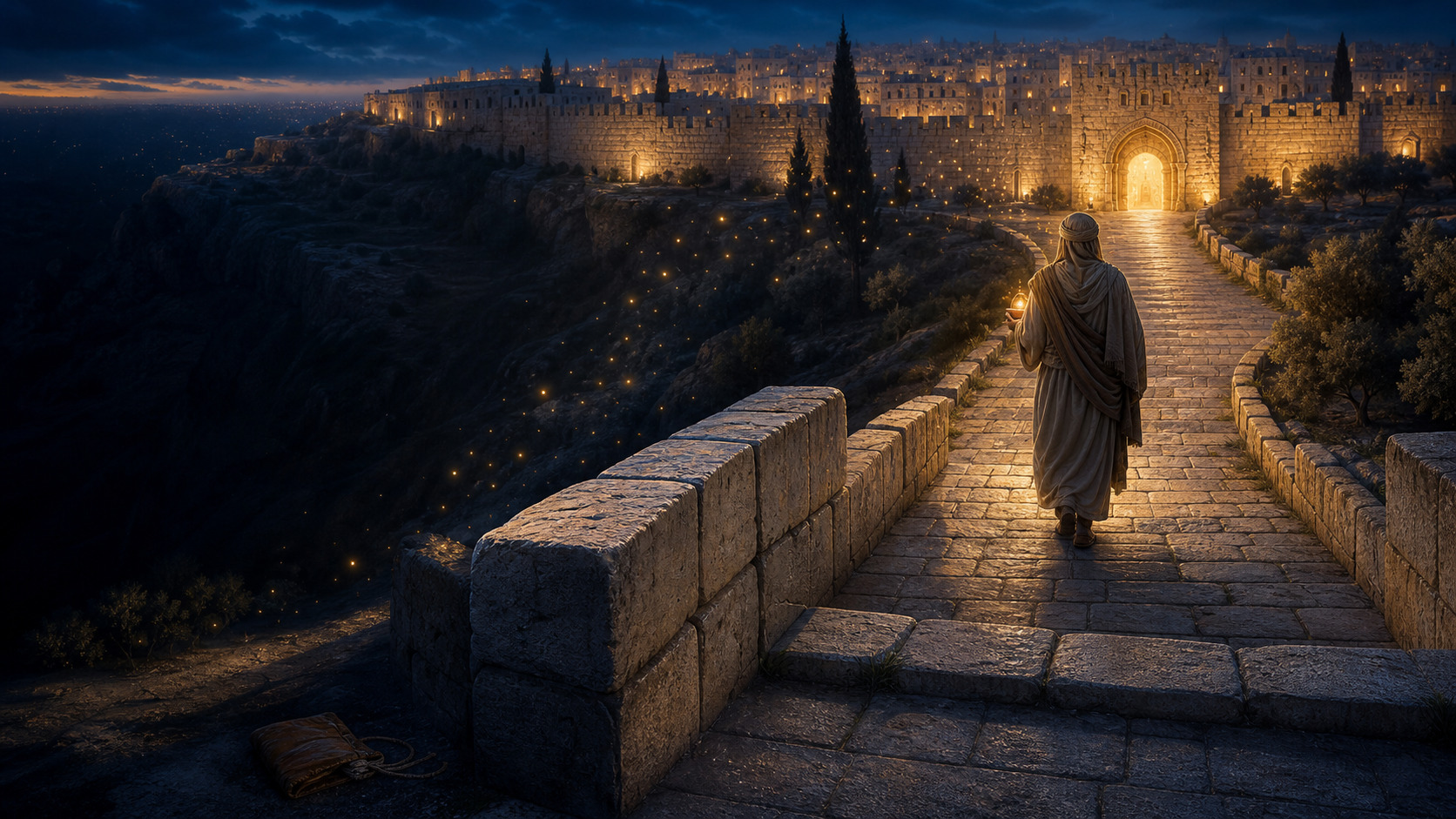
“You shall capture his captivity”: the Ari teaches that mitzvot performed while a person remains ruled by sin draw light that the external forces seize. Teshuvah recovers what the kelipah swallowed and returns Torah and mitzvot to holiness.
Why does Torah open a path for the yefat toar here? The Or HaChaim reveals that precious souls have remained captive among the nations since Adam’s sin. A meeting may conceal a spark meant to return, as in the traditions about converts and the chain from Dinah to Osnat and Yosef’s house.
One sin draws another: yefat toar, loved and hated wives, a disputed firstborn, then the rebellious son. The Zohar turns the nearly impossible law into Israel’s plea: even rebellious, a son remains a son; the Father and Shekhinah will never consent to his annihilation.
Even the executed criminal still bears tzelem Elokim. Leaving him exposed dishonors the King. The parapet then limits both roof and ego: when success puts a person “in the clouds,” humility prevents the falling one from falling further.
Today is the 4th of Elul, and we read Ki Tetze. As we have said, the names of these parashot match the time we are moving through. Re'eh fell before Rosh Chodesh Elul — see, Elul is coming. Then Shoftim: "judges and officers shall you appoint for yourself" — a person has seven gates, and he must know what he lets in and out, what he looks at, what he smells, what he hears. This is how the masters of mussar bound these names to the days we are living.
Ki Tetze la-milchamah — and if you won that war, the next parashah will be Ki Tavo: "you will come to the land that Hashem gives you as an inheritance and dwell in it" — because you defeated the yetzer hara. Then Nitzavim, as Rosh Hashanah draws near: "You stand today" — the holy Zohar says "the day" is Rosh Hashanah, from the verse in Iyov: "And it was the day, and the sons of God came to present themselves — and the Satan too among them." Then Haazinu, already facing Yom Kippur — the end of its song says vekhiper admato amo: we hear the word Kippur in it. And if, with God's help, we pass through it all in peace — Sukkot, Simchat Torah — then Vezot Haberakhah: blessing for the whole year.
In the plain sense, this is going out to actual war. But it can also be read through mussar, fitting these days of Elul: who is man's number one enemy? The yetzer hara.
And here is the question: "you will capture his captives" — shivyo. It should have said shivyekha, your captives: if the enemy seized something that belongs to you, it is yours. Why "his captives"?
The verse says “his captivity,” not “your captives.” A sinner may still learn Torah and perform mitzvot, drawing light from above. While he remains enslaved to sin, the external forces seize that light: what a slave acquires belongs to his master. Complete teshuvah makes the kelipah return what it swallowed. Torah and mitzvot return to their proper domain. War with the yetzer means recovering the light taken from us.
Beyond the usual answer that Torah addresses the exceptional pressure of war, the Or HaChaim asks why such a path exists precisely when victory and a holy camp demand closeness to God. Since Adam’s sin, elevated souls have been held among the nations. Onkelos, Ruth, Shemaya, Avtalyon and Rabbi Akiva’s ancestry exemplify returning sparks. A tradition links Rabbi Chanina ben Teradyon’s spark to Shechem and its return through Dinah, Osnat and Yosef. The permission does not trivialize desire; it regulates a meeting that may conceal spiritual release.
From here the Torah rolls on — as they say, an averah drags an averah, a mitzvah drags a mitzvah. If you went to war and took captive an eshet yefat toar because you desired her, it has a price. In those days, when armies went to war, the enemy's women feared being killed: they would adorn themselves before the enemy to entice them and stay alive. There is a halakhic dispensation within the framework of war.
But to check that you truly want her — and not merely because of the high adrenaline of battle — the Torah says: bring her home. She will remove simlat shivyah, her beautiful garment, for plain clothes; "and she shall do her nails" — not today's manicure: either let them grow so she becomes unattractive, or cut them if the fashion is precisely long nails — and of course she shaves her hair.
And the consequence: you come home, your wife is waiting — now you have two wives. Immediately afterwards it is written: "If a man has two wives, one loved and one hated." Who is the hated one? The one he took captive — the one he will end up hating. And the firstborn of the hated one? "If a man has a wayward and rebellious son" — you received a complete ben sorer u-moreh. Now deal with him. This is what an averah dragging an averah means.
According to the peshat of the Torah, this is a very harsh din. This son has discipline problems; they chastise him and he does not listen — he scoffs at them. What do we do in such a case? Take him to an educational counselor? To a Rav who will talk with him? No — according to the Torah: "his father and mother shall seize him and bring him out to the elders of his city," and they shall say: "this son of ours is wayward and rebellious, he does not listen to our voice — zolel vesove, a glutton and a drunkard."
Gentlemen — what did this child do to you? Zolel vesove. Rashi explains: he eats meat and drinks wine. And the Gemara gives the quantity: a steak of about 240 grams — the minimal steak in a good restaurant — and about 300 cc of good wine. And for this: "all the men of his city shall stone him and he shall die; you shall remove the evil from your midst, and all Israel shall hear and fear."
Chazal come and say: see how many conditions must hold for this son to be liable to death. First, he must be over 13 — younger, he is a minor, not bound by mitzvot — but no older than 13 years and three months. Past that, even if he is zolel vesove, he no longer has the din of ben sorer. The entire window: three months.
And that is not all: the Gemara says he must steal the meat and wine from his father, carry them into another domain, and eat and drink them there. Why would he steal? The meat is there, the wine is there — yet the theft too is required for the din to apply.
Then: "he does not listen to the voice of his father or the voice of his mother" — why does the Torah double bekol… uvekol? It could have written "our voice." The Gemara derives that father and mother must have the same voice — sound identical. This is almost inconceivable: the only ones with the same voice would be twins, and twins cannot marry. And they must both be fully sound — not one maimed and the other not.
So the Gemara asks: if so, why does the Torah write us this din? Answer: derosh vekabel sakhar — expound and receive reward. Exactly what we are doing now: we study this sugya, we delve into it, and this engagement is Torah lishmah that carries reward. But this too must be understood — could the Torah not give us real dinim to study, rather than dinim with no possible reality?
One of the hardest points: Rashi writes that the ben sorer u-moreh is put to death "on account of his end" — al shem sofo. What is his crime? He ate, drank, stole from his father, disobeyed — and for that, death? Rashi answers: the Torah reached the end of his mind. He will finish off his father's money, find nothing left to steal, stand at the crossroads and rob passers-by — and it may be that when someone resists, he will kill him. The Torah judges him now: if at 13 years and three months he is this crooked, we see where he will end.
From here we learn that a person is not judged by his end, but as he is there. There, with the Egyptian, Moshe saw that nothing would come from him — "he saw that there was no man", no one worthy would descend from him — and struck him. But from Yishmael evil would come, and still: we will face it in its hour. So why here is the ben sorer judged now, on account of his end? This whole passage is very, very problematic — and truly, we cannot do without the Zohar.
And more: what did he actually do? He did not listen to his parents — take him to an educator, put him even in prison, but kill him? And the verse says "urgamuhu kol anshei iro" — all the men of his city. His father and mother brought him together: it should say the men of their city, iram. Why iro?
The holy Zohar says: come, let us read this passage differently. "If a man — ish — has a wayward and rebellious son": who is the Ish? The Holy One, blessed be He — as it says: "Hashem ish milchamah." Who is the son? Israel — "beni bekhori Israel," My firstborn son. "Who does not listen to the voice of his father" — the Holy One; "or the voice of his mother" — the holy Shekhinah. Israel does not want to learn Torah, makes trouble, scoffs at everything — sorer u-moreh.
In passing: the phrase "sorer u-moreh" appears four times in the Tanakh — and everywhere it speaks of Am Israel, never of a lone son; so in the book of Yirmiyahu.
"They chastise him and he does not listen" — the Holy One sends rebukes; they are not heeded. "His father and mother shall seize him" — vetafsu vo: though he is wayward and rebellious, this Father and this Mother — the Holy One and the Shekhinah — do not despair of this son. It is not written "they shall cast him away"; it is written "they shall seize him." And they bring him "to the elders of his city" — who are the elders? The prophets. The Holy One comes to the prophets: see what Israel is doing, scoffing at Me, not listening to My voice. And the prophets go and rebuke Israel — return! They do not listen; they refuse to hear.
We asked why the Torah writes this din. Now, within the din of the ben sorer there is one thing that can annul everything. The verdict is issued, the square is prepared, the whole people already surrounds the boy, stones in hand. One person alone can stop it: the father or the mother. If at the last moment the father says — stop, stop, we forgive, we want our child — at that very moment the court can say nothing: the din is annulled.
Then Moshe Rabbenu comes before the Holy One and says: You gave in Your Torah this din of the ben sorer u-moreh. Is there any situation in the world — You who know the heart — where a father and mother, however angry at their child, however bad he may be, the worst in the world, would agree to have him executed? Never. The feeling of a father and mother will not allow it. No such situation exists. You write it in Your Torah knowing that a father and mother will never carry this to the end — so either the holy Shekhinah will plead for Israel, or You, the Father of Israel, will stand and say: stop — I am not willing that he be killed.
And where, inside the passage, hides the word that carries this plea? Notice: from beginning to end, of whom do we speak? Of a ben — a son. "Banim atem la-Hashem Elokeikhem" — you are sons to Hashem your God. Whatever we do, we are sons. "Beni bekhori Israel" — when we are good, and when we are not: banim mashchitim, corrupted sons — but sons. The name of son never leaves us. And if we are sons, we have a Father — a merciful Father; we have a Mother — a merciful Mother. There is no situation in which, God forbid, we reach annihilation.
Therefore "they shall stone him and he shall die" — what dies? The sufferings with which the Holy One chastens us come to put to death the evil side within Israel — uviarta hara mikirbekha. And when the evil goes out, what remains? Israel — yashar El, straight with God. This, God willing, is the final station: to pass from Yaakov to Israel — and so merit the Geulah, speedily in our days.
The condemned must be taken down and buried that day. Rashi explains that leaving him exposed dishonors the King, for a human bears His image and Israel is His child. The parable tells of identical twins, one a minister and one a robber: when the robber hangs, passersby think the minister hangs. Punishment does not erase tzelem Elokim. Exposure also defiles the land; the shiur recalls the joy when Beitar’s dead could finally be buried.
Maakeh conveys pressure and limitation: it closes space to protect. Why “the falling one” before he falls? A new homeowner may already have fallen into “my strength made this wealth.” Success puts him in the clouds. The parapet says: limit yourself, return to proportion, practice humility. Onkelos uses a term related to an enclosing siegework. The roof’s physical barrier models an inner boundary that prevents an initial spiritual fall from becoming an actual fall.
🎯 Test Yourself
Five questions. Click an answer.
Result
Shalom Bayit — The Mouth at Home
My covenant of peace — peace begins at home. Reveal a Shalom Bayit card.
Gematria — Rav Ménaché
Shalom, Mashiah, Yisamech — secrets of the letters by Rav Ménaché zatsal.
🔢 Gematria CourseAll Parashot
All shiurim of M. Yéhouda Himi — from Bereshit to Devarim and the festivals.
📚 All ParashotBooks
Torah wisdom in thriller format — Éditions Gueoula.
Guardians of the Rift
Forty-nine gates open — the fiftieth hides in a single moment. An ancient secret resurfaces, and one man stands between the rift and the world. Drawn from Talmud and Kabbalah.
📖 Read the free excerpt · Book $9.90