Ki Tetze contains seventy-four mitzvot. The shiur selects two clusters: shaatnez—wool and linen—followed by tzitzit, and the exclusion of Ammon and Moab.
Halakhah forbids wool and linen together, yet priestly garments contained both and the juxtaposed verses allow their meeting in tzitzit. The shiur asks what this exception teaches.
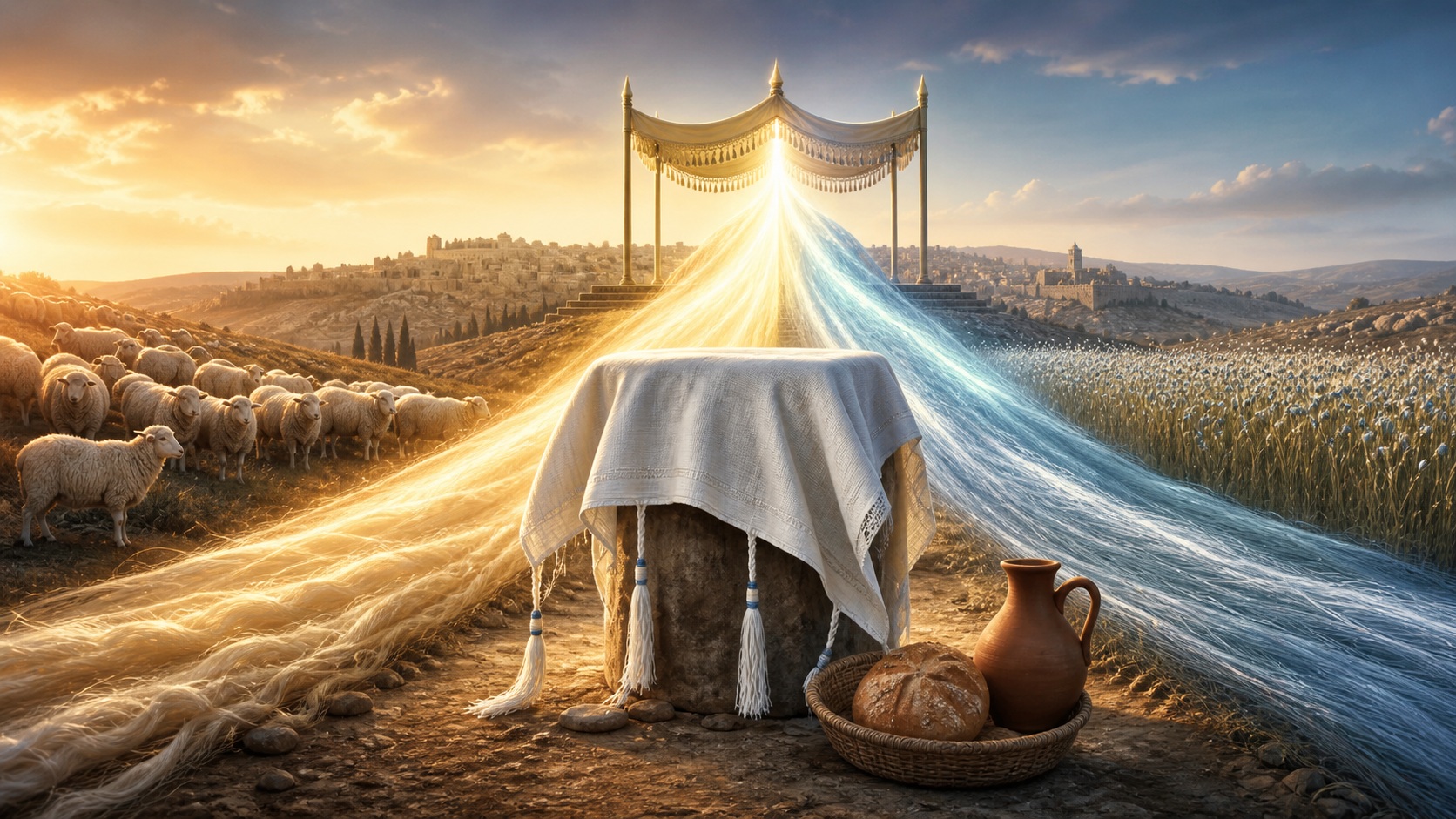
In the midrashic and Zohar-based reading presented here, linen recalls Cain’s offering and wool Abel’s flock. For an ordinary person they are opposite poles; the Kohen can unite them because he unites Israel, while tzitzit gathers the four corners.
Ammon and Moab failed to offer bread and water and hired Bilam. The shiur goes back to Lot: their existence depended on Abraham’s rescue. Refusing his descendants exposed ingratitude. Gratitude to people prepares gratitude to God—hence Modeh Ani.
The shiur presents Ki Tetze as the parashah with the largest concentration of commandments: twenty-seven positive and forty-seven prohibitions. Two details—clothing and welcoming travelers—teach when to unite, when to keep distinctions, and how to recognize received good.
“You shall not wear shaatnez, wool and linen together.” The first level is law: the mixture is forbidden. It is classed among chukkim whose reason Torah does not state. Seeking meaning accompanies obedience; it does not cancel the rule.
The next verse commands cords on the garment’s four corners. From the juxtaposition, the Sages derive the mitzvah-context in which wool and linen may meet in tzitzit. Priestly garments also combined linen—shesh—with wool dyed tekhelet and argaman. What ordinary clothing may not mix can serve mitzvah and sacred service.
Cain brought fruit of the soil. Rashi cites Midrash that it was inferior produce, and one tradition identifies flaxseed. Abel brought firstlings of his flock, the source of wool. In the shiur’s symbolic construction, linen marks Cain and wool Abel. This is midrash and sod, not the halakhic definition of shaatnez.
The shiur compares the poles to positive and negative battery cables: joining them without mediation drains energy. The ordinary person must not wear the confusion. The Kohen, however, represents all Israel in service; his mission turns opposition into circulation and rebuilds unity without erasing differences.
Tzitzit evokes the world’s four corners and gathering every dispersion under mitzvot. If fringes accidentally touch the ground, do not seek it or demean the mitzvah, but do not panic: even dust belongs to creation and contains sparks to raise. Respect and inclusion remain together.
They may not enter because they did not meet Israel with bread and water and hired Bilam. Tradition reads “Moabite,” not “Moabitess,” opening the way for Ruth because public greeting fell to the men. Why is this more lasting than Egypt’s crimes, whose third generation may enter?
Abraham risked himself to rescue captive Lot. Ammon and Moab descend from Lot’s daughters; their existence thus carries Abraham’s gift. When Abraham’s descendants reached their border, gratitude should have moved them to help. Instead they closed the road and Moab hired Bilam. Israel must still remember the shelter once received in Egypt. Failure to thank people becomes failure to thank God; the first morning words are Modeh Ani.
🎯 Quiz
5
Result
Shalom Bayit — The Mouth at Home
My covenant of peace — peace begins at home. Reveal a Shalom Bayit card.
Gematria — Rav Ménaché
Shalom, Mashiah, Yisamech — secrets of the letters by Rav Ménaché zatsal.
🔢 Gematria CourseAll Parashot
All shiurim of M. Yéhouda Himi — from Bereshit to Devarim and the festivals.
📚 All ParashotBooks
Torah wisdom in thriller format — Éditions Gueoula.
Guardians of the Rift
Forty-nine gates open — the fiftieth hides in a single moment. An ancient secret resurfaces, and one man stands between the rift and the world. Drawn from Talmud and Kabbalah.
📖 Read the free excerpt · Book $9.90