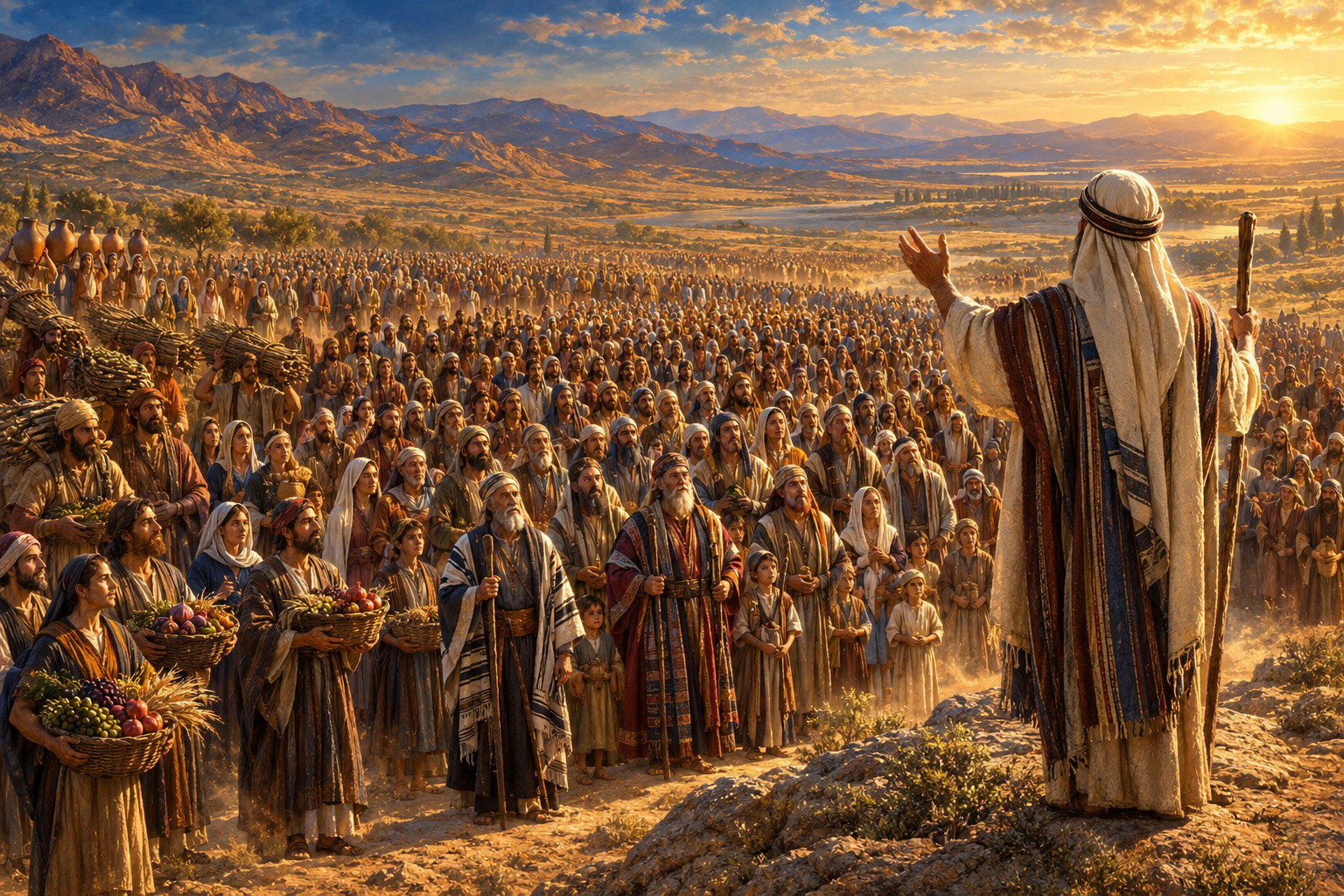
Rashi ties Nitzavim directly to Ki Tavo: having heard one hundred curses less two, Israel turned pale and said, who can stand before these? Moshe begins to comfort them — "you are standing today": lift up your heads, you stand before the Lord your God.
Bechukotai: 49 rebukes, in the plural, with consolation at the end. Ki Tavo: 98, in the singular, ending at the very bottom — "and you will offer yourselves for sale as slaves, and there will be no buyer." Not one word of comfort.
The Zohar HaKadosh answers: you are reading it wrong. "Yaalem" — not "He will make you vanish" but "He will lift you up." And "until you are destroyed": up to that point, without reaching it. Even the lowest verse is a blessing: it is the gentile himself who reveals, by refusing to buy, that this Jew is a son of the King.
The proof in numbers: in the section of the curses the Name appears 26 times — 26 × 26 = 676, the gematria of ra'ot, evils. And the section contains exactly 676 words. The sweetening is already inside.
It is Elul, a Monday, as we approach Nitzavim-Vayelech. We have completed Ki Tavo, and we can already move on to Nitzavim — because the two parashot are joined.
Rashi asks: why was the parasha Atem Nitzavim placed right after the curses? And he answers: because Israel had heard one hundred curses less two — ninety-eight — besides the forty-nine in Torat Kohanim, in parashat Bechukotai.
So Moshe begins to comfort them: lift up your heads. "You are standing today" — whatever you have just heard, stand upright, because before whom are you standing? Before the Lord your God. Do not be afraid.
Let us go deeper. Bechukotai has 49 rebukes; here, double: 98. Another difference: in Bechukotai everything is said in the plural; in Ki Tavo everything is in the singular — "cursed shall you be in your coming in, cursed shall you be in your going out," "the Lord will send against you."
But there is a greater difference still. In Bechukotai the closing verses bring consolation — the very ones we say every morning in the Korbanot:
In Ki Tavo, by contrast, despite the 98 curses, the final verse holds no comfort at all. It is the bottom of the bottom:
The Zohar HaKadosh answers: you do not know how to read. You are not reading these verses correctly at all.
In other words: inside every curse the blessing itself is contained.
Take the worst curse, the last one, and read it as it must be read. The Jew is brought and set on the platform: "what will you give for him?" — "not one shekel."
What do we say on Rosh Hashana after each round of shofar blasts? "If as sons, if as servants. If as sons — have mercy on us as a father has mercy on his sons; if as servants — our eyes are turned to You." But first of all, what are we? Sons.
What we took for curses are in truth blessings. Look at the root of the word kelala, curse: kuf-lamed-lamed. Yet we know the expression nechoshet kalal — and it does not mean "cursed bronze": it means burnished, excellent bronze.
The burden of proof is on me. So see how our Torah is sweeter than honey, and how exact every detail in it is.
Count, from the beginning of the curses to their end, how many times the Name of mercy appears. Twenty-six times. Even when there is a curse, who is doing it to you? "The Lord will send against you…" — that is the Name of mercy. All the blows come with mercy.
And we, today, how do we sweeten the judgments?
The psalm of Elul. We say "LeDavid, the Lord is my light and my salvation" twice a day through the Days of Awe. How many times does the Name appear in it? Thirteen — corresponding to the thirteen attributes of mercy — and twice a day makes twenty-six. The sefarim write that one who says this psalm twice daily will meet no evil: those 676 stand against the evils that could occur that day.
On Yom Kippur. How many times do we say the Thirteen Attributes of mercy, "and the Lord passed before him and proclaimed"? Twenty-six times across the whole day, through Ne'ila.
There is another answer to "where is the consolation?" Moshe's address is one continuous speech, spoken on a single day. The continuation of Ki Tavo is precisely "you are standing today" — and the whole of parashat Nitzavim is the consolation.
"Which I have set before you" — set where? In Ki Tavo. And now, says Moshe, let me comfort you. The consolation is there after all: Moshe simply separated it out and placed it in Nitzavim.
One question remains: why return to the curses, when they had already been said in Bechukotai?
We learned that Sefer Vayikra closes with "these are the commandments and statutes which the Lord commanded Moshe at Mount Sinai": had it not been for the sin of the spies, Israel would have entered the Land right then. The 49 rebukes of Bechukotai were the preparation before entering. But there was a mishap: Sefer Bamidbar begins, the sin of the spies, and thirty-eight years in the wilderness.
And even if everything foretold comes to pass — and one can say it has, for the descriptions there call the Shoah to mind — that means we have already passed through them. What remains is "and He will bring back your captivity and have compassion on you": to greet Mashiach and see the Beit HaMikdash rebuilt, speedily in our days. Amen.
🎯 Test yourself
Five questions. Click an answer.
Result
Shalom Bayit — The Mouth at Home
My covenant of peace — peace begins at home. Reveal a Shalom Bayit card.
Gematria — Rav Ménaché
Shalom, Mashiah, Yisamech — secrets of the letters by Rav Ménaché zatsal.
🔢 Gematria CourseAll Parashot
All shiurim of M. Yéhouda Himi — from Bereshit to Devarim and the festivals.
📚 All ParashotBooks
Torah wisdom in thriller format — Éditions Gueoula.
Guardians of the Rift
Forty-nine gates open — the fiftieth hides in a single moment. An ancient secret resurfaces, and one man stands between the rift and the world. Drawn from Talmud and Kabbalah.
📖 Read the free excerpt · Book $9.90