🕯️ Elul 5786 · Entering the parashot Nitzavim-Vayelech "Let the year and its curses end, let the year and its blessings begin"
Nitzavim-Vayelech — Moshe's last day: twelve Torah scrolls and a heart to know
Parashat Nitzavim-Vayelech · Elul 5786 · Shiur 2
"This Day You Have Become a People"
Moshe's last day · The protest for the Torah · Twelve Torah scrolls in a single day
A shiur by M. Yehuda Himi
🕯️ For the elevation of the soul of Rav Ron Chaya זצ״לThis study is also dedicated to the memory of Rav Ron Chaya זצ״ל, who devoted his life to spreading Torah, awakening teshuva and strengthening a true shalom — a shalom of truth, of kedusha and of responsibility.May the merit of the righteous protect us and all Israel. May his soul be bound in the bond of life. Amen.
🎙️
🎙 Listen to the shiur · M. Yehuda Himi
Nitzavim-Vayelech — Shiur 2 · "This day you have become a people"
⬇ Download the recording
"This Day You Have Become a People"
M. Yehuda Himi · Parashat Nitzavim-Vayelech · Elul 5786 · Shiur 2

The Zohar reads "you are standing today" as Rosh Hashana. Chronologically, though, the parasha was spoken on the last day of Moshe's life. If Ezra HaSofer placed it before Rosh Hashana, it is because it deals with teshuva — and because it acts as a screen between the curses of Ki Tavo and the year to come.

On that same day Moshe says something astonishing: "the Lord has not given you a heart to know, eyes to see and ears to hear, until this day." For forty years he had not seen it? What happened on that day?

The answer lies in a verse in Vayelech that seems badly built — the Torah given to the Kohanim, and then to the elders of Israel. Rashi supplies it: when Moshe entrusted the Torah scroll to the sons of Levi, all Israel came to protest: we too stood at Sinai, it is ours as well. And Moshe rejoiced: today I understand that you cling to the Holy One, blessed be He.

He then wrote twelve Torah scrolls, one for each tribe — all within the same day, the day he entered every tent to take his leave. The shiur closes on a difficulty from the Zohar: Moshe departs at the hour of mincha, on Shabbat. How could he have written that day?

📖 Read the full shiur
1 "You are standing today"

We are entering the parashot Nitzavim-Vayelech, which we will read on Shabbat. The opening is familiar: "you are standing today," and the Zohar teaches: "this day is Rosh Hashana."

But chronologically, when was this parasha spoken? Certainly not on Rosh Hashana. It was spoken on the last day of Moshe's life. So what does the Zohar mean?
2 Why Nitzavim always falls before Rosh Hashana

When Ezra HaSofer fixed the order of the yearly readings, it always came out that Nitzavim falls before Rosh Hashana — sometimes with Vayelech, sometimes alone, but always before. So the Zohar tells us: know that as you read this passage you are meant to feel "you are standing today" — today, on the eve of Rosh Hashana.

Why this order? First for the content: the parasha deals with teshuva — "and you shall return to your heart," "and the Lord your God will bring back your captivity."

And above all, to make a separation between the curses read in Ki Tavo and Rosh Hashana. As we say: "let the year and its curses end, let the year and its blessings begin." This parasha is set there as a screen, to divide the curses from the blessings we are to receive.

Exactly the same happens with Bechukotai: Bamidbar is always read right after it, to separate the curses from the festival of Shavuot.

3 Moshe's last day — the seventh of Adar

When, then, was the parasha spoken? On Moshe's last day, the seventh of Adar. How do we prove it? From the next parasha:

And Moshe went and spoke these words to all Israel… I am one hundred and twenty years old today Devarim 31, 1-2

Since Moshe passed away at one hundred and twenty and here he says "today," we apply a gezera shava: the "today" of "you are standing today" is that same last day.

4 Part of Ki Tavo was said that day too

It is not only Nitzavim and Vayelech — Haazinu and Vezot HaBeracha as well, obviously. But here is the novelty: part of Ki Tavo was also spoken on that last day. Look at the closing verses of Ki Tavo, after the rebukes end:

These are the words of the covenant… And Moshe called all Israel and said to them… But the Lord has not given you a heart to know, eyes to see and ears to hear, until this day Devarim 28, 69 – 29, 3
⭐ Hold on to this rule: wherever the word "hayom," today, appears from this point to the end of the Chumash, it refers to Moshe's last day.
5 The question — and the forty years before?
Moshe says to Israel, after forty years with them in the wilderness: "the Lord has not given you a heart to know… until this day." Meaning: for forty years you were closed, and only today do I understand that the Holy One, blessed be He, has given you a heart to know? For forty years Moshe had not seen it?

The Torah is inviting us to investigate: what event led Moshe, on the last day of his life, just before parting from them, to say this verse? It was an ordinary last day — and suddenly he tells them: I have understood that you are a wise people. What happened that day?

6 The strange verse in Vayelech

To understand, let us go to Vayelech. Moshe calls Yehoshua, tells him "be strong and courageous," and then it is written:

And Moshe wrote this Torah and gave it to the Kohanim, the sons of Levi, who carry the ark of the covenant of the Lord, and to all the elders of Israel Devarim 31, 9
What is wrong with this verse? If you first tell me he gave it to the Kohanim, sons of Levi, why do you then add "and to all the elders of Israel"? Decide: to whom did he give it? If to everyone, say so in one clause. That "and to all the elders of Israel" arrives at the end of the verse as though out of place. Something happened in between.
7 Rashi — the protest

Let us return to Rashi, in Ki Tavo, on "until this day." Rashi writes: I have heard that on the day Moshe gave the Torah scroll to the sons of Levi — precisely what we just read in Vayelech — he entrusted it to the important ones, those who keep the sacred watch.

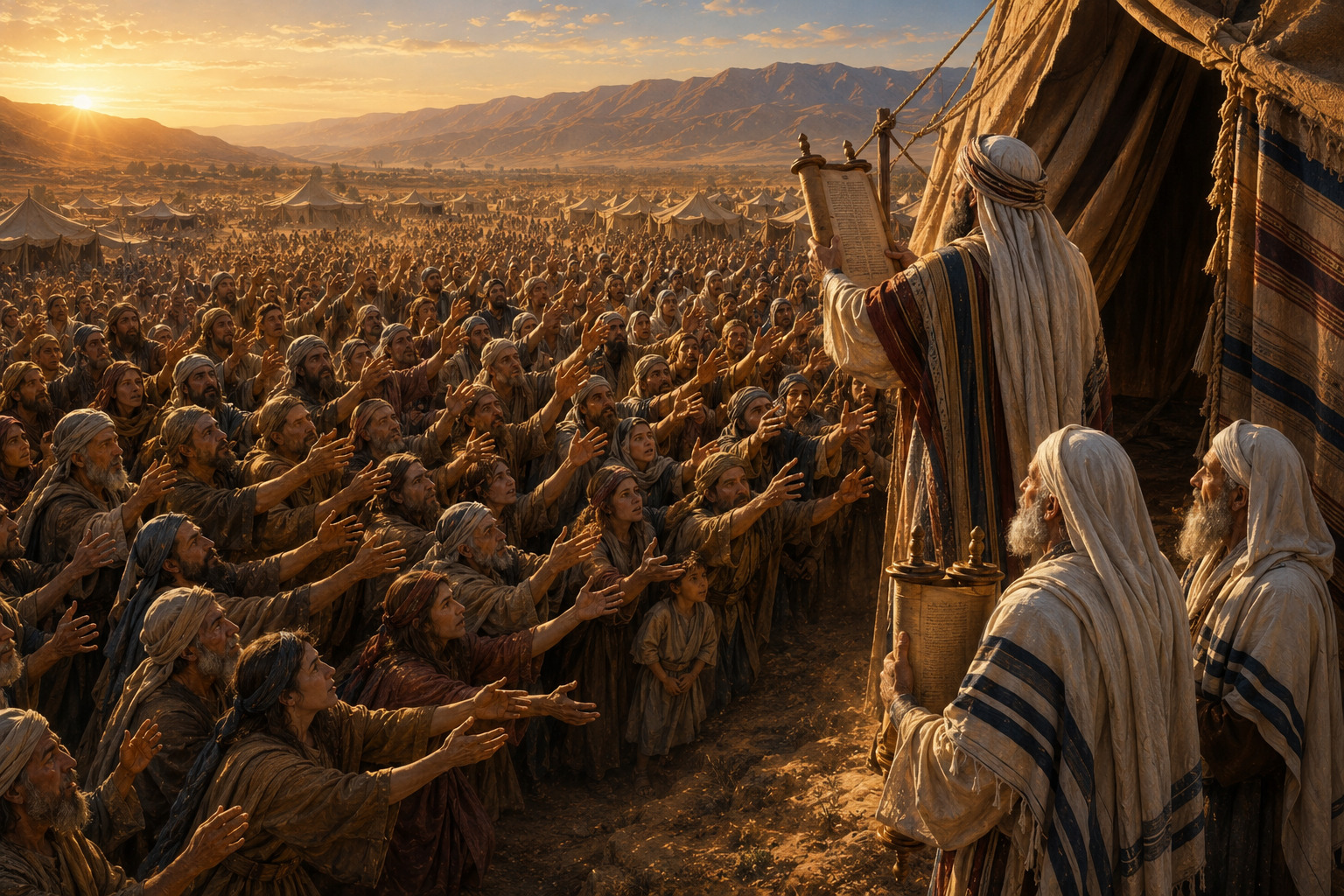
Then all Israel came before Moshe. A protest, placards and all: "Moshe, we too stood at Sinai and received the Torah — give it to us as well! Why do you set your own tribe over it?" We are simple people — Reuven, Shimon, Yehuda, Gad — but we stood at Mount Sinai in the same row as they did. "Tomorrow, when we come and ask the sons of Levi to teach us, they will say: it was not given to you, it was given to us."
8 And Moshe rejoiced

Here is a protest against a man — and the man rejoices at it. Instead of being disappointed that his decision is contested, Rashi reports: and Moshe rejoiced at the matter, and said to them:

This day you have become a people to the Lord your God Devarim 27, 9
⭐ Today, says Moshe, I have understood that you cling to and desire the Makom. That is the event of that day. Until now I was not sure you would fight for the Torah — you seemed passive: fine, he is giving a shiur, let us hear, we will take what we take. Today, when you protest like this, I understand that the Lord has given you a heart to know, eyes to see and ears to hear.
9 "A heart to know" — feeling and intellect

What we learn here: cleaving to the Lord, cleaving to the Torah, the desire to know Torah — that is what makes you the people of the Lord.

And look at the phrase chosen. With Moshe every word is weighed: lev, the heart, is feeling; da'at, knowledge, is intellect. They are not the same. The wisdom of the Torah is to join the heart to the intellect: to feel what you know.

Not merely to be learned: I know verses, I know Gemara, very good. But what of it do you bring into your life? Does it become a Torat Chaim, a part of you — or does it stay academic, knowledge for its own sake? This Torah you know, bring it into the heart. That is what today's language calls emotional intelligence: to feel the wisdom.
10 Twelve Torah scrolls, one per tribe

Moshe rejoiced in that joy, and the Midrash tells what he did at that moment: he stood up and wrote them twelve Torah scrolls, one for each tribe.

And that is why the verse is built as it is: he had one scroll, which he gave to the Kohanim, the sons of Levi. Then came the protest. He understood that all of them wanted it, stood up and wrote twelve scrolls — "and to all the elders of Israel": each tribe received a scroll of its own.

11 The schedule of that last day
An excellent question: how did he have the time? All of this in a single day?

Let us see what Moshe did that day. He rises early, and at once: "and Moshe went and spoke these words to all Israel." How does one speak to all Israel? The Midrash explains that he entered every single tent, personally, looked inside and said: good morning, today I part from you. Then the next tent. And so on, to each one.

⭐ And here is what "a heart to know" means in practice. If we take this Midrash as it stands, every one of us — through the root of his soul, which reaches back to the generation of the wilderness — saw Moshe with his own eyes, and Moshe looked at him personally before he left. That is why we love him so without knowing why. I know the fact: what does it do in my heart?
12 Who wrote the closing verses?

He then finishes writing the Torah scroll. But who wrote the closing verses of the Chumash? The Gemara records a dispute.

One view: Moshe cannot have written them, since it says there "and Moshe died there" — if he is dead, how could he write that he is dead? So Yehoshua wrote them.

The accepted view is the other: the Holy One, blessed be He, dictated and Moshe wrote — writing in tears. Reaching the final verse, he was told: write "and there arose no prophet in Israel like Moshe." In his humility he refused to write such a thing about himself; he was answered: write it, I testify to it. A third view compromises: Moshe traced the letters without ink, and Yehoshua later filled them in.
13 How to write twelve scrolls in one day

He finishes writing, hands the scroll to the sons of Levi, the protest takes place — all in the same day. So how does he write twelve Torah scrolls?

There is what is called an et mahir, a "swift pen": there are holy Names whose use makes the pen write of itself. Moshe knew how to do this — and he stood up and wrote them the twelve scrolls.

And still the same day: the end of Ki Tavo, Nitzavim, Vayelech, Haazinu and Vezot HaBeracha, the blessing he gave to all Israel. Then he parted from them: "and Moshe went up from the plains of Moav to Mount Nevo, to the top of the ridge."

14 The strongest question: it was Shabbat

Now the question that must be asked. You know the passage of the Zohar said before the third meal of Shabbat, on the ra'ava de'ra'avin. All week the hour of mincha is an hour of judgment; but at mincha on Shabbat it is the opposite — an hour of mercy, the hour when all wills are received.

And why? The Zohar explains: because that is the hour at which Moshe departed — and it was not possible for Moshe to leave the world while judgment reigned in it. But if so, his last day was a Shabbat. How then did he do everything we have just described — writing twelve Torah scrolls, on Shabbat?
15 The answer — two days, and the parting

The answer given, and with it I close: Moshe's departure must be divided in two. On Friday he did everything described. Then, as Shabbat drew near: "and Moshe went up from the plains of Moav to Mount Nevo." That is the last image Israel keeps of him — at dusk, Moshe climbing toward the mountain, taking his leave.

Up there he does not die at once. The Midrash Petirat Moshe tells the whole struggle: his soul refuses to leave that body, it argues with the angel of death — go away, I am not dying today, I will not leave this body, I am bound to it.

⭐ Until the Holy One, blessed be He, says to him: listen well. I had issued two decrees. I decreed that Israel would not enter the Land because of the sin of the spies — and you came and prayed and asked Me to annul that decree, and it was annulled. This is decree against decree: which do you prefer? Moshe answered: let not one hair fall from the heads of the children of Israel — and I am ready to depart.

Then: "and Moshe, servant of the Lord, died there… by the mouth of the Lord" — by the divine kiss, as with Aharon HaKohen. This happens at the hour of mincha, on Shabbat, and Israel no longer sees him. Rabbi Shimon bar Yochai tells us what took place up there through that whole Shabbat, until the hour of mincha, when he departed. Blessed is the Lord forever, amen and amen.

🎯 Test yourself

Five questions. Click an answer.

1
Why is Nitzavim always read before Rosh Hashana?
The same principle as Bamidbar, read after Bechukotai to separate the curses from Shavuot.
2
How do we know Nitzavim was spoken on the last day of Moshe's life?
From then on, every "hayom" up to the end of the Chumash refers to that last day.
3
What event made Moshe say "today the Lord has given you a heart to know"?
Rashi on "ad hayom hazeh." Moshe rejoiced at the protest: it proved their attachment to the Torah.
4
What does the phrase "lev lada'at," a heart to know, mean?
"Lev" is feeling, "da'at" is intellect. The wisdom of the Torah is to bind them together.
5
According to the Zohar of the ra'ava de'ra'avin, when did Moshe depart?
Hence the difficulty: the twelve Torah scrolls must have been written the day before, on Friday, before the ascent of Mount Nevo.

Result

📅 Seven-day program — Nitzavim-Vayelech · Elul
Sunday
Read Devarim 29, 1-3 and find the word "hayom." Note where it returns up to the end of the Chumash.
Monday
Study Devarim 31, 9 and ask why "and to all the elders of Israel" comes at the end of the verse.
Tuesday
Read Rashi on "ad hayom hazeh" — Israel's protest and Moshe's joy.
Wednesday
Take one thing you know from the Torah and bring it down into the heart today, not only the head.
Thursday
Ask to learn something new — like one who fights to receive his portion of Torah.
Friday
Prepare the third meal: read the passage of the ra'ava de'ra'avin before Shabbat.
Shabbat
At the hour of mincha, one minute of silence to ask: this is the hour when all wills are received.
Four Practical Steps
🏠

Shalom Bayit — The Mouth at Home

My covenant of peace — peace begins at home. Reveal a Shalom Bayit card.

🔢

Gematria — Rav Ménaché

Shalom, Mashiah, Yisamech — secrets of the letters by Rav Ménaché zatsal.

🔢 Gematria Course
📝

Torah Study

Dig deeper into the Baal HaTurim and Rashi on Parashat Nitzavim.

📝 Beith Hamidrach
📚

All Parashot

All shiurim of M. Yéhouda Himi — from Bereshit to Devarim and the festivals.

📚 All Parashot
📕

Books

Torah wisdom in thriller format — Éditions Gueoula.
🌙

Dream Interpretation

Did you dream? Check the meaning according to Rav Almoli.

🌙 Dreams
🎬

Videos

Video shiurim on the festivals, the Menorah and the secrets of the Mishkan.

🎬 Videos
💡

Idea Box

An idea, a remark, a suggestion for the site? Share it with us.

💡 Idea Box
🤝

Maasser

Give your Maasser and take part in spreading Torah.

🤝 Maasser
📨 Get the Weekly Shiur
Every week, straight to your inbox. No spam. One-click unsubscribe.
🕯️ Dedicate This Shiur
Dedicate this shiur for the days of Bein HaMetzarim — in memory, for healing or for success.
🧱 Wall of Dedications →
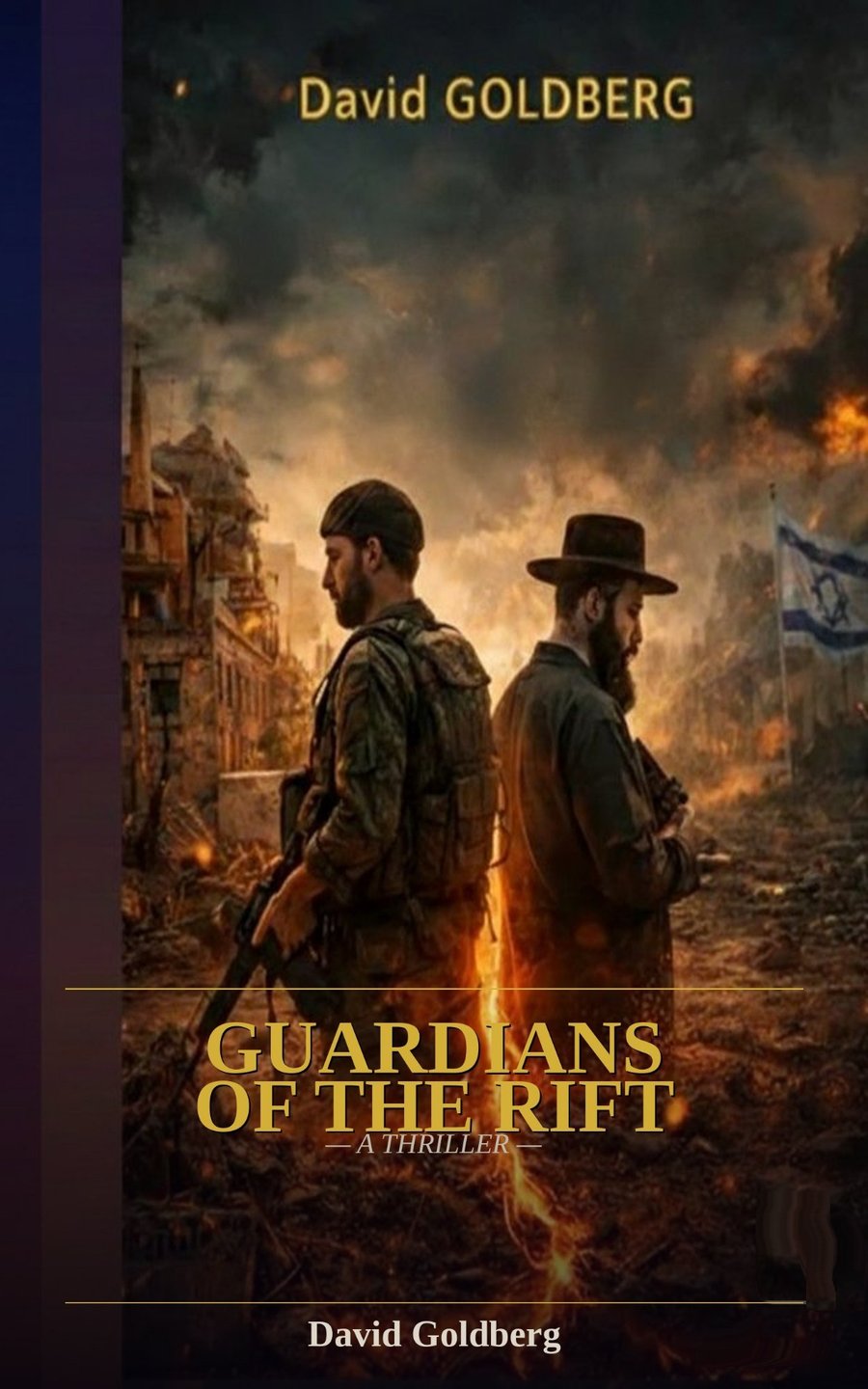
Guardians of the Rift

Guardians of the Rift

A spiritual thriller · David Goldberg

Forty-nine gates open — the fiftieth hides in a single moment. An ancient secret resurfaces, and one man stands between the rift and the world. Drawn from Talmud and Kabbalah.

📖 Read the free excerpt · Book $9.90