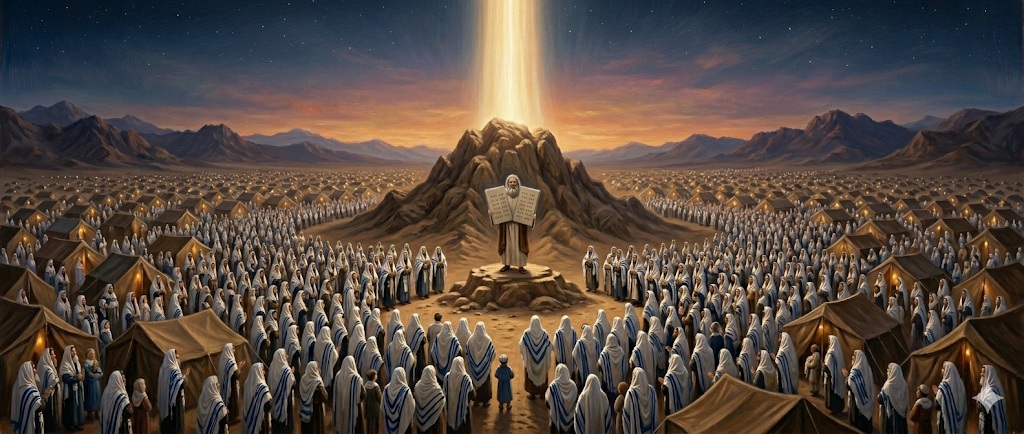
Shavuot 5786 — The Power to Be Nothing
Shavuot 5786 — The Power to Be Nothing · Holidays · 5786
A shiur by M. Yéhouda Himi · Chag HaShavuot 5786 · Third shiur
Shavuot 5786 — The Power to Be Nothing
M. Yéhouda Himi
🎙️
🎙 Full recorded shiur · M. Yéhouda Himi
A shiur by M. Yéhouda Himi · Chag HaShavuot 5786 · Third shiur
⬇ Download the recording
A shiur by M. Yéhouda Himi · Chag HaShavuot 5786 · Third shiur
M. Yéhouda Himi · Shavuot 5786 — The Power to Be Nothing · Holidays · 5785

King David repeats the same verse at the start and end of Psalm 8, but the second time drops "who has set Your glory upon the heavens" — the angels ultimately conceding that the Torah must descend to earth.

Chokhmah (wisdom) = Koach + Mah: the true sage is one who has the power to consider himself nothing, making him a greater vessel for receiving wisdom.

Lakhem ("Atzeret tihye lakhem") = 90 in gematria = Mah (45) + Mah (45): the two dimensions of humility — man's and God's revealed greatness — meet at Shavuot.

Mount Sinai was chosen not because it had nothing to offer, but because it knew (from the promise at the burning bush) that the Torah would be given upon it — and chose silence anyway: true humility.

Binyamin's Yashfeh stone (Yesh + Peh, "there was a mouth") illustrates the same secret: having something to say, and staying silent — and in merit, receiving the highest honor.

📖 Full Text
1 Opening — Tehillim, Psalm 8

On the eve of the festival, with God's help, let us continue with matters of Shavuot. Tomorrow we have this wonderful festival — the festival of the giving of the Torah. What I want is for us to study together a very interesting question from Psalm 8 in Tehillim, and connect it to Shavuot and the giving of the Torah.

"For the conductor, upon the Gittit, a psalm of David. Hashem our Master — how mighty is Your Name in all the earth — who has set Your glory upon the heavens."Tehillim 8:1-2

And the psalm closes thus: "Hashem our Master — how mighty is Your Name in all the earth." Period.

Two phenomena King David uses the same expression twice: once at the beginning, once at the end. And there is a difference. The first time he continues: "Who has set Your glory upon the heavens." At the end — silence. Why? And why does he repeat the same expression twice?
2 Part I — The Angels' Protest
Midrash — Rabbi Yehoshua ben Levi said: When Moshe ascended on high, the ministering angels said before the Holy One: "Master of the universe, what is one born of woman doing among us?" He answered: "He has come to receive the Torah." They said: "A precious treasure hidden 974 generations before the world was created — and You wish to give it to flesh and blood? What is man that You should remember him... who has set Your glory upon the heavens."

Hear what is happening here. When King David writes this psalm, he is — through divine inspiration — imagining the very debate between the angels and the Holy One when Moshe ascended to receive the Torah. The angels tell God: "The Torah must be in the heavens — let it stay there."

God says to Moshe: "Answer them back." Moshe: "Master of the universe, I am afraid they will burn me with the breath of their mouths." He said: "Do not worry — grasp the throne of My glory and answer them back."

3 Part II — Moshe's Answer
"The Torah You are giving me — what is written in it? I am Hashem your God, who brought you out of the land of Egypt." And then Moshe turned to the angels: "Did you go down to Egypt? It is written: do not murder — do you murder? do not commit adultery — do you have evil inclinations? do not steal — is there envy among you?"

Immediately they conceded to God. As it is said: "Hashem our Master, how mighty is Your Name in all the earth" — and "who has set Your glory upon the heavens" is not written. The bottom line: they agreed that the Torah must be given on the earth.

But wait What should Moshe have answered? He should have convinced them why the Torah must be on the earth. Instead, he said "why should it stay with you?" — that was not the question! How does that answer address their claim? The key word — Mah.
4 Part III — The Secret of the Word "Mah"

There is a principle: God gives wisdom to the wise. But if they are already wise, what does God have left to give them? There is something illogical here. The secret: we must know what wisdom truly is.

Chokhmah = Koach + Mah A simple letter rearrangement. The sage is the one who has the power to be Mah. And "mah" means nothing: "And we, what are we, that you complain against us?" (Shemot 16:7). A person who has the power to consider himself nothing — he is the true sage, because he is more open to learning.
"And wisdom — from where (me'ayin) is it found?"Iyov 28:12

If you make yourself ayin (nothing), you find wisdom. And therefore: "Whoever is arrogant — his wisdom departs from him."

5 Part IV — The Two Dimensions of "Mah"

Why is a person called Adam? King David says: "What is man (mah enosh) that You remember him?" — man is nothing. And immediately after: "Yet You have made him slightly less than God, and crowned him with glory and honor." — one level below the Holy One.

Adam, two meanings Adam = dust of the earth — nothing. Adam = adameh le'Elyon ("I shall resemble the Most High") — image of God. The more a person diminishes himself, the more God is revealed through him.

Two "mahs": the lower mah ("what is man") and the upper mah ("how mighty is Your Name"). Two dimensions that cannot exist one without the other.

6 Part V — "Grasp the Throne of My Glory"

What is the glory of the Holy One? Is He glorified by angels doing His bidding? That is no great feat — they have no evil inclinations. What is interesting is giving the Torah to human beings with weaknesses who nevertheless overcome. That internal battle — that is the true glory of the Holy One.

God tells the angels: "Look — human beings, dust of the earth, striving, reaching achievements. That is My glory. And you, by contrast, have no evil inclination at all. Not interesting."

And here the angels heard and conceded: "Hashem our Master, how mighty is Your Name in all the earth" — specifically in the earth, not in the heavens.

7 Part VI — "Atzeret Tihye Lakhem"

What is Shavuot called in the Torah? "Atzeret tihye lakhem." Why does the Torah add "it shall be for you"?

Lakhem = 90 = Mah + Mah Lakhem = ל(30)+כ(20)+ם(40) = 90. And Mah = 45 (מ=40, ה=5). 90 = 45+45. "What is man" (our Mah) added to "how mighty is Your Name" (God's Mah) — together: Lakhem. This is Shavuot: the place where the two dimensions meet.
8 Part VII — Why Mount Sinai?

God wanted to give the Torah. All the mountains competed: Mount Carmel (green and flowering), Mount Tabor (the highest), Mount Hermon (white, fitting for a wedding). And the Midrash says: Mount Sinai was silent. God said: "You who were silent — upon you I shall give the Torah."

What did it have to offer? It is in the desert, low, barren. It has nothing! Of course it was silent... But wait a moment.
The first time God appeared to Moshe was at the burning bush, on Mount Chorev. God said: "When you bring this people out of Egypt, you shall serve God on this mountain." Mount Sinai knew! It could have shouted: "The Torah is mine!" — and yet it kept silent.
Pirkei Avot "Moshe received Torah from Sinai" — not "at" Sinai. He received it from the conduct of the mountain, from the humility of Sinai. Moshe said: "If a mountain behaves this way, who am I not to behave this way?"
9 Part VIII — Binyamin's Yashfeh Stone

On the breastplate, which stone belonged to Binyamin? Yashfeh. Why specifically Yashfeh?

Yashfeh = Yesh + Peh "He had a mouth to speak — and he kept silent." When Yosef placed the goblet in Binyamin's sack, the brothers accused him of theft. Binyamin knew the truth, had a mouth to speak, and kept silent. God said: "Since you kept silent — in your portion the Temple shall be built."

Exactly the same secret with Mount Sinai. It had a mouth to speak, and it kept silent. God gave the Torah upon it.

10 Conclusion — The Humble Shall Inherit the Land

Humility is the vessel that brings the Torah down into the world: King David — two "mahs" in Psalm 8; Chokhmah = Koach-Mah; Atzeret tihye Lakhem = 90; Mount Sinai had a mouth and kept silent; Binyamin had a mouth and kept silent; Moshe received his entire Torah from the humility of Sinai.

"And the humble shall inherit the land" (Tehillim 37:11). May we merit to take from this Torah the humility through which we shall inherit the Land and hasten the redemption. With Mashiach Tzidkenu speedily in our days, Amen.

🎯 Test yourself

Five questions. Click an answer.

1
How many times does the verse "Hashem our Master, how mighty is Your Name in all the earth" appear in Psalm 8?
Twice. The first time, King David continues "who has set Your glory upon the heavens" (the angels' claim). The second time he is silent. This difference is the entire secret of the psalm.
2
How does the word "Chokhmah" break down according to the shiur?
Chokhmah = Koach + Mah. The true sage is the one who has the power to be Mah — to be nothing. "And wisdom — from where is it found?"
3
What is the gematria of "Lakhem," and why is it important for Shavuot?
Lakhem = 30+20+40 = 90. And Mah = 45. "Atzeret tihye lakhem" connects "what is man" (lower mah) and "how mighty is Your Name" (upper mah). 45+45=90.
4
Why was Mount Sinai silent in the audition of the mountains, according to the shiur?
At the burning bush, God promised Moshe "you shall serve God on this mountain" — a hint to the giving of the Torah. Sinai heard the promise, had reason to shout, and still kept silent. This is true humility.
5
What is the secret of Binyamin's Yashfeh stone, and how does it relate to Sinai?
Yashfeh = Yesh Peh (there was a mouth). Binyamin knew the truth about the goblet and kept silent; in merit, the Temple was built in his portion — the same secret as Mount Sinai.

Result

📅 7-Day Programme — The Power to Be Nothing
Sunday
Day 1 — Reread Psalm 8 in full; note the two occurrences of the verse and the difference between them.
Monday
Day 2 — Meditate on Chokhmah = Koach + Mah: note an area where you think yourself already wise, and practice saying "I don't know."
Tuesday
Day 3 — Calculate Lakhem = 90 = Mah + Mah in your mind; reflect on your own smallness (mah enosh) as a gateway to God's greatness.
Wednesday
Day 4 — Choose a moment today when you could snap back, and like Mount Sinai, choose silence instead.
Thursday
Day 5 — Study the story of Binyamin and the goblet; identify an occasion where staying silent would be better than justifying yourself.
Friday
Day 6 — Prepare for Shavuot by rereading Pirkei Avot 1:1 ("Moshe received Torah from Sinai") and meditate on humility as the vessel of receiving.
Shabbat
Day 7 — Shavuot day: read the Ten Commandments and the Book of Ruth, keeping in mind the lesson of humility that brings the Torah down.
Four Practical Steps
🏠

Shalom Bayit — The Mouth at Home

My covenant of peace — peace begins at home. Reveal a Shalom Bayit card.

🔢

Gematria — Rav Ménaché

Shalom, Mashiah, Yisamech — secrets of the letters by Rav Ménaché zatsal.

🔢 Gematria Course
📝

Torah Study

Dig deeper into the Baal HaTurim and Rashi on Parashat Devarim.

📝 Beith Hamidrach
📚

All Parashot

All shiurim of M. Yéhouda Himi — from Bereshit to Devarim and the festivals.

📚 All Parashot
📕

Books

Torah wisdom in thriller format — Éditions Gueoula.
🌙

Dream Interpretation

Did you dream? Check the meaning according to Rav Almoli.

🌙 Dreams
🎬

Videos

Video shiurim on the festivals, the Menorah and the secrets of the Mishkan.

🎬 Videos
💡

Idea Box

An idea, a remark, a suggestion for the site? Share it with us.

💡 Idea Box
🤝

Maasser

Give your Maasser and take part in spreading Torah.

🤝 Maasser
📨 Get the Weekly Shiur
Every week, straight to your inbox. No spam. One-click unsubscribe.
🕯️ Dedicate This Shiur
Dedicate this shiur for the days of Bein HaMetzarim — in memory, for healing or for success.
🧱 Wall of Dedications →
Guardians of the Rift

Guardians of the Rift

A spiritual thriller · David Goldberg

Forty-nine gates open — the fiftieth hides in a single moment. An ancient secret resurfaces, and one man stands between the rift and the world. Drawn from Talmud and Kabbalah.

📖 Read the free excerpt · Book $9.90