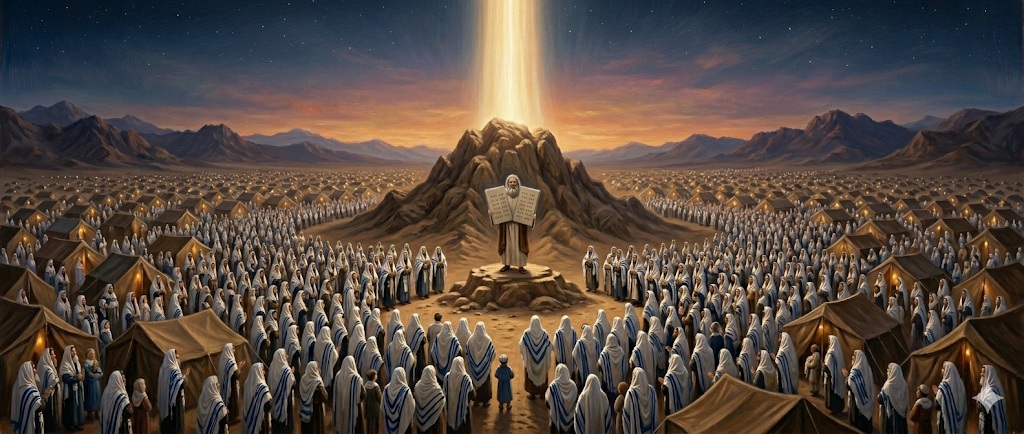
The Power to Be Nothing
Shiur de M. Yéhouda Himi · Chag HaShavuot 5786 · Shiur III
King David asks twice: "Hashem our Master, how mighty is Your Name in all the earth." The first time the angels protest. The second time they fall silent. What changed in between? A single Hebrew word — mah. And inside it, the entire reason God chose the lowest mountain.
שבועות — תקציר
שיר אחד. שתי שאלות. מילה אחת שמשנה הכל.
דוד המלך פותח את המזמור במשפט הזה, וסוגר אותו במשפט הזה. אבל בפעם הראשונה הוא ממשיך: ״אֲשֶׁר תְּנָה הוֹדְךָ עַל הַשָּׁמַיִם״ — תנה את התורה בשמיים. ובפעם השנייה — שתיקה. רק ״מָה אַדִּיר שִׁמְךָ בְּכָל הָאָרֶץ.״
מה קרה בין שתי האמירות? המדרש מספר: כשעלה משה למרום, מחו המלאכים: ״חמודה גנוזה תשעה מאות שבעים וארבעה דורות לפני בריאת העולם — ואתה נותן אותה לבשר ודם?״ משה ענה: ״תורה שאתה נותן לי, מה כתוב בה? לא תרצח, לא תנאף, לא תגנוב. וכי אתם בני אדם? יש בכם יצרים?״ — מיד הודו וחזרו ואמרו: ״ה׳ אֲדוֹנֵינוּ מָה אַדִּיר שִׁמְךָ בְּכָל הָאָרֶץ״ — אבל הפעם השמיטו את ההמשך. כבר לא ״אֲשֶׁר תְּנָה הוֹדְךָ עַל הַשָּׁמָיִם״. המלאכים בעצמם מסירים את הטענה שהתורה צריכה להישאר בשמיים. הם מודים: התורה יורדת אל הארץ.
סוד המילה ״מָה״
חָכְמָה = כֹּחַ + מָה. החכם האמיתי הוא מי שיש לו הכוח להיות מָה — להיות כלום. ״וְהַחָכְמָה מֵאַיִן תִּמָּצֵא״ — אם אתה שם את עצמך כְּ"אַיִן", אתה מוצא את החכמה.
סוד המספר 90
״עֲצֶרֶת תִּהְיֶה לָכֶם״ — לָכֶם = 90 = מָה + מָה (45+45). שתי הבחינות: ״מה אנוש כי תזכרנו״ (אדם נמוך) ו״מה אדיר שמך״ (ה׳ גבוה). שתי בחינות של ״מה״ — וזהו חג השבועות.
סוד הר סיני
כל ההרים התחרו: ״עליי תינתן התורה.״ הר סיני שתק. למה? כי הוא כבר ידע — בסנה, ה׳ הבטיח למשה ״בְּהוֹצִיאֲךָ אֶת הָעָם הַזֶּה מִמִּצְרַיִם תַּעַבְדוּן אֶת הָאֱלֹהִים עַל הָהָר הַזֶּה.״ ידע שהתורה תינתן עליו — ובכל זאת שתק.
Shavuot — Summary
One psalm. Two questions. One word that changes everything.
King David opens the psalm with this verse, and closes it with this verse. But the first time he continues: "Asher tena hodkha al hashamayim" — place Your Torah in the heavens. The second time — silence. Just "How mighty is Your Name in all the earth."
What happened between the two? The Midrash tells: when Moshe ascended on high, the angels protested: "A precious treasure hidden 974 generations before the world was created — and You give it to flesh and blood?" Moshe answered: "The Torah You are giving me — what is written in it? Do not murder, do not commit adultery, do not steal. Are you human? Do you have evil inclinations?" — Immediately they conceded and repeated: "Hashem our Master, how mighty is Your Name in all the earth" — but this time they dropped the continuation. No more "who has set Your glory upon the heavens." The angels themselves withdraw the claim that the Torah must stay above. They admit: the Torah descends upon the earth.
The secret of the word Mah (מָה)
Chokhmah (wisdom) = Koach + Mah — strength + "what?" The true sage is the one who has the power to be Mah — to be nothing. "And wisdom — from where (me'ayin) is it found?" If you make yourself nothing, you find wisdom.
The secret of the number 90
"Atzeret tihye lakhem" (Shavuot shall be for you) — Lakhem (לָכֶם) = 90 = Mah + Mah (45+45). Two dimensions: "What is man that You remember him" (lower mah) and "How mighty is Your Name" (upper mah). Two dimensions of mah — that is Shavuot.
The secret of Mount Sinai
All the mountains competed: "On me shall the Torah be given." Mount Sinai was silent. Why? Because it already knew — at the burning bush, God had promised Moshe: "When you bring this people out of Egypt, you shall serve God on this mountain." Sinai knew the Torah would be given upon it — and still it kept silent.
Chavouot — Résumé
Un psaume. Deux questions. Un mot qui change tout.
Le roi David ouvre le psaume par cette phrase, et le ferme par cette phrase. Mais la première fois il continue : « Asher tena hodkha al hashamayim » — place Ta Torah dans les cieux. La seconde fois — silence. Seulement « Que Ton Nom est puissant dans toute la terre. »
Que s'est-il passé entre les deux ? Le Midrash raconte : quand Moché monta dans les hauteurs, les anges protestèrent : « Un trésor précieux caché 974 générations avant la création du monde — et Tu le donnes à de la chair et du sang ? » Moché répondit : « La Torah que Tu me donnes — qu'est-ce qui y est écrit ? Tu ne tueras pas, tu ne commettras pas d'adultère, tu ne voleras pas. Êtes-vous humains ? Avez-vous des pulsions ? » — Immédiatement ils concédèrent et répétèrent : « Hashem notre Maître, que Ton Nom est puissant dans toute la terre » — mais cette fois ils ont laissé tomber la suite. Plus de « Toi qui as placé Ta gloire sur les cieux ». Les anges retirent eux-mêmes la prétention que la Torah doit rester en haut. Ils admettent : la Torah descend sur la terre.
Le secret du mot Mah (מָה)
'Hokhma (sagesse) = Koa'h + Mah — force + « quoi ? » Le vrai sage est celui qui a la force d'être Mah — d'être rien. « Et la sagesse — d'où (mé'ayin) la trouve-t-on ? » Si tu te fais rien, tu trouves la sagesse.
Le secret du nombre 90
« Atseret tihye lakhem » (Chavouot sera pour vous) — Lakhem (לָכֶם) = 90 = Mah + Mah (45+45). Deux dimensions : « Qu'est-ce que l'homme pour que Tu te souviennes de lui » (mah inférieur) et « Que Ton Nom est puissant » (mah supérieur). Deux dimensions de mah — voilà Chavouot.
Le secret du Mont Sinaï
Toutes les montagnes rivalisaient : « C'est sur moi que sera donnée la Torah. » Le Mont Sinaï se tut. Pourquoi ? Parce qu'il savait déjà — au buisson ardent, D. avait promis à Moché : « Quand tu feras sortir ce peuple d'Égypte, vous servirez D. sur cette montagne. » Sinaï savait que la Torah serait donnée sur lui — et pourtant il garda le silence.
פתיחה — מזמור ח׳ בתהילים
ערב חג, בעזרת השם נמשיך בענייני חג השבועות. מחר יש לנו את החג הנפלא הזה, חג מתן תורה. ומה שאני רוצה — שנלמד יחד שאלה מאוד מאוד מעניינת ממזמור ח׳ בתהילים, ונקשור את זה לחג השבועות ולמתן תורה.
וכך נגמר המזמור: ״ה׳ אֲדוֹנֵינוּ מָה אַדִּיר שִׁמְךָ בְּכָל הָאָרֶץ.״ נקודה.
חלק א — מחאת המלאכים
שמע מה קורה כאן. כשדוד המלך כותב את המזמור, הוא ברוח הקודש מדמיין את הוויכוח שהיה בין המלאכים לקב״ה כשמשה עלה לקבל את התורה. המלאכים מצטטים את הפסוק. הם אומרים לקב״ה: ״אתה הולך לתת את התורה לבן אדם, שאדם להבל דמה? בשמיים צריכה להיות התורה — שתישאר שם.״
הקב״ה אומר למשה: ״תחזיר להם תשובה.״ משה: ״ריבונו של עולם, מתיירא אני שמא ישרפוני בהבל פיהם.״ אמר לו: ״אל תדאג, אֱחוז בכיסא כבודי וחזור להם תשובה.״
חלק ב — תשובת משה
מיד הודו לו לקב״ה. שנאמר: ״ה׳ אֲדוֹנֵינוּ מָה אַדִּיר שִׁמְךָ בְּכָל הָאָרֶץ״ — ו״אשר תנה הודך על השמיים״ לא כתיב. השורה התחתונה: הם הסכימו שהתורה צריכה להינתן בארץ.
אבל רגע — צריך להבין. מה הם שאלו? ״תנה הודך על השמיים — שהתורה תישאר בשמיים.״ מה היה משה צריך לענות? לשכנע למה התורה צריכה להיות בארץ. במקום זה הוא אמר: ״בשביל מה שתישאר אצלכם, מה אתם צריכים אותה?״ זו לא הייתה השאלה! הם אמרו ״התורה צריכה להישאר בשמיים״ — בלי קשר מי צריך אותה. איך התשובה ״לא תרצח, לא תנאף״ עונה לטענה הזו?
מילת המפתח — מָה.
חלק ג — סוד המילה ״מָה״
יש כלל: ״יָהֵיב חוֹכְמְתָא לְחַכִּימִין״ — ה׳ נותן חכמה לחכמים. אבל רגע — אם הם כבר חכמים, מה יש לקב״ה לתת להם? יש כאן משהו לא־לוגי.
הסוד: צריך לדעת מה זה חכמה.
חילוף אותיות פשוט. החכם — הוא מי שיש לו הכוח להיות מָה. ומה זה ״מָה״? בעברית, ״מה״ זה כלום. ״וְנַחְנוּ מָה כִּי תַלִּינוּ עָלֵינוּ.״ מה זה כלום. דבר שאין בו ממשות.
אדם שיש לו הכוח להחשיב את עצמו כלום — הוא החכם האמיתי. כי כשאתה אומר ״אני שום דבר״, אתה פתוח יותר ללמוד. אם אני חכם גדול, אני אומר ״אני כבר יודע הכל״ — איזה מה ללמד אותי? אבל אם אני חכם מספיק להגיד שאני לא יודע כלום — אני כלי גדול יותר לקבל חכמה.
״יָהֵיב חוֹכְמְתָא לְחַכִּימִין״ — האנשים החכמים האמיתיים הם אלה שלומדים, לומדים, לומדים, ומגיעים למסקנה שהם עוד לא יודעים כלום. זה מעיין מתגבר. וכשהם אומרים ״אני לא יודע כלום״ — הם יכולים להתמלא עוד ועוד חכמה.
אם אתה שם את עצמך כְּעין, אתה מוצא את החכמה. ולכן: ״כל המתיהר — חכמתו מסתלקת.״ המתיהר חושב שהוא יודע הכל. אומר לו הקב״ה: ״אם אתה כזה גאון, תסתדר לבד.״ חכמתו מסתלקת.
חלק ד — שתי הבחינות של ״מה״
למה האדם נקרא אדם? המזמור מגלה לנו. דוד המלך אומר: ״מָה אֱנוֹשׁ כִּי תִזְכְּרֶנּוּ וּבֶן אָדָם כִּי תִפְקְדֶנּוּ?״ — אדם הוא כלום. ומיד אחר כך: ״וַתְּחַסְּרֵהוּ מְעַט מֵאֱלֹהִים, וְכָבוֹד וְהָדָר תְּעַטְּרֵהוּ.״ — דרגה אחת פחות מהקב״ה.
🔹 אדם = עפר מן האדמה — כלום
🔹 אדם = אֲדַמֶּה לְעֶלְיוֹן — צלם אלוקים
אם אדם רוצה להגיע למעלות גבוהות, הוא צריך לעשות מעצמו כלום. ככל שיקטין את עצמו, כך יתגלה הקב״ה דרכו.
עכשיו חזור למזמור. יש לנו שני ״מה״:
🔹 ״מָה אֱנוֹשׁ כִּי תִזְכְּרֶנּוּ״ — מה תחתון, האדם המקטין את עצמו
🔹 ״מָה אַדִּיר שִׁמְךָ״ — מה עליון, גדולת ה׳
ככל שהאדם יקטין את עצמו ב״מה אנוש״, כך יבין יותר את ״מה אדיר שמך״. שתי בחינות שאי אפשר זו בלי זו.
חלק ה — סוד ״אֱחוז בכיסא כבודי״
עכשיו נחזור לקב״ה ומשה. ״אֱחוז בכיסא כבודי ותענה להם.״ מה זה הכבוד של הקב״ה? האם הוא מתכבד בזה שהמלאכים עושים את דברו? זו לא חכמה. אין למלאכים יצרים, אין להם תאוות, אין להם כלום. זה לא מעניין.
המעניין — לתת את התורה לבני אדם שיש להם יצרים, תאוות, חולשות. ובכל זאת — לא תרצח, לא תנאף, לא תגנוב, לשמור שבת, ללמוד תורה. כל המלחמה הפנימית הזאת — כשהאדם מתגבר — זה הכבוד האמיתי של הקב״ה.
לכן ״אֱחוז בכיסא כבודי״ — תפוס את הכבוד שלי, הכבוד שבא מהאדם שמקיים את התורה והמצוות. זה המאדיר את הקב״ה.
וכאן המלאכים שמעו והודו: ״ה׳ אֲדוֹנֵינוּ מָה אַדִּיר שִׁמְךָ בְּכָל הָאָרֶץ״ — דווקא בארץ, לא בשמיים.
חלק ו — סוד ״עצרת תהיה לכם״
איך נקרא חג השבועות בתורה? ״עֲצֶרֶת תִּהְיֶה לָכֶם״. בשביל מה התורה מוסיפה ״תהיה לכם״?
ל (30) + כ (20) + ם (40) = 90
ומָה = 45 (מ=40, ה=5)
90 = מָה + מָה = 45 + 45
״עצרת תהיה לכם״ — חג בעצם של שתי הבחינות של ״מה״ גם יחד. ״מה אנוש כי תזכרנו״ — זה ה״מָה״ שלנו (45), ועוד ״מה אדיר שמך בכל הארץ״ — זה ה״מָה״ של הקב״ה (45). יחד: 45 + 45 = 90 = לָכֶם. זוהי שבועות.
חג השבועות הוא המקום שבו שתי הבחינות נפגשות. ככל שאדם מקטין את עצמו, כך התורה יכולה להתגלות עליו.
חלק ז — למה דווקא הר סיני?
נחזור לכיתה א׳. הקב״ה רצה לתת את התורה. כל ההרים התחרו:
🏔️ הר כרמל: ״אני ירוק, פרחוני, ססגוני — עליי ראוי שתינתן התורה.״
🏔️ הר תבור: ״סליחה, אני הגבוה ביותר בארץ ישראל — עליי תינתן.״
🏔️ הר חרמון: ״סליחה, אם זה חתונה בין הקב״ה לעם ישראל — עושים לבן, שלג, פה זה מתאים.״
והמדרש אומר: הר סיני שתק. אמר לו הקב״ה: ״אתה ששתקת — עליך אני נותן את התורה.״
השאלה הגדולה: מה היה לו להר סיני להציע? הוא במדבר, הוא נמוך, הוא צחיח. אין לו שום דבר! כמובן שהוא שתק — מה היה לו לדבר?
הר סיני ידע! הוא שמע בעצמו את ההבטחה. כשהתחיל האודישן, היה לו מה לצעוק: ״חברים, יש לי הבטחה אלוקית! התורה שלי!״ — ובכל זאת שתק.
זה לא שתיקה של מסכן בלי כלום. זו שתיקה של מי שיודע שהתורה שלו — ובכל זאת שותק. זוהי הענווה האמיתית.
כי משה רבנו לא קיבל את התורה מההר. הוא קיבל אותה מההתנהגות של ההר. הוא קיבל את כל התורה — מהענווה של סיני. אמר משה: ״אם ככה הר מתנהג, מי אני שלא אתנהג כך?״ את כל תורתו של משה — תורת הענווה — הוא קיבל מסיני.
חלק ח — אבן הישפה של בנימין
באבני החושן, איזו אבן הייתה לבנימין? יָשְׁפֵה. למה דווקא יָשְׁפֵה?
״היה לו פה לדבר — והוא שתק.״ כשיוסף נתן את הגביע באמתחת בנימין, האחים אמרו לו: ״אתה גנב בן גנבת! אמא שלך גנבה את התרפים, ואתה גנב את הגביע!״
בנימין יכול היה לזעוק: ״לא גנבתי! יוסף שם את הגביע!״ הוא ידע. היה לו פה לדבר. ושתק. אמר לו הקב״ה: ״כיוון ששתקת — בנחלתך יִיבָּנֶה בית המקדש.״ יֵשׁ פֶּה ושתק → בנחלת בנימין נבנה המקום הקדוש ביותר בעולם.
אותו סוד בדיוק עם הר סיני. היה לו פה לדבר, ושתק. ה׳ נתן עליו את התורה.
סיכום — ענווים יירשו ארץ
אז מה למדנו? הענווה היא הכלי שמוריד את התורה לעולם.
🔹 דוד המלך — שתי בחינות של ״מה״ במזמור ח׳
🔹 חכמה = כוח־מָה — הכוח להיות כלום
🔹 עצרת תהיה לָכֶם = 90 = שני המָה ביחד
🔹 הר סיני — היה לו פה, ושתק
🔹 בנימין — היה לו פה, ושתק
🔹 משה רבנו — את כל תורתו קיבל מענוות סיני
Opening — Tehillim, Psalm 8
On the eve of the festival, with God's help, let us continue with matters of Shavuot. Tomorrow we have this wonderful festival — the festival of the giving of the Torah. What I want is for us to study together a very interesting question from Psalm 8 in Tehillim, and connect it to Shavuot and the giving of the Torah.
And the psalm closes thus: "Hashem our Master — how mighty is Your Name in all the earth." Period.
Part I — The Angels' Protest
Hear what is happening here. When King David writes this psalm, he is — through divine inspiration — imagining the very debate between the angels and the Holy One when Moshe ascended to receive the Torah. The angels are quoting the verse. They tell God: "You are going to give the Torah to a human being — to one who is like a fleeting breath? The Torah must be in the heavens — let it stay there."
God says to Moshe: "Answer them back." Moshe: "Master of the universe, I am afraid they will burn me with the breath of their mouths." He said: "Do not worry — grasp the throne of My glory and answer them back."
Part II — Moshe's Answer
Immediately they conceded to God. As it is said: "Hashem our Master, how mighty is Your Name in all the earth" — and "who has set Your glory upon the heavens" is not written. The bottom line: they agreed that the Torah must be given on the earth.
But wait — we must understand. What did they ask? "Place Your glory upon the heavens — let the Torah remain in the heavens." What should Moshe have answered? He should have convinced them why the Torah must be on the earth. Instead, he said: "Why should it stay with you? What do you need it for?" That was not the question! They said: "The Torah must remain in the heavens" — regardless of who needs it. How does the answer "do not murder, do not commit adultery" address their claim?
The key word — Mah.
Part III — The Secret of the Word "Mah"
There is a principle: ״יָהֵיב חוֹכְמְתָא לְחַכִּימִין״ — God gives wisdom to the wise. But wait — if they are already wise, what does God have left to give them? There is something illogical here.
The secret: we must know what wisdom truly is.
A simple letter rearrangement. The sage is the one who has the power to be Mah. And what is "Mah"? In Hebrew, "mah" means nothing. "Ve-nachnu mah ki talinu aleinu" — "And we, what are we, that you complain against us?" (Shemot 16:7). We are nothing. A thing with no substance.
A person who has the power to consider himself nothing — he is the true sage. Because when you say "I am nothing," you are more open to learning. If I am a great sage, I say "I already know everything" — what is there to teach me? But if I am wise enough to say I know nothing — I am a greater vessel for receiving wisdom.
"God gives wisdom to the wise" — the truly wise are those who study and study and study, and reach the conclusion that they still know nothing. They are like a flowing spring. And when they say "I know nothing" — they can be filled with more and more wisdom.
If you make yourself ayin (nothing), you find wisdom. And therefore: "Whoever is arrogant — his wisdom departs from him." The arrogant person thinks he knows everything. God says: "If you are such a genius — figure it out alone." His wisdom departs.
Part IV — The Two Dimensions of "Mah"
Why is a person called Adam? The psalm reveals it. King David says: "What is man (mah enosh) that You remember him, and the son of man that You be mindful of him?" — man is nothing. And immediately after: "Yet You have made him slightly less than God, and crowned him with glory and honor." — one level below the Holy One.
🔹 Adam = dust of the earth (afar min ha'adama) — nothing
🔹 Adam = adameh le'Elyon ("I shall resemble the Most High") — image of God
If a person wants to reach high levels, he must make himself into nothing. The more he diminishes himself, the more God is revealed through him.
Now return to the psalm. We have two "mahs":
🔹 "What is man (mah enosh) that You remember him" — the lower mah, man diminishing himself
🔹 "How mighty (mah adir) is Your Name" — the upper mah, God's greatness
The more a person diminishes himself in "what is man," the more he understands "how mighty is Your Name." Two dimensions that cannot exist one without the other.
Part V — The Secret of "Grasp the Throne of My Glory"
Now let us return to God and Moshe. "Grasp the throne of My glory and answer them." What is the glory of the Holy One? Is He glorified by the fact that the angels do His bidding? That is no great feat. The angels have no evil inclinations, no desires, no struggles. It is not interesting.
What is interesting — giving the Torah to human beings who have evil inclinations, desires, weaknesses. And nevertheless — do not murder, do not commit adultery, do not steal, keep Shabbat, study Torah. All this internal battle — when a person overcomes — that is the true glory of the Holy One.
Therefore: "Grasp the throne of My glory" — take hold of My glory, the glory that comes from the human being who keeps the Torah and the mitzvot. That is what magnifies the Holy One.
And here the angels heard and conceded: "Hashem our Master, how mighty is Your Name in all the earth" — specifically in the earth, not in the heavens.
Part VI — The Secret of "Atzeret Tihye Lakhem"
What is Shavuot called in the Torah? "Atzeret tihye lakhem" ("It shall be an assembly for you"). Why does the Torah add "tihye lakhem" (it shall be for you)?
ל (30) + כ (20) + ם (40) = 90
And Mah (מָה) = 45 (מ=40, ה=5)
90 = Mah + Mah = 45 + 45
"Atzeret tihye lakhem" — a festival, in essence, of the two dimensions of "mah" together. "What is man that You remember him" — that is our "Mah" (45), added to "How mighty is Your Name in all the earth" — that is God's "Mah" (45). Together: 45 + 45 = 90 = Lakhem. This is Shavuot.
Shavuot is the place where the two dimensions meet. The more a person diminishes himself, the more the Torah can be revealed upon him.
Part VII — Why Mount Sinai?
Let us return to first grade. God wanted to give the Torah. All the mountains competed:
🏔️ Mount Carmel: "I am green, flowering, multicolored — it is fitting that the Torah be given upon me."
🏔️ Mount Tabor: "Excuse me, I am the highest in the Land of Israel — let it be given upon me."
🏔️ Mount Hermon: "Excuse me, if this is a wedding between the Holy One and the people of Israel — one wears white, snow — that fits with me."
And the Midrash says: Mount Sinai was silent. God said: "You who were silent — upon you I shall give the Torah."
The great question: what did Mount Sinai have to offer? It is in the desert, it is low, it is barren. It has nothing! Of course it was silent — what did it have to say?
Mount Sinai knew! It heard the promise itself. When the audition began, it could have shouted: "Friends, I have a divine promise! The Torah is mine!" — and yet it kept silent.
This is not the silence of a poor wretch with nothing to offer. This is the silence of one who knows that the Torah is his — and still keeps silent. This is true humility.
Because Moshe Rabbenu did not receive the Torah from the mountain itself. He received it from the conduct of the mountain. He received his entire Torah — from the humility of Sinai. Moshe said: "If a mountain behaves this way, who am I not to behave this way?" Moshe's entire Torah — the Torah of humility — he received from Sinai.
Part VIII — Binyamin's Yashfeh Stone
On the breastplate, which stone belonged to Binyamin? Yashfeh (יָשְׁפֵה). Why specifically Yashfeh?
"He had a mouth to speak — and he kept silent." When Yosef placed the goblet in Binyamin's sack, the brothers said: "You are a thief, son of a thief! Your mother stole the terafim, and you stole the goblet!"
Binyamin could have cried out: "I did not steal! Yosef placed the goblet there!" He knew. He had a mouth to speak. And he kept silent. God said: "Since you kept silent — in your portion the Temple shall be built." There was a mouth and it kept silent → in Binyamin's portion was built the holiest place in the world.
Exactly the same secret with Mount Sinai. It had a mouth to speak, and it kept silent. God gave the Torah upon it.
Conclusion — The Humble Shall Inherit the Land
So what have we learned? Humility is the vessel that brings the Torah down into the world.
🔹 King David — the two dimensions of "mah" in Psalm 8
🔹 Chokhmah = Koach-Mah — the power to be nothing
🔹 Atzeret tihye Lakhem = 90 = the two mahs together
🔹 Mount Sinai — had a mouth, and kept silent
🔹 Binyamin — had a mouth, and kept silent
🔹 Moshe Rabbenu — received his entire Torah from the humility of Sinai
Ouverture — Tehillim, Psaume 8
À la veille de la fête, avec l'aide de D., poursuivons avec les sujets de Chavouot. Demain nous avons cette fête merveilleuse — la fête du don de la Torah. Ce que je veux, c'est que nous étudions ensemble une question très intéressante du Psaume 8 dans Tehillim, et que nous la relions à Chavouot et au don de la Torah.
Et le psaume se ferme ainsi : « Hashem notre Maître — que Ton Nom est puissant dans toute la terre. » Point.
Partie I — La protestation des anges
Écoute ce qui se passe ici. Quand le roi David écrit ce psaume, il est — par inspiration divine — en train d'imaginer le débat même entre les anges et le Saint béni soit-Il quand Moché monta recevoir la Torah. Les anges citent le verset. Ils disent à D. : « Tu vas donner la Torah à un être humain — à celui qui est comme un souffle passager ? La Torah doit être dans les cieux — qu'elle y reste. »
D. dit à Moché : « Réponds-leur. » Moché : « Maître de l'univers, j'ai peur qu'ils ne me brûlent par le souffle de leur bouche. » Il dit : « Ne t'inquiète pas — saisis le trône de Ma gloire et réponds-leur. »
Partie II — La réponse de Moché
Immédiatement ils concédèrent à D. Comme il est dit : « Hashem notre Maître, que Ton Nom est puissant dans toute la terre » — et « Toi qui as placé Ta gloire sur les cieux » n'est pas écrit. Conclusion : ils ont admis que la Torah devait être donnée sur la terre.
Mais attends — il faut comprendre. Que demandaient-ils ? « Place Ta gloire sur les cieux — que la Torah reste dans les cieux. » Que devait répondre Moché ? Il devait les convaincre pourquoi la Torah devait être sur la terre. Au lieu de cela, il a dit : « Pour quoi resterait-elle chez vous, à quoi vous sert-elle ? » Ce n'était pas la question ! Ils disaient : « La Torah doit rester dans les cieux » — peu importe qui en a besoin. Comment la réponse « tu ne tueras pas, tu ne commettras pas d'adultère » répond-elle à leur argument ?
Le mot-clé — Mah.
Partie III — Le secret du mot « Mah »
Il y a un principe : ״יָהֵיב חוֹכְמְתָא לְחַכִּימִין״ — D. donne la sagesse aux sages. Mais attends — s'ils sont déjà sages, que reste-t-il à D. à leur donner ? Il y a quelque chose d'illogique ici.
Le secret : il faut savoir ce qu'est vraiment la sagesse.
Un simple réarrangement de lettres. Le sage est celui qui a la force d'être Mah. Et qu'est-ce que « Mah » ? En hébreu, « mah » signifie rien. « Ve-na'hnou mah ki talinou aleinou » — « Et nous, que sommes-nous, pour que vous murmuriez contre nous ? » (Chemot 16, 7). Nous ne sommes rien. Une chose sans substance.
Une personne qui a la force de se considérer comme rien — c'est elle le vrai sage. Parce que quand tu dis « je ne suis rien », tu es plus ouvert à apprendre. Si je suis un grand sage, je dis « je sais déjà tout » — qu'y a-t-il à m'enseigner ? Mais si je suis assez sage pour dire que je ne sais rien — je suis un plus grand récipient pour recevoir la sagesse.
« D. donne la sagesse aux sages » — les vrais sages sont ceux qui étudient, étudient, étudient, et arrivent à la conclusion qu'ils ne savent encore rien. Ils sont comme une source qui jaillit. Et quand ils disent « je ne sais rien » — ils peuvent se remplir de plus en plus de sagesse.
Si tu te fais ayin (rien), tu trouves la sagesse. Et donc : « Celui qui est orgueilleux — sa sagesse le quitte. » L'orgueilleux pense qu'il sait tout. D. lui dit : « Si tu es un tel génie — débrouille-toi seul. » Sa sagesse le quitte.
Partie IV — Les deux dimensions de « Mah »
Pourquoi appelle-t-on l'homme Adam ? Le psaume nous le révèle. Le roi David dit : « Qu'est-ce que l'homme (mah enosh) pour que Tu te souviennes de lui, et le fils de l'homme pour que Tu te soucies de lui ? » — l'homme est rien. Et immédiatement après : « Pourtant Tu l'as fait d'un peu moindre que D., et Tu l'as couronné de gloire et d'honneur. » — un niveau en dessous du Saint béni soit-Il.
🔹 Adam = poussière de la terre (afar min ha'adama) — rien
🔹 Adam = adameh le'Elyon (« je ressemblerai au Très-Haut ») — image de D.
Si une personne veut atteindre de hauts niveaux, elle doit se faire rien. Plus elle se diminue, plus D. se révèle à travers elle.
Maintenant retourne au psaume. Nous avons deux « mah » :
🔹 « Qu'est-ce que l'homme (mah enosh) pour que Tu te souviennes de lui » — le mah inférieur, l'homme se diminuant
🔹 « Que Ton Nom est puissant (mah adir) » — le mah supérieur, la grandeur de D.
Plus une personne se diminue dans « qu'est-ce que l'homme », plus elle comprend « que Ton Nom est puissant ». Deux dimensions qui ne peuvent exister l'une sans l'autre.
Partie V — Le secret de « Saisis le trône de Ma gloire »
Retournons maintenant à D. et Moché. « Saisis le trône de Ma gloire et réponds-leur. » Qu'est-ce que la gloire du Saint béni soit-Il ? Est-ce qu'Il est glorifié par le fait que les anges font Sa volonté ? Ce n'est pas un exploit. Les anges n'ont pas de mauvais penchants, pas de désirs, pas de luttes. Ce n'est pas intéressant.
Ce qui est intéressant — c'est de donner la Torah à des êtres humains qui ont des mauvais penchants, des désirs, des faiblesses. Et malgré tout — ne pas tuer, ne pas commettre d'adultère, ne pas voler, garder Shabbat, étudier la Torah. Toute cette bataille intérieure — quand l'homme surmonte — voilà la vraie gloire du Saint béni soit-Il.
C'est pourquoi : « Saisis le trône de Ma gloire » — prends en main Ma gloire, la gloire qui vient de l'être humain qui garde la Torah et les mitsvot. Voilà ce qui magnifie le Saint béni soit-Il.
Et ici les anges ont entendu et concédé : « Hashem notre Maître, que Ton Nom est puissant dans toute la terre » — spécifiquement dans la terre, pas dans les cieux.
Partie VI — Le secret de « Atseret tihye lakhem »
Comment Chavouot est-elle appelée dans la Torah ? « Atseret tihye lakhem » (« Ce sera une assemblée pour vous »). Pourquoi la Torah ajoute-t-elle « tihye lakhem » (ce sera pour vous) ?
ל (30) + כ (20) + ם (40) = 90
Et Mah (מָה) = 45 (מ=40, ה=5)
90 = Mah + Mah = 45 + 45
« Atseret tihye lakhem » — une fête, en essence, des deux dimensions de « mah » ensemble. « Qu'est-ce que l'homme pour que Tu te souviennes de lui » — c'est notre « Mah » (45), additionné à « Que Ton Nom est puissant dans toute la terre » — c'est le « Mah » de D. (45). Ensemble : 45 + 45 = 90 = Lakhem. Voilà Chavouot.
Chavouot est le lieu où les deux dimensions se rencontrent. Plus une personne se diminue, plus la Torah peut se révéler sur elle.
Partie VII — Pourquoi le Mont Sinaï ?
Retournons en première année. D. voulait donner la Torah. Toutes les montagnes rivalisaient :
🏔️ Mont Carmel : « Je suis vert, fleuri, multicolore — il est juste que la Torah soit donnée sur moi. »
🏔️ Mont Tabor : « Pardon, je suis le plus haut en Terre d'Israël — qu'elle soit donnée sur moi. »
🏔️ Mont Hermon : « Pardon, si c'est un mariage entre le Saint béni soit-Il et le peuple d'Israël — on porte du blanc, la neige — ça me correspond. »
Et le Midrash dit : Le Mont Sinaï se tut. D. lui dit : « Toi qui t'es tu — sur toi je donnerai la Torah. »
La grande question : qu'avait le Mont Sinaï à offrir ? Il est dans le désert, il est bas, il est aride. Il n'a rien ! Bien sûr qu'il s'est tu — qu'avait-il à dire ?
Le Mont Sinaï savait ! Il a entendu la promesse lui-même. Quand l'audition a commencé, il aurait pu crier : « Amis, j'ai une promesse divine ! La Torah est à moi ! » — et pourtant il a gardé le silence.
Ce n'est pas le silence d'un pauvre misérable sans rien à offrir. C'est le silence de celui qui sait que la Torah est à lui — et garde quand même le silence. Voilà la vraie humilité.
Parce que Moché Rabbenou n'a pas reçu la Torah de la montagne elle-même. Il l'a reçue de la conduite de la montagne. Il a reçu toute sa Torah — de l'humilité de Sinaï. Moché dit : « Si une montagne se comporte ainsi, qui suis-je pour ne pas me comporter ainsi ? » Toute la Torah de Moché — la Torah de l'humilité — il l'a reçue du Sinaï.
Partie VIII — La pierre Yashfeh de Binyamin
Sur le pectoral, quelle pierre appartenait à Binyamin ? Yashfeh (יָשְׁפֵה). Pourquoi spécifiquement Yashfeh ?
« Il avait une bouche pour parler — et il s'est tu. » Quand Yossef plaça la coupe dans le sac de Binyamin, les frères dirent : « Tu es un voleur, fils de voleuse ! Ta mère a volé les terafim, et toi tu as volé la coupe ! »
Binyamin aurait pu crier : « Je n'ai pas volé ! Yossef y a placé la coupe ! » Il le savait. Il avait une bouche pour parler. Et il s'est tu. D. dit : « Puisque tu t'es tu — dans ton héritage sera construit le Temple. » Il y avait une bouche et elle s'est tue → dans l'héritage de Binyamin fut construit le lieu le plus saint du monde.
Exactement le même secret avec le Mont Sinaï. Il avait une bouche pour parler, et il s'est tu. D. donna la Torah sur lui.
Conclusion — Les humbles hériteront de la terre
Alors qu'avons-nous appris ? L'humilité est le vase qui fait descendre la Torah dans le monde.
🔹 Le roi David — les deux dimensions de « mah » dans le Psaume 8
🔹 'Hokhma = Koa'h-Mah — la force d'être rien
🔹 Atseret tihye Lakhem = 90 = les deux mah ensemble
🔹 Le Mont Sinaï — avait une bouche, et s'est tu
🔹 Binyamin — avait une bouche, et s'est tu
🔹 Moché Rabbenou — reçut toute sa Torah de l'humilité de Sinaï
🎯 חידון שיעור שבועות
חמש שאלות. לחץ על תשובה לראות אם צדקת.
1. כמה פעמים מופיע הפסוק ״ה׳ אדוננו מה אדיר שמך בכל הארץ״ במזמור ח׳ בתהילים?
2. איך המילה ״חכמה״ מתפרקת לפי השיעור?
3. כמה זה ״לָכֶם״ בגימטריה, ולמה זה חשוב לחג השבועות?
4. למה הר סיני שתק באודישן של ההרים, לפי השיעור?
5. מה סוד אבן הישפה של בנימין, ואיך זה קשור לסיני?
🎯 Shavuot Shiur Quiz
Five questions. Click an answer to see if you got it right.
1. How many times does the verse "Hashem our Master, how mighty is Your Name in all the earth" appear in Psalm 8?
2. How does the word "Chokhmah" break down according to the shiur?
3. What is the gematria of "Lakhem," and why is it important for Shavuot?
4. Why was Mount Sinai silent in the audition of the mountains, according to the shiur?
5. What is the secret of Binyamin's Yashfeh stone, and how does it relate to Sinai?
🎯 Quiz Shiur Chavouot
Cinq questions. Clique sur une réponse pour voir si tu as juste.
1. Combien de fois apparaît le verset « Hashem notre Maître, que Ton Nom est puissant dans toute la terre » dans le Psaume 8 ?
2. Comment le mot « 'Hokhma » se décompose-t-il selon le shiur ?
3. Combien vaut « Lakhem » en guematria, et pourquoi est-ce important pour Chavouot ?
4. Pourquoi le Mont Sinaï s'est-il tu lors de l'audition des montagnes, selon le shiur ?
5. Quel est le secret de la pierre Yashfeh de Binyamin, et comment se rapporte-t-il à Sinaï ?
קבל · הקדש · תמוך
כל יום שישי — פרשה חדשה לתיבת הדואר שלך. וגם — דרך להקדיש את השיעור הזה לאדם אהוב.
קבל את הפרשה
כל יום שישי לפני שבת — הפרשה החדשה, מלאה, בשלוש שפות, חינם.
הקדש את השיעור
לעילוי נשמת, לרפואת חולה, להצלחת ילד — קבל תעודה מהודרת להדפסה ושמירה.
✦ הצע תפילה ←בחר את הכוונה בעמוד המוקדש. בדיסקרטיות, מאובטח, ללא התחייבות.
Receive · Dedicate · Support
Every Friday, a new paracha in your inbox — and a way to dedicate this shiur to someone you love.
Receive the Paracha
Each Friday before Shabbat — the new paracha in full, trilingual, free.
Dedicate this Shiur
In memory of a loved one, for the healing of a patient, for the success of a child — receive a certificate to print and keep.
✦ Offer a prayer →Choose your intention on the dedicated page. Discreet, secure, no commitment.
Reçois · Dédie · Soutiens
Chaque vendredi, une nouvelle paracha dans ta boîte mail — et un moyen de dédier ce shiur à quelqu'un que tu aimes.
Recevoir la paracha
Chaque vendredi avant Shabbat — la nouvelle paracha en entier, trilingue, gratuite.
Dédier ce shiur
À la mémoire d'un proche, pour la guérison d'un malade, pour la réussite d'un enfant — reçois un certificat à imprimer et conserver.
✦ Offrir une prière →Choisis ton intention sur la page dédiée. Discret, sécurisé, sans engagement.
Guardians of the Rift
After October 7th, a hidden fracture opens in the soul of Israel. A spiritual thriller that reads like Dan Brown — and ends like the Zohar. Yours, free, in seconds.
📖 Download free (email required)
Les Gardiens de la Faille
Après le 7 octobre, une faille cachée s'ouvre dans l'âme d'Israël. Un thriller spirituel qui se lit comme Dan Brown — et finit comme le Zohar. À toi, gratuit, en quelques secondes.
📖 Télécharger gratuit (email requis)
Guardians of the Rift
אחרי השביעי באוקטובר, סדק נסתר נפתח בנשמת ישראל. תריילר רוחני שנקרא כמו דן בראון — ומסתיים כמו הזוהר. שלך, חינם, בשניות.
📖 הורד חינם (דרוש מייל)M. Yéhouda Himi · Éditions Gueoula · Chavouot 5786 · gueoula.com