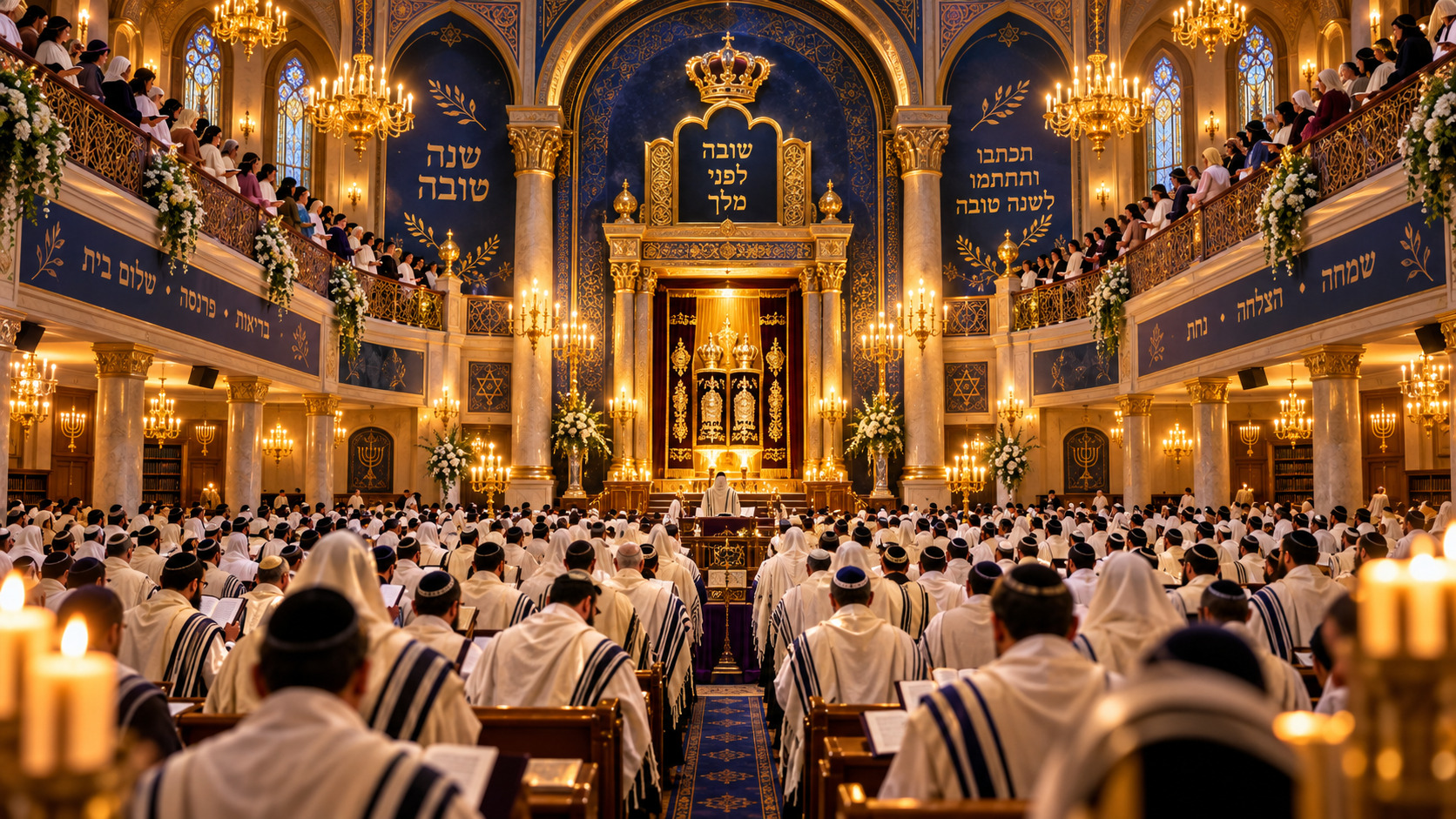
“Betokh ami anokhi yoshavet”
The Zohar gives a rule of reading: wherever the text says hayom, “the day”, it hints at Rosh Hashanah, the day the Holy One sits in judgment over the world.
The story of the Shunammite woman (II Kings 4) opens with exactly those words. Elisha wants to repay her kindness and asks: “is there anything to say on your behalf to the king?” She answers: betokh ami anokhi yoshavet — I dwell among my own people.
The Zohar reads that “king” as the King above, and that day as Rosh Hashanah, when the Holy One is called HaMelekh HaMishpat. Her answer then becomes a rule of prayer: I ask nothing for myself alone.
Why? Because whoever separates from the community on the day of judgment is examined alone — and is seized first. Hence prayer in the plural: barkhenu, bless us.
And there is something greater still than the nation: the Shekhinah in exile. If she returns, nothing is missing. That is what the Or HaChaim's prayer asks: veye'ol malkenu behekhaleh — may our King enter His palace.
We are two days from Rosh Hashanah, and there is something to learn before we enter it. It is in the parasha we have just read: Atem nitsavim hayom — you are standing today, all of you, before Hashem your God.
And the question is: what is this hayom? What is this “today”?
The holy Zohar says this: wherever the Torah, wherever Tanakh, writes hayom, “the day”, it is a hint to Rosh Hashanah — the day the Holy One, blessed be He, sits to judge the world.
From where is this learned? From a verse in Job:
“And it was the day, and the sons of God came to present themselves before Hashem, and the Satan also came among them.” Job 1:6
That day is the day of Rosh Hashanah: the day the world is judged.
Take the story of the Shunammite woman. It is in the book of Kings, II Kings chapter 4, in the days of Elisha the prophet — Elisha, who succeeded Elijah.
“And it was the day, and Elisha passed over to Shunem, where there was a great woman, and she urged him to eat bread.” II Kings 4:8
What day was it? Rosh Hashanah — since it is written vayehi hayom. Shunem is a place name.
She sees a prophet, a holy man of God, passing through her neighbourhood. She says: come, let me invite you to eat, to be received in my house properly. And from then on he ate with her whenever he passed.
She then says to her husband:
“Behold, I know that this is a holy man of God who passes by us continually. Let us make a small upper chamber, and set for him there a bed, a table, a chair and a lamp.” II Kings 4:9-10
In other words: it is not right to offer him only a meal. Let us also give him lodging as it should be — a small gallery, an upper room; a bed, a table, a chair, a lamp.
And so it was: vayehi hayom, he came there, withdrew to the upper room and lay down. She had arranged everything for him — food, drink, a place to sleep.
Naturally Elisha feels that gratitude must be expressed. This woman looks after him, his meals, his lodging. The good must be repaid.
He calls Gehazi his servant — the one always at his side — and says: call this Shunammite woman. She comes and stands before him. And he does not speak to her directly: that would be neither fitting nor modest. He tells Gehazi: please ask her.
“You have taken all this trouble for us; what is to be done for you? Is there anything to say on your behalf to the king, or to the captain of the host?” II Kings 4:13
Meaning: what can be done for you, what can be arranged on your behalf? In today's terms: do you want a reduction on your municipal tax? A licence for your business? I can arrange it. Something with the king? I can speak to the king. A position? Whatever you want, I can organise it.
“And she said: I dwell among my own people.” II Kings 4:13
That is her answer. How does it answer the question? We do not know yet. For the moment: betokh ami anokhi yoshavet.
On the plain level it can be understood this way: I need nothing. I live here like all the people, I want nothing, thank you very much.
Elisha is not satisfied with that. He turns to his servant and says uma la'asot lah — and what is to be done for her? She has not answered the question; what can still be done so that she has good?
Gehazi answers:
“But she has no son, and her husband is old.” II Kings 4:14
A barren woman and an aged husband: whom does that recall? Abraham and Sarah.
He says: call her. She is called, and she stands in the doorway. Do you remember the doorway? Petach ha-ohel kechom hayom, the entrance of the tent in the heat of the day. The story is very close to the other one.
“At this season, at this time next year, you shall embrace a son.” II Kings 4:16
Exactly as was said to Sarah. What does lamo'ed hazeh ka'et chayah mean? A year from now, at this same date, you will embrace a son.
And she answers: “No, my lord, man of God, do not deceive your handmaid” — that is: we are in no condition to have children. That too recalls what Sarah said.
The text then tells us that the child grew up.
“The child grew; and it was the day, and he went out to his father, to the reapers.” II Kings 4:18
He went to help his father in the field. He was struck by the sun — “my head, my head!” — they carried him to his mother, he sat on her knees until noon, and he died.
She goes up, lays him on the bed of the man of God, shuts the door and goes to fetch Elisha. She tells him: I told you so, you played with me — and now he is dead. Elisha answers: do not worry.
Gehazi goes ahead of them with the staff:
“He laid the staff on the face of the boy: no voice and no answer… the boy has not awakened.” II Kings 4:31
Elisha comes into the house, and there is the boy, dead, laid on his bed. He goes in, shuts the door on the two of them, and prays to Hashem.
“He went up and lay upon the child, and put his mouth on his mouth, his eyes on his eyes, his palms on his palms… and the boy sneezed seven times, and the boy opened his eyes.” II Kings 4:34-35
He then calls the Shunammite: “take up your son”. She comes, falls at his feet, bows to the ground, takes her son and goes out.
Who is this child, the son of the Shunammite? He is Habakkuk the prophet.
And why is he called Havakuk? Because he was embraced twice. His mother embraced him once, and Elisha embraced him a second time in order to bring him back to life.
“And this is Habakkuk the prophet… why Chavakuk, twice over? One embrace from his mother, and one from Elisha, who embraced himself with him.” Zohar, Beshalach
Now we must understand. He asks what she wants arranged for her, and she answers betokh ami anokhi yoshavet. On the plain level: I need nothing.
But the holy Zohar says this. When he asks “is there anything to say on your behalf to the king, or to the captain of the host?”, something else can be heard. Who is the King?
And she answers: betokh ami anokhi yoshavet. That is: I want nothing for myself alone, nothing private. I am inside Israel. Whatever the Holy One blesses for Israel, I shall benefit from it anyway as one of the people.
Take an example. If I want financial security: bless Israel, that they should have financial security — and I, as an individual within a blessed Israel, will be blessed from it.
And this is what the Zohar says on the passage:
“That day was the good day of Rosh Hashanah… on that day the Holy One, blessed be He, is called King — the King of Judgment.” Zohar, Beshalach
So Elisha is saying to her: have you anything to ask before the King above, concerning the matters in your hand? What do you want me to do for you before the Holy One, today, the day of Rosh Hashanah?
Here is the heart of it, and it is a very important piece of advice for Rosh Hashanah and for the prayers of Rosh Hashanah.
On Rosh Hashanah the mercies of the Holy One spread over His people as one. The whole nation of Israel stands in judgment on that day.
It is true that He passes us one by one before Him, like bnei maron. But in a single glance, at one stroke, He sees all Israel and the details within it. And the nation of Israel as a nation stands in judgment too.
“Let a man not separate himself alone, nor be inscribed above on his own, nor be singled out by himself.” Zohar, Beshalach
This is why it is neither fitting nor to a man's advantage to separate from the community on that day. What does separating mean? Praying as an individual, and above all asking for oneself alone, making private requests for one's own person.
“I want health.” — Is it owed to you? Let us check. What have you done that health should be owed to you? I examine you, one by one.
There is a saying in the Zohar that the wicked are like dogs: they say hav hav. You know how a dog barks — hav hav.
Now hav, in Aramaic, means: give. Give, give, give. One who says only “give me, give me, give me” is like the dog begging. That is not the way to do it.
We said one step: the nation of Israel. Ask for Israel — betokh ami anokhi yoshavet.
But there is something greater still, and if you pray for it you have solved every problem at once. What are we missing, that makes us feel lacking all the time?
So it is wiser not to waste the bullets on our small private affairs, but to ask for the greatest thing: that the Shekhinah return to her place. And if you pray for the return of the Shekhinah, then everything else will be in order anyway.
This wisdom, this secret, the Or HaChaim HaKadosh also revealed to us. There is a prayer he wrote, printed in the Yom Kippur siddurim, which it is good to say during Vaya'avor Hashem al panav vayikra — during the thirteen attributes. That is why the chazanim leave a little room there, so that whoever can manage it may say it.
Look closely at the wording, and at what he asks for.
זְכֹר אַהֲבָתֵנוּ וְחִבָּתֵנוּ, וְהָשֵׁב שְׁכִינָתְךָ לְבֵית קָדְשֵׁנוּ, וְתַחֲזֹר לְהִשְׁתַּעֲשֵׁעַ בָּנוּ כִּימֵי קֶדֶם,
כִּי קָשָׁה פְּרֵדָתְךָ מִמֶּנּוּ כִּפְרִידַת נַפְשֵׁנוּ מִגּוּפֵנוּ… הִנְנוּ מִתְחַנְּנִים וּבוֹכִים לְפָנֶיךָ ה' אָב הָרַחֲמָן, עַל גָּלוּת הַשְּׁכִינָה… וְיֵעוֹל מַלְכֵּנוּ בְּהֵיכָלֵהּ. Or HaChaim HaKadosh
Imagine what that means: we ask for nothing else. We have received everything, we need nothing — only that You should be able to delight in us again as before. That is the summary of it all.
Why? “For Your parting from us is as hard as the parting of our soul from our body.” And the last line: veye'ol malkenu behekhaleh — may our King enter His palace, that is, the Beit HaMikdash.
What should we pray for? The question was asked, and the answer is simple. You want to pray for a livelihood? You get an automatic message from Heaven: go to work. You want a match? Register, go out, meet people. All of it is already laid out before you.
So, with God's help: on Rosh Hashanah, in the prayers, put the thought on the exile of the Shekhinah, and on her swift return in our days. Veye'ol malkenu behekhaleh.
May we merit a good and blessed year. Tikhleh shanah vekileloteha, tachel shanah uvirkhoteha — let the year end with its curses, and let the year begin with its blessings.
🎯 Test yourself
Five questions on the shiur. Click an answer.
Result
Shalom Bayit — The Mouth at Home
My covenant of peace — peace begins at home. Reveal a Shalom Bayit card.
Gematria — Rav Ménaché
Shalom, Mashiah, Yisamech — secrets of the letters by Rav Ménaché zatsal.
🔢 Gematria CourseTorah Study
Go deeper into the Baal HaTurim and Rashi on the Rosh Hashanah readings.
📝 Beith HamidrachAll Parashot
All shiurim of M. Yéhouda Himi — from Bereshit to Devarim and the festivals.
📚 All ParashotBooks
Torah wisdom in thriller format — Éditions Gueoula.
Guardians of the Rift
Forty-nine gates open — the fiftieth hides in a single moment. An ancient secret resurfaces, and one man stands between the rift and the world. Drawn from Talmud and Kabbalah.
📖 Read the free excerpt · Book $9.90