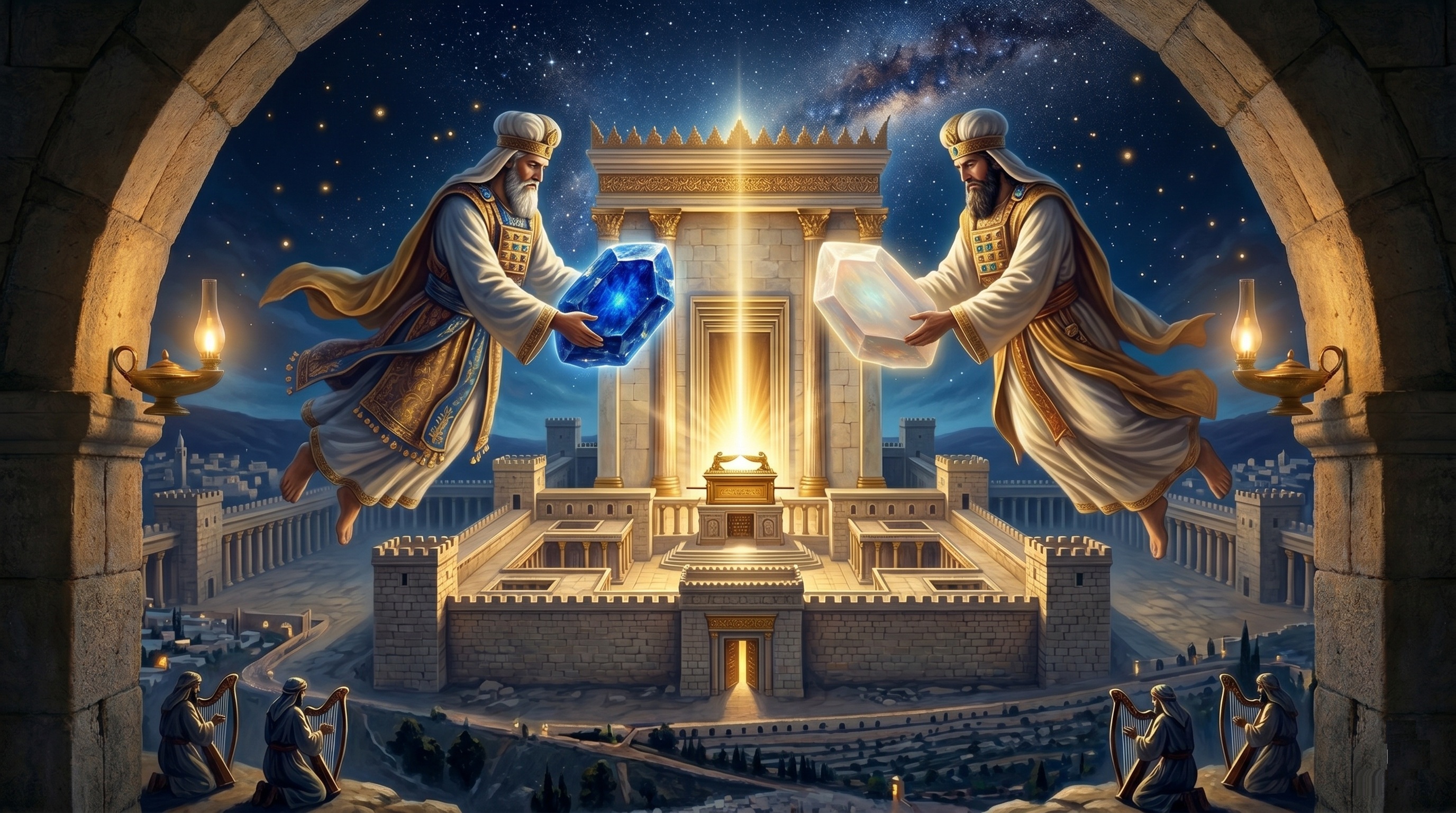
Two angels, Mikhael and Gavriel, disagree over which precious stone — Shoham or Yashpeh — will form the windows of the rebuilt Jerusalem; Hashem answers "kaden u-khaden," both together, hence the word kadkhod.
Shoham and Yashpeh sit in the fourth row of the Hoshen, corresponding to Yossef and Binyamin; Yashpeh (Binyamin) is a reward for the silence he kept when falsely accused of theft.
Mikhael represents Hessed and Mashiah ben David (kingship in peace); Gavriel represents Guevoura and Mashiah ben Yossef (the preparatory battle) — Jerusalem, like the world at Creation, needs both forces together.
The very name Yerushalayim = Yiru (awe/Guevoura) + Shalem (peace/Hessed), uniting both attributes.
When the exiled Leviim severed their own fingers rather than play before idols, Hashem Himself swore by His right hand never to forget Jerusalem — measure for measure.
With Hashem's help, in honor of Yom Yerushalayim let us share an idea. But first let us enter the atmosphere. Here is a passage from the speech delivered by Mota Gur in June 1967, immediately after the liberation of the Temple Mount:
We enter the learning carrying that emotion — and turn immediately to the strong and beautiful words of Torah.
In the prophet Yeshayahu, chapter 54, there is a verse prophesying the rebuilding of Jerusalem in the future:
The word kadkhod (כדכד) is a strange Hebrew word: kaf-dalet, kaf-dalet — written as one single word, "kadkhod." Only the first kaf carries a daguesh (because beged-kefet letters at the start of a word are hardened), while the second kaf is soft. Why does Scripture write this syllable twice? What is it hinting at?
Rabbi Shemuel bar Nahmani teaches (Baba Batra): "pligi terei malakhei birkiya" — two angels in heaven disagreed. About what?
Gavriel said: Shoham. Mikhael said: Yashpeh. The Holy One, blessed be He, listening to the dispute, intervened and ruled: "lehevi kaden u-khaden" — let it be this one AND that one. And this is the word "kadkhod" — twice "kad", meaning this AND that, together.
Where do these stones come from? From the Hoshen Mishpat of the Kohen Gadol. Twelve stones in four rows, corresponding to the twelve tribes:
The fourth row, the final row, corresponds to the last tribes: Yossef and Binyamin — the two sons of Rachel. Shoham for Yossef, Yashpeh for Binyamin. And here the secret begins.
Why does the stone Yashpeh correspond to Binyamin? The word Yashpeh is built from two words: yesh peh — "he had a mouth."
When the brothers found Yossef's goblet in Binyamin's sack, they fell upon him: "Thief, son of a thief! You're a thief just like your mother — Rachel stole the Terafim from Lavan, and you stole the goblet!" Binyamin could have answered. He had a mouth to defend himself. But he stayed silent. As a reward for that silence, he merited this blessing:
"And dwells between his shoulders" — the Shekhinah will rest in his portion of the Land, not in Yehuda's portion. There, in Binyamin's territory, the Beit HaMikdash will be built.
Now we return to the two angels. Gavriel — from the root guevoura (strength, severity). Mikhael — the prince of Israel, corresponding to hessed (kindness).
This is the deep dispute: will Jerusalem be built by guevoura (Mashiah ben Yossef, preparatory war) or by hessed (Mashiah ben David, kingship in peace)? The Holy One's answer: kaden u-khaden — both together.
The Holy One declared: "I will build Jerusalem just as I created the world." What does this mean? In Bereshit chapter 1 it is written: "In the beginning Elokim created" — only the name Elokim, the attribute of strict judgment. The Holy One first sought to create the world through judgment alone, saw that the world could not endure on judgment alone, and joined to it the attribute of mercy. Therefore in chapter 2 it is written: "On the day Hashem Elokim made earth and heaven" — both names together, mercy AND judgment. And thus the world stands. Jerusalem is the same: not by hessed alone, not by guevoura alone. By both together.
This very duality is encoded in the city's name. "Yerushalayim" — two words: Yiru and Shalem.
Shalem — the ancient name of Jerusalem. When Avraham returned from the war of the four kings, he was met by Malki-Tsedek melekh Shalem (Bereshit 14:18). Shalem = shalom = peace = hessed.
Yiru — from the root yirah (awe, fear). At the Akedat Yitzhak, Avraham named the place "Hashem yireh" (Bereshit 22:14). Yirah = guevoura.
Yerushalayim = Yiru + Shalem = Yirah + Shalom = Guevoura + Hessed. The very name of the city declares that she is built of two forces together. And the Beit HaMikdash, at the heart of the city, is the place where peace descends into the whole world — but both yirah and shalem are required, together.
In Tehilim 137, David HaMelekh writes with ruah hakodesh the fate of the Leviim in exile:
The Leviim are exiled after the destruction of the Beit HaMikdash, and Nevuhadnetzar leads them toward Babylon. At one stopping point, on the bank of a river, he orders them: "Why do you sit and weep? Prepare yourselves — I want you to play before me and before my idols on your lyres, just as you used to play in the Beit HaMikdash."
The Leviim refuse. To physically prevent themselves from yielding, they bit off their own fingers and severed them — so they could no longer play. They answered Nevuhadnetzar: "How shall we sing the song of Hashem on foreign soil? We no longer have fingers." Nevuhadnetzar killed many of them, but they rejoiced that they had not profaned the song of Hashem before idolatry.
We are accustomed to think that the one who says "If I forget thee, O Jerusalem, let my right hand forget her cunning" is David HaMelekh, or the people of Israel. But the Midrash reveals: at that very moment, when the Leviim severed their own fingers, the Holy One, blessed be He, in His own Glory, swore an oath:
Measure for measure: the Leviim mastered themselves and severed the fingers of their right hand for the honor of Jerusalem. The Holy One swore — as it were — upon His own right hand.
And in Shir HaShirim: "For my head is drenched with dew." What does this mean? The Holy One says: as long as the Beit HaMikdash lies in ruins, I Myself am in exile with you. Just as Israel has no house — so My head is filled with dew, I have no roof. I sit in exile together with you.
And this is the complete Redemption: when the two forces unite — hessed and guevoura, Mashiah ben Yossef and Mashiah ben David, Yirah and Shalem, Mikhael and Gavriel. Then the Third Beit HaMikdash will be built, speedily in our days, amen.
🎯 Test yourself
Five questions. Click an answer.
Result
Shalom Bayit — The Mouth at Home
My covenant of peace — peace begins at home. Reveal a Shalom Bayit card.
Gematria — Rav Ménaché
Shalom, Mashiah, Yisamech — secrets of the letters by Rav Ménaché zatsal.
🔢 Gematria CourseAll Parashot
All shiurim of M. Yéhouda Himi — from Bereshit to Devarim and the festivals.
📚 All ParashotBooks
Torah wisdom in thriller format — Éditions Gueoula.
Guardians of the Rift
Forty-nine gates open — the fiftieth hides in a single moment. An ancient secret resurfaces, and one man stands between the rift and the world. Drawn from Talmud and Kabbalah.
📖 Read the free excerpt · Book $9.90