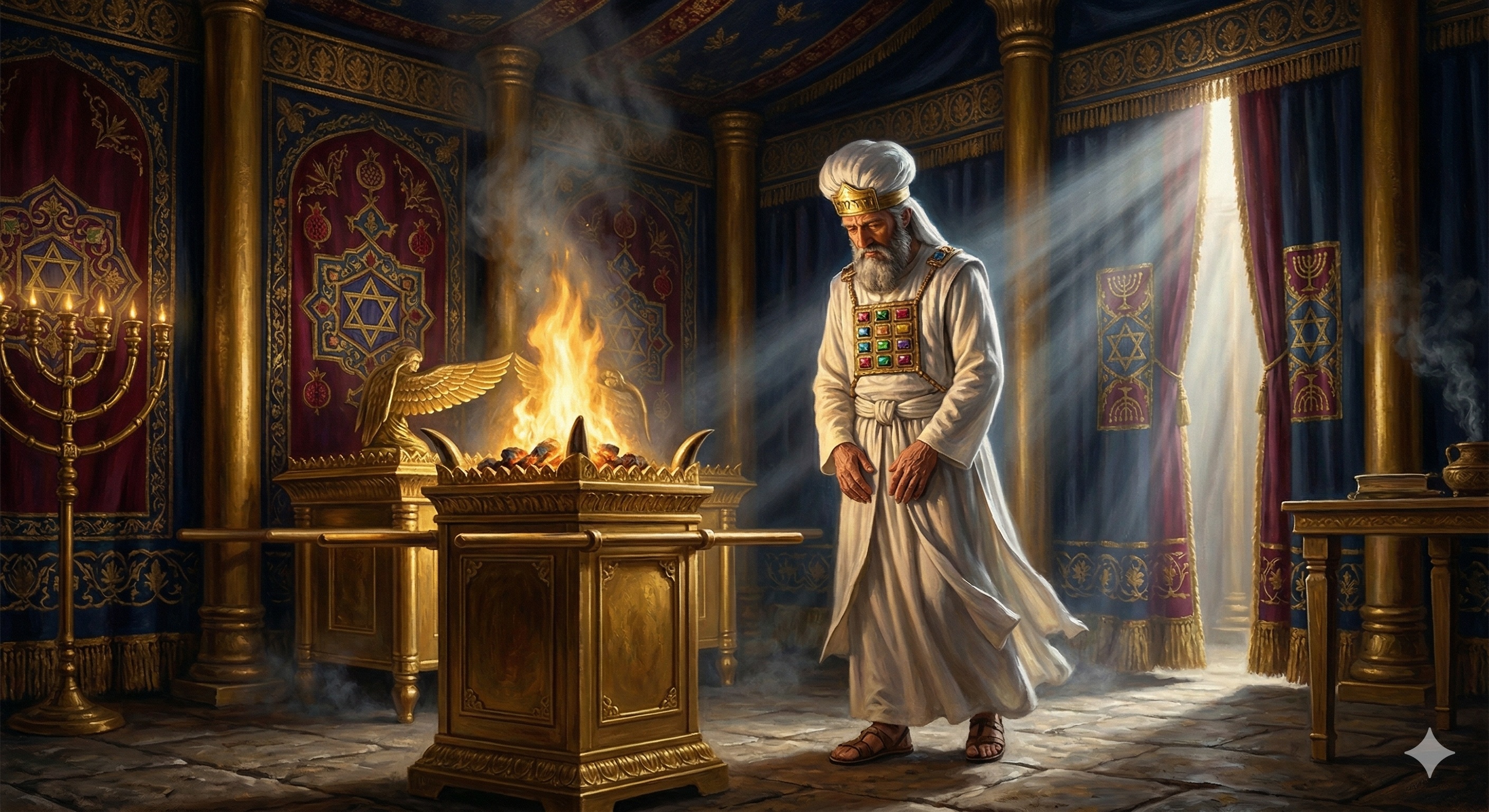

On the eighth day — the most joyous day in the history of Israel, the inauguration of the Tabernacle — Aaron the High Priest stood at the altar and did not move. Moses had to tell him: “Draw near to the altar.” Why did the greatest Kohen hesitate at the greatest moment? Three themes: humility as the secret of leadership, Nadav and Avihu on the happiest day, and the hidden Name of G-d inside every mitzva.
Rashi asks: eighth — from what? From the seven days of Milluim — the training period described at the end of Exodus. The eighth day was the first of Nissan, Rosh Chodesh, the day the Tabernacle was erected. In that single morning: the Torah portions of Vayikra, Tzav, and most of Shemini were all communicated. One day equal to seven worlds.
Two offerings — two ancient wounds.
The Goat → atonement for the sale of Joseph. The brothers of Joseph slaughtered a goat and dipped his coat in its blood to deceive their father.
Before the Tabernacle opens its doors, the two deepest moral failures in Israel’s early history must be addressed. A sacred space cannot be inaugurated on an unhealed conscience.
Rashi writes: “Aaron was ashamed and afraid to approach.”
Ashamed — because Aaron felt personally responsible for the sin of the Golden Calf. Though Micha threw the tablet into the fire, Aaron was in charge of the camp. A true leader does not excuse himself.
Afraid — because he feared that Korach’s faction would rise up and accuse him. On this grand and public occasion, any protest could spiral into catastrophe.
A leader must have something that humbles him — something in his past that prevents him from ever becoming arrogant over those he leads. Without it, power corrupts. Without it, he forgets his place.
Aaron’s basket is hanging. His shame is real. His humility is not performance — it is structure. That is why he was chosen.
Imagine the scene: the entire nation gathered around the Tabernacle, waiting. Fire descends from Heaven and consumes the offering — Vayehi — and the people shout for joy. And then that same fire leaps and consumes Nadav and Avihu.
Commentators differ on the exact sin — intoxication, deciding law in Moses’ presence, drawing too close uninvited — but all agree: Nadav and Avihu were great, and their greatness overstepped its boundary.
A famous story: David fled from Saul and hid in a cave. A spider spun its web across the entrance. When Saul’s soldiers arrived, they saw an intact web and said: “No one has entered.” David was saved. From that moment, he understood that even the spider has a role.
The creeping creatures exist so that G-d can always reason from them: if I sustain what appears purposeless, I will certainly sustain those who study Torah, pray, and observe mitzvot.
Two profound answers — that arrive at the same point:
That is why the verse says “Vehitkadashem” — you will become holy, progressively. Each mitzva adds another layer. The more we observe, the closer we approach the level of “for I am holy.”
Shalom Bayit
20 levels. One question per card. No answers — only mirrors. Click to discover a new Shalom Bayit card.
Gematria — Mitzva = G-d’s Name
Mitzva in ATBaSH = the Name of G-d. Discover hidden connections according to Rav Ménashé zatsal.
🔢 Gematria CourseTorah Study
Want to go deeper into Parashat Shemini? Our Beith HaMidrash offers comprehensive classes.
📝 Beith HaMidrashAll Parashot
All shiurim by M. Yéhouda Himi — from Bereshit to Devarim and the holidays.
📖 All ParashotDream Interpretation
Dreamed of fire, a Kohen, or an altar? Discover traditional interpretations based on classical sources.
🌙 Dream InterpretationBooks
Éditions Gueoula books present Torah wisdom in an accessible and compelling format.
This Shiur Was Built by Donors
Every lesson, every translation, every page is built on love of Torah and generosity. You become a partner in Redemption.
💛 I Want to Be a PartnerOn the eighth day — the inauguration of the Tabernacle — the entire nation was waiting. The altar was ready. The offerings were ready. And Aaron the High Priest stood at the altar and could not bring himself to move. Moses had to tell him: “Draw near to the altar.”
Rashi tells us: Aaron was ashamed and afraid to approach. Ashamed — because he felt responsible for the Golden Calf. Afraid — because he feared the reaction of those who had not sinned. And Moses answered with two words: “For this you were chosen.” Your shame is not a disqualification — it is your credential. The broken heart, the refusal to feel entitled: that is what qualifies you to stand before G-d.
The Talmud (Yoma 22b) teaches: we do not appoint a communal leader unless he carries a “basket of creeping things” behind him — some weight that keeps him humble, that prevents him from rising above those he leads. Korach had no such basket. Aaron’s was always there. That is the entire difference.
Tonight, as we enter Shabbat, let us take one moment of honest humility before lighting candles: “Master of the Universe, I come to Your Shabbat with everything I have failed at this week. Precisely because of that — I am here. I was chosen.” Good Shabbat.
Parashat Shemini ends with a command: “You shall sanctify yourselves and be holy, for I am holy.” A daunting command. How can a human being become holy like G-d?
The Torah does not say “be holy.” It says “Vehitkadashem” — you will become holy, progressively, through a process. And every time we recite a blessing, we say: “Blessed are You G-d, who has sanctified us through His commandments.” The mitzvot are the instruments of holiness.
How? There is a hidden cipher called ATBaSH: Mem becomes Yod, Tzadi becomes Heh. The word mitzva — Mem-Tzadi-Vav-Heh — becomes Yod-Heh-Vav-Heh. The Name of G-d. Every mitzva contains the Divine Name within it. When you observe a mitzva, you are literally holding G-d’s Name in your hands.
And more: the word mitzva comes from the root tzevet — team. When G-d commands us, He is not merely issuing an order. He is bringing us into His team. We become His partners in Creation. And if we are on His team: “I am holy — and you, too, will be holy.” Shabbat Shalom and Mevorah.