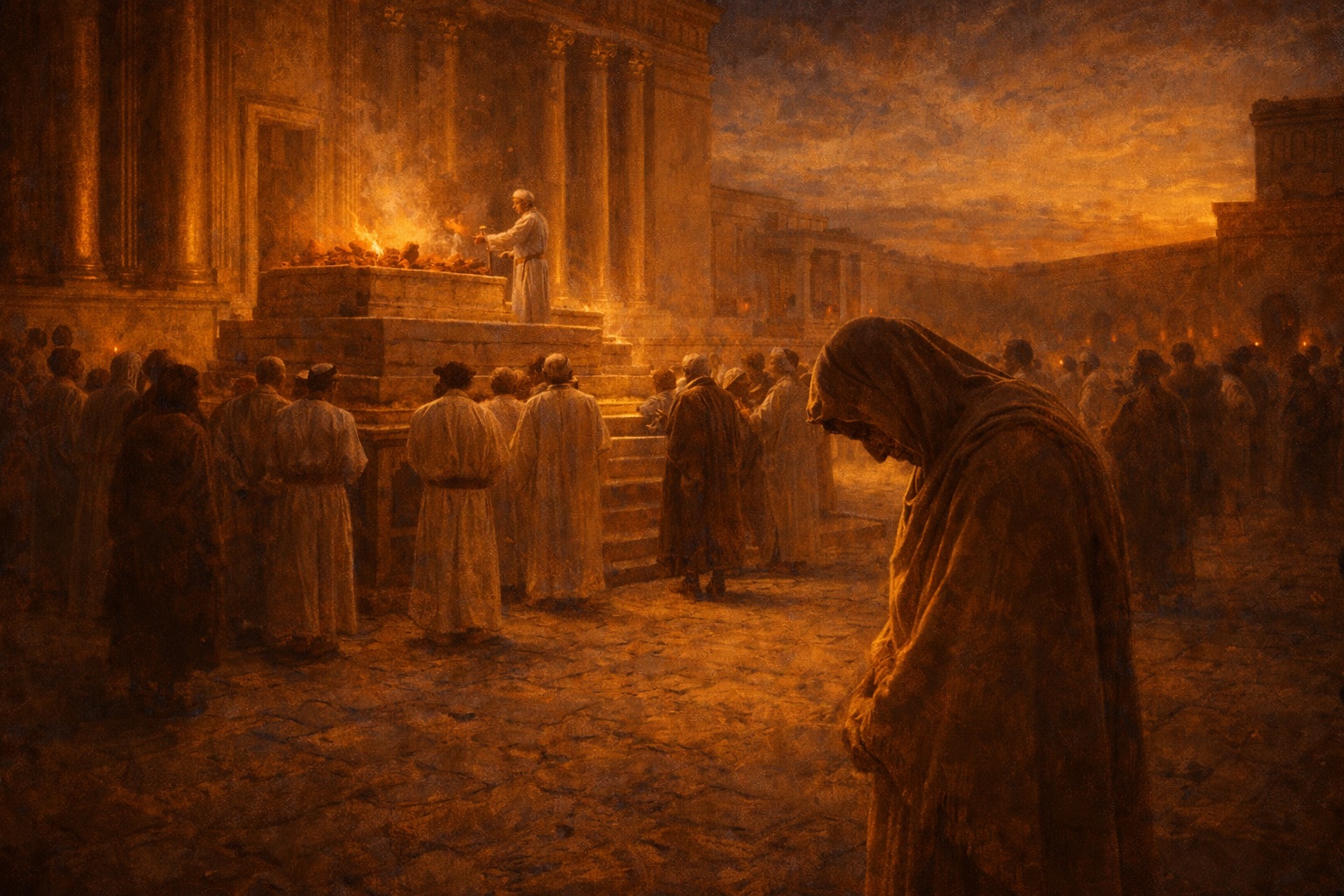
Parashat Tzav was spoken on the very day the Mishkan was inaugurated — Rosh Chodesh Nissan. Buried inside the parashah is a question that connects the honor of every Jew to the service of God: why must the chatat be slaughtered in the exact same spot as the olah? And why did 38 complete years pass without a single korban in the Mishkan? The answer leads us to one of the Torah's most foundational principles — the infinite dignity of every Jewish soul.
This year, the Torah is perfectly synchronized with the Hebrew calendar — something that does not happen every year. Parashiyot Vayikra, Tzav, and Shemini were all spoken on a single day: the first of Nissan, year two in the desert.
Rosh Chodesh Nissan fell this year on Thursday. We are literally inside these days. And remarkably, this year's Pesach calendar aligns exactly one-to-one with the original Exodus from Egypt — as we will see in the next section.
Shabbat HaGadol is named for the great miracle that occurred on it. God commanded Bnei Yisrael on the 10th of Nissan: "Each household shall take a lamb, tie it to the bedpost for four days." On the 14th of Nissan — they slaughter it.
This is not coincidence. God arranges time so that we feel the truth from within. We are not merely retelling a story — we are standing inside it.
There are two types of korban: the olah — the ascending offering, brought by one who wishes to draw close and give to God — and the chatat — the sin offering, brought by someone who sinned and needs atonement.
The question is simple: if there were a designated area for slaughtering chatat offerings, everyone would watch a person walking there and think: "There goes the sinner, coming to bring his chatat." He would be publicly shamed. Keep this question in mind — the answer comes at the end.
Year one — they slaughtered the Pesach before leaving (all had been circumcised). Year two — the Mishkan was inaugurated on Rosh Chodesh Nissan; the Nesi'im brought offerings for 12 days; and on the 14th of Nissan — they brought their first Korban Pesach since the Exodus. So far so good.
The proof that they entered on the 10th of Nissan? The verse says they crossed on "the tenth of the first month" — the very same day the lamb was tied! Joshua's entry into the Land is also linked to the 10th of Nissan.
The Ibn Ezra says: Not only were they uncircumcised — most of Bnei Yisrael had no livestock to bring as an offering at all! They had no "mila hakriv" — the essential prerequisite for any korban.
⭐ Three proofs from the Ibn Ezra:
Proof 1 — "The mixed multitude (Erev Rav) that came up with them had flocks and very great herds" (Shemot 12). The fact that the Torah singles out the Erev Rav as having livestock proves that everyone else did not!
Proof 2 — "The children of Reuven had very large livestock" (Bamidbar 32). Again — if the Torah singles out Reuven, it proves that the other tribes had nothing.
Proof 3 — "Who will give us meat to eat?" — the complaint at Kivrot HaTa'avah! If they had flocks and herds, what is the complaint? Slaughter one! The answer is: they had none. That is why God brought them the quail.
And even if they tried to buy — Edom and Moav refused to sell them anything. "Lest I come out against you with the sword" — they would not sell them water, let alone livestock.
If there existed a special "chatat corner," anyone who walked there would immediately be identified: "There goes the sinner, bringing his chatat." Everyone watches. Everyone points. He is humiliated. To spare him that shame, the Torah commands that the chatat be slaughtered in the very same place as the olah. It is impossible to know whether a korban is an olah or a chatat.
1. Vidui in a whisper — If we confessed our sins aloud, everyone would hear what we did. The confessional is spoken quietly — between a person and God.
2. The daughters of Israel on Tu B'Av — They would go out to dance in the vineyards, all wearing white — not each woman in her most beautiful dress — so that no woman would feel ashamed for having less.
3. Thirty-eight years without korbanot — Those who had livestock refrained, so as not to shame those who had none.
This idea appears again and again throughout the Torah: human dignity — the honor of every person — is so great that the Torah adjusts mitzvot to protect it.
An embarrassing moment. The person who ate — everyone would stare as he stood to leave. Rabbi Chiya stood up — and left. One of the greatest of the disciples. Everyone else stood up and left too. If Rabbi Chiya leaves — we are not staying.
Rabbi Chiya replied: "Let it never be said that such a thing happened in Israel! Heaven forbid that I would do such a thing." He had not eaten garlic. He stood up on purpose — so that the one who had eaten garlic could slip out anonymously, hidden among the crowd.
The answer is simple and profound: because man was created in the image of God. And when it comes to Israel — it is truly the image of God, a portion of God above. Whoever humiliates a Jew — humiliates God Himself.
And therefore: sins between a person and their fellow — Yom Kippur does not atone for them until one reconciles with that person. Yom Kippur atones for sins between a person and God. But when you have hurt a fellow Jew, you must go directly to that person.
Chalom Bayit
20 floors. One question per card. No answers — only mirrors. Click to discover a new Chalom Bayit card.
Torah Study
Want to go deeper into Kavod HaBriot, the korbanot of the desert, and the story of Rabbi Chiya? Our Beith Hamidrach offers shiurim on the Book of Vayikra and the work of the soul.
📝 Beith HamidrachGematria — Tzav
Gematria on the pilgrimage and Korban Pesach — Rav Menashe zatsal's method.
🔢 Gematria StudiesAll Parashiyot
The Book of Vayikra — the Book of Holiness and Purity. Discover more shiurim on korbanot, human dignity, and Pesach.
📖 All ParashiyotDream Interpretation
Seeing yourself bring a korban in a dream — a sign of teshuvah. Seeing Shabbat HaGadol — a sign of redemption. Discover traditional interpretations.
🌙 Dream InterpretationBooks
Want to go deeper? Éditions Gueoula presents spiritual wisdom in an accessible format — a gentle entry point for every reader.
Videos
Watch videos on Parashat Tzav, the Korban Pesach, and the Ibn Ezra on Israel in the desert. Great for shiurim, lectures, or personal review.
🎬 VideosContact
Do you have a question about the chatat's location, the 38 desert years, or the story of Rabbi Chiya? We'd love to hear from you.
✉️ ContactThis shiur reached you — thanks to donors
Every shiur, every translation, every page — built with love of Torah and generosity of heart. Your donation allows thousands of Jews around the world to connect to Torah in their language. You become a partner in the Geula.
💛 I want to be a partner