From Adam to Avraham —
The Return to the Land
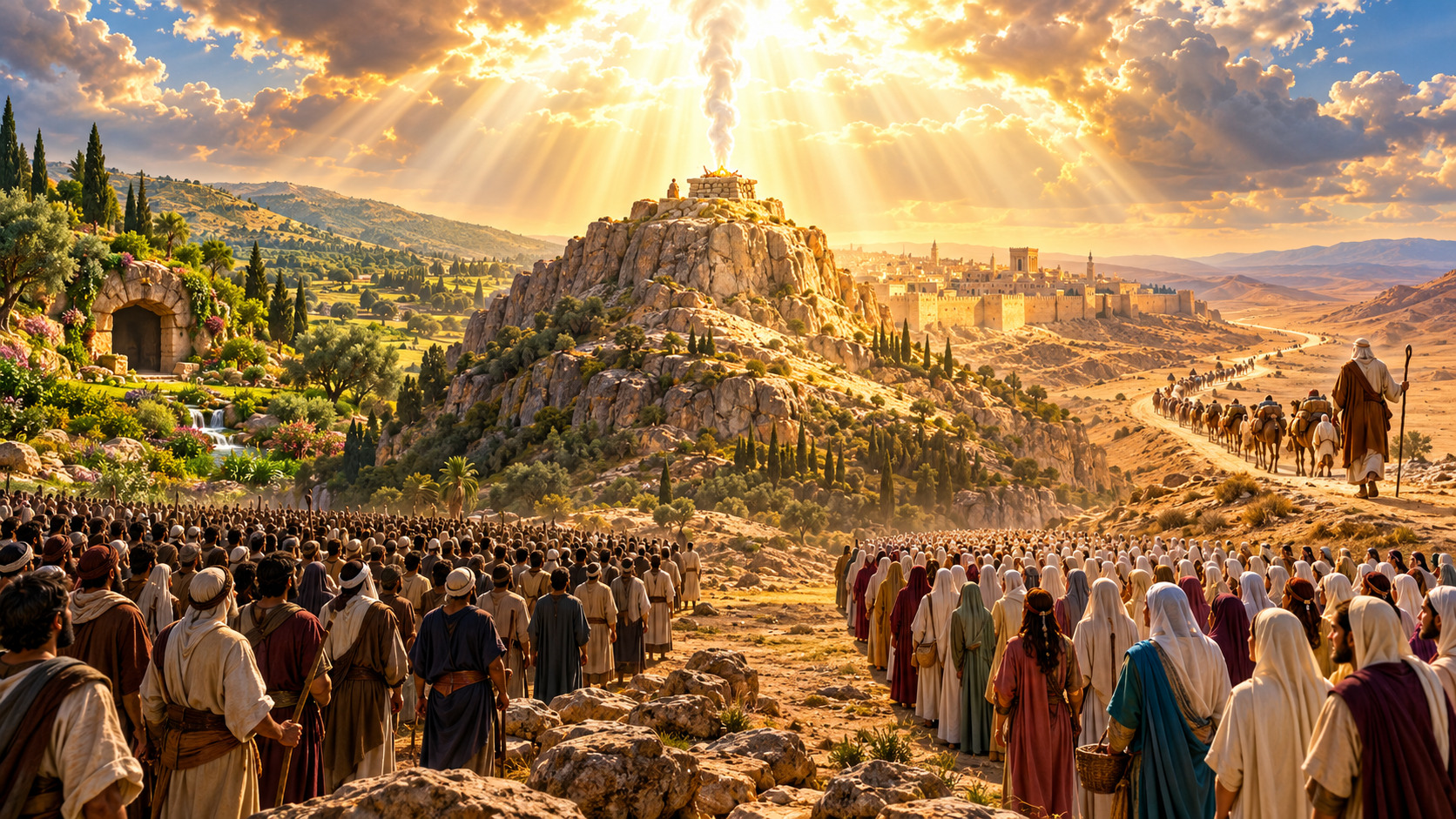
Between Parashat Noach and Parashat Lech Lecha stands a Mishnah in Pirkei Avot: ten generations from Adam to Noach and ten from Noach to Avraham, all of them “angering and coming.” What does “and coming” mean? To understand, the shiur goes back to the creation of Adam on Mount Moriah, to Gan Eden in Hebron and to the Cave of Machpelah. Adam was driven out of Gan Eden, and his repair is to return, at least to Eretz Israel. Noach left the ark in order to return, but at the plain of Shinar they stopped and built the tower. Terach also set out for Canaan and stopped at Haran; Avraham is the only one of all the generations who arrives, and so he receives the reward of all.
Pirkei Avot teaches: there were ten generations from Adam to Noach, to show how great is His patience, for all those generations kept angering Him and coming, until He brought the waters of the Flood upon them. There were ten generations from Noach to Avraham, to show how great is His patience, for all those generations kept angering Him and coming, until Avraham our father came and received the reward of all of them. “Angering” is easy to understand: theft, violence, forbidden relations, and in the generation of the Dispersion, the Tower of Babel. But what does “and coming” mean? It is the central word of the Mishnah, and it is the key to understanding what the Mishnah wants to say.
The Torah tells of the creation of the world, of Adam who was placed to work and guard the garden, of his failure and expulsion from Gan Eden; then Kayin, Hevel and all the generations after them, until the end of Bereshit, “the earth was filled with violence.” Parashat Noach opens with “for I have seen you righteous before Me in this generation,” and there is hope that Noach will repair what Adam spoiled. Noach builds an ark, the Flood comes, and after a year they come out; then the Tower of Babel and the generation of the Dispersion, and the world needs someone to repair it. Suddenly, in Lech Lecha, “Hashem said to Avram: Go forth from your land,” with nothing said about Avraham before. The Midrashim tell that at three or four years old he went out, looked around and said: it cannot be that all this came about by itself. When the Holy One, blessed be He, sees a child so eager to know who the King is, He reveals Himself to him.
To understand “and coming,” we must go back to the creation of Adam: Hashem formed man of dust from the ground and breathed into his nostrils the breath of life. He took the dust from the four corners of the earth and made the “cake,” the body, before He breathed the spirit of life into it. Where did this happen? On Mount Moriah, in the seam between the steps leading up to the Kodesh HaKodashim and the altar of the olah. This is why it is said that Adam was created “from the place of his atonement.” It is also where Avraham later builds the altar to bind Yitzchak upon it, the threshing floor of Aravna the Yevusi that David buys, and where Shlomo builds the Beit HaMikdash, next to the Even HaShtiya, from which the world was founded.
Many think Adam was created in Gan Eden, but the Torah says explicitly: “Hashem Elokim took the man” — He took him from Mount Moriah — “and placed him in Gan Eden.” So Gan Eden is in another place. Where? “Hashem Elokim planted a garden in Eden mikedem”: to the east of Mount Moriah, that is, in Hebron. The ancient Gan Eden was there, and the tradition is that the entrance to Gan Eden is in the Cave of Machpelah in Hebron.
When Adam sinned, the Holy One, blessed be He, drove him out of Gan Eden and set the cherubim and the revolving flaming sword so that he could not return inside. The Midrash tells that before he died, Adam longed intensely to return to Gan Eden, but he could not. So he fixed his grave next to the entrance of Gan Eden, and Chava was buried there too: this is the Cave of Machpelah. When Avraham welcomes the angels and wants to prepare a meal for them, he chases a calf that runs away from him, and the calf leads him to the entrance of the cave. Avraham follows it inside, sees a special light, and within he sees Adam and Chava lying there. So Avraham understood that this was the Cave of Machpelah, and years later, when Sarah died, he came to Efron and said: “Let him give me the Cave of Machpelah.”
One lesson follows from all this: Adam was driven out of Gan Eden because he sinned, so his repair must be a return — to Gan Eden, or at least to Eretz Israel, to the place from which he was sent out. This is the key to everything that follows: Adam’s repair is a return.
At first, everything around Parashat Noach is centered on Eretz Israel, and Noach builds the ark there. When the Flood comes, the ark is lifted up; according to one opinion the Flood fell in Eretz Israel too, and according to another the waters at least reached it and lifted the ark. For a year the ark is carried over the flooded world, and it comes to rest on the mountains of Ararat. Noach opens the window of the ark, and he is stuck in Turkey. What must he do? Return home, to the center of Eretz Israel. And they begin the journey back.
On the way they reach the plain of Shinar and stop there. They forgot that they needed to return to Eretz Israel, and there they built the tower. This is “and coming”: they had a plan to come back to Eretz Israel, but they got stuck on the plain of Shinar and cancelled their plans. They are “angering” the Holy One, blessed be He, and also “coming” — moving toward the Land, and not arriving.
For ten generations from Noach to Avraham, a tradition was still passed from one to the next. Noach had three sons, and at the Shabbat table, whenever they spoke of the parasha, Noach would tell his children: my dear children, remember that before the Flood we lived in the land of Canaan, in Eretz Israel? That is where we must return. The message was picked up on the side of Ever, and from Ever came Avraham the Hebrew. But Cham’s son caught it too: Cham had four sons — Kush, Put, Mitzrayim and Canaan. Canaan grasped the matter, ran fast and reached Eretz Israel, which is why it is called the land of Canaan. The sons of Ever followed the story and began to walk toward Eretz Israel; they were “angering and coming” along the way, but did not arrive.
At the end of Parashat Noach there is a verse that not many notice: someone had a plan to reach Eretz Israel even before Avraham. “These are the generations of Terach: Terach begot Avram,” and “Terach took Avram his son, and Lot the son of Haran his grandson, and Sarai his daughter-in-law”: “and they went out with them from Ur Kasdim to go to the land of Canaan.” They already had a plan to reach the land of Canaan. But what happened? “They came to Haran and settled there.” Again they do not arrive; they advance and stop.
Compare Avraham: “Avram went as Hashem had spoken to him,” “Avram took Sarai his wife,” and in almost the same language: “and they went out to go to the land of Canaan, and they came to the land of Canaan.” All the others anger and come, but do not arrive. Avraham is the only one of the twenty generations who finally returns, and so he receives the reward of all, including the reward for the return to Eretz Israel.
This is the root of what happened to the people of Israel throughout its generations: it went into exile at the First Temple, it went into exile at the Second Temple, two thousand years. The return to the Land is a condition of the redemption: Mashiach must be here in Eretz Israel, and Mashiach is David, who is derived from Adam HaRishon, and the people of Israel must be in its land. Without this the redemption is not realized. So the links must follow one another in one sequence: Adam, his expulsion, the ark, the tower, Terach, Avraham.
One last point: when Noach comes out of the ark, what is the first thing he does? After he sent out the dove and opened the doors of the ark, he builds an altar: “Noach built an altar to Hashem, and took of every pure animal.” All the commentators say that Noach restored the altar of Adam HaRishon, on which Kayin and Hevel also offered. But how? Adam’s altar is on Mount Moriah, in Eretz Israel, and Noach is on the mountains of Ararat. One explanation: just as there is a Beit HaMikdash below and a Beit HaMikdash above, a Jerusalem below and a Jerusalem above, so there is an altar below and an altar above. The Kohen Gadol up there is Michael, and he offers the souls of the righteous. The upper altar is aligned with the altar of Adam HaRishon, and when Noach builds his altar he builds it opposite the altar above; the offerings on the mountains of Ararat therefore rise favorably to the upper altar, which faces the altar of Kayin, Hevel and Adam HaRishon.
Test yourself
Five questions on the shiur. Choose an answer.
Result
Shalom Bayit — The Mouth at Home
My covenant of peace — peace begins at home. Reveal a Shalom Bayit card.
Gematria — Rav Ménaché
Shalom, Mashiah, Yisamech — secrets of the letters by Rav Ménaché zatsal.
🔢 Gematria CourseAll Parashot
All shiurim of M. Yéhouda Himi — from Bereshit to Devarim and the festivals.
📚 All ParashotBooks
Torah wisdom in thriller format — Éditions Gueoula.

Guardians of the Rift
Forty-nine gates open — the fiftieth hides in a single moment. An ancient secret resurfaces, and one man stands between the rift and the world. Drawn from Talmud and Kabbalah.
📖 Read the free excerpt · Book $9.90