“And He Brought Her to the Man”
With God’s help we begin once more the cycle of the five books of the Torah. Bereshit — Onkelos translates “at the beginning”; the holy Zohar reads “with wisdom”, as in “the beginning of wisdom” and “Hashem founded the earth with wisdom”. And what is wisdom? Chochmah is koach mah — the power of “what”, of the one who says “and what are we?”. The One who is utterly unique chose to give of Himself and to bring into being a reality other than Himself: that is immense humility. The whole world “hangs on belimah” — on the one who holds himself back.
Chapter 1 uses only the Name Elokim, the attribute of judgment; from “these are the generations of heaven and earth behibaram” onward we read Hashem Elokim: there He joined mercy to judgment, as Rashi teaches. And behibaram means “with the letter heh He created them” — and also “for Abraham”, in whose merit, and in the merit of the Torah on his children’s lips, the world stands.
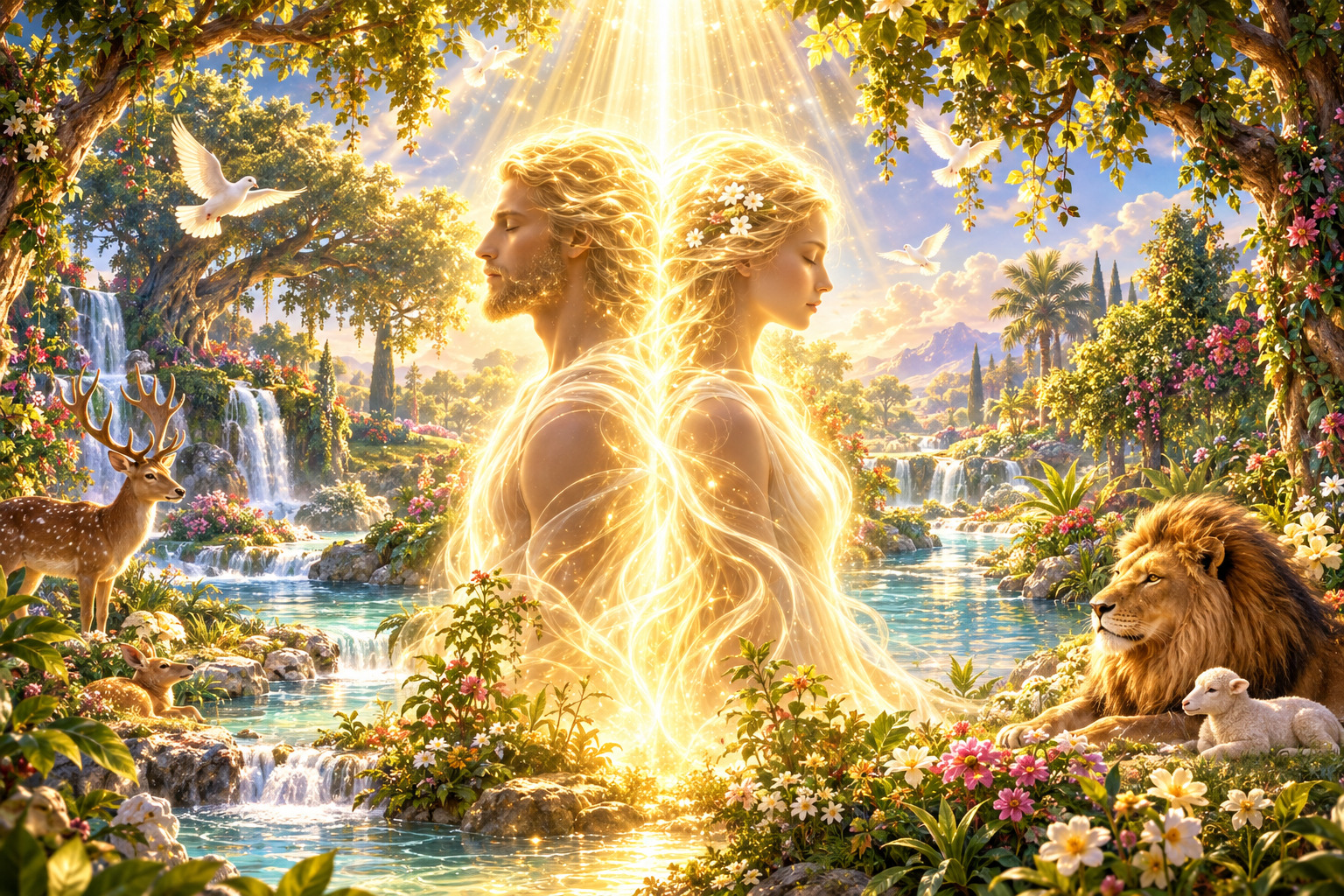
“Male and female He created them”: Adam was created with two faces, back to back. The tzela is not a bone from the chest but a side — and from the side God separated the woman. Before bringing her to Adam He braided her hair and adorned her, so that she would not appear unsightly to him and not be hurt: the Torah’s first kindness, just as its end — the burial of Moshe — is kindness.
“Man and woman: if they merit, the Shechinah is between them; if not, fire consumes them.” The Name Havayah spelled out in full with alef comes to 45 = Adam; the filling letters alone come to 19 = Chava. Chava is contained within Adam — and when they are together, the Name is complete between them. This is the foundation of peace in the home.
With God’s help, and in a good hour, we begin once again the cycle of the five books of the Torah. Parashat Bereshit, the first verse:
“In the beginning God created the heavens and the earth.”
What does Bereshit mean? There are a great many explanations. Onkelos says:
“At the beginning Hashem created the heavens and the earth.”
That is: at the start. Bereshit — at the beginning, at the beginning God created the heavens and the earth.
The holy Zohar says: what is Bereshit? With wisdom. And where do we take the word “wisdom” from — how is it connected to the word Bereshit? As the verse says:
“The beginning of wisdom is the fear of Hashem.”
Reshit, “beginning”, is wisdom. And another verse:
“Hashem founded the earth with wisdom; He established the heavens with understanding.”
The Holy One, blessed be He, created the world with wisdom. But what does “with wisdom” mean? What does wisdom have to do with it?
We once said that the word chochmah, חכמה, is made of two words. If I swap its first two letters, ח״כ becomes כ״ח, and what remains is מ״ה: koach mah — “the power of what”.
And what is this “what”? We know what Moshe and Aharon said:
“And what are we, that you should complain against us?”
That is: we are mah — we are nothing, nothing at all. And again:
“And now, Israel, what does Hashem your God ask of you, but to fear Hashem your God?”
The Holy One, blessed be He, asks us to live with modesty — to be mah, in humility, to be as nothing.
So what does “Hashem founded the earth with wisdom” mean? What does “with wisdom God created the heavens and the earth” mean? Wisdom is, in truth, the power with which God created the world — the power of humility.
God, as it were, says: I am One, unique and singular; “the whole earth is full of His glory” (Yeshayahu 6:3). But I wish to bestow of Myself upon others — so that others too may have existence, through the abundance I pour upon them. Out of this humility, out of God’s wish to share His world with yet another reality, He creates the world. And that is very great humility.
For ordinarily, one who is alone says: “I am, and there is none besides me” (Yeshayahu 47:8) — I am unique in my world, I want no one, there is no one after me. And God says: No — I want precisely that there be creatures, and that I bestow upon them from Myself.
All of existence depends on this matter of mah:
“He stretches out the north over emptiness; He hangs the earth upon nothing.”
Al belimah — al beli mah, “upon without-what”. And our Sages said: the world endures only for the sake of one who restrains himself at a time of strife (Chullin 89a). One who holds himself back in a quarrel — beli mah, he has nothing to say. Everything stands upon that same foundation.
We know the words Rashi brings on the first verse:
“‘God created’ — it does not say ‘Hashem created’, for at first He intended to create it with the attribute of judgment; He saw that the world could not endure, so He gave precedence to the attribute of mercy and joined it with the attribute of judgment.”
Where do we see this in the plain meaning of the words? God has many Names by which He appears: there is the Name of Lordship, Adnut, alef-dalet; there is yud-heh-vav-heh, the Name Havayah; there is Tzeva’ot, Shaddai, and so on. Elokim — that is the attribute of judgment.
And indeed, when we read “In the beginning Elokim created the heavens and the earth”, it means He created the world with the attribute of judgment. Where do we see that He afterwards joined mercy with it?
If we follow all six days of creation — all the verses that speak of the first day, the second, and so on — the expression we always find is Elokim. “In the beginning Elokim created”; “and the spirit of Elokim hovered”; “and Elokim saw”. On the second day: “And Elokim said, let there be a firmament”. So too on the third, fourth, fifth; on the sixth: “And Elokim said, let the earth bring forth”, “and Elokim created” — until the end of creation: “The heavens and the earth were finished”, “and Elokim finished”, “and Elokim blessed… and sanctified it, for on it He rested from all His work which Elokim created to make”.
Here we have seven days of creation, and in all of them the Name Elokim appears. And then it begins:
“These are the generations of the heavens and the earth when they were created, on the day that Hashem Elokim made earth and heavens.”
From here on we find Hashem Elokim: “for Hashem Elokim had not caused it to rain upon the earth”; “and Hashem Elokim formed the man”. That is the meaning of “He joined the attribute of mercy with it”: throughout chapter 2 we see both the Name Havayah and Elokim, side by side, continuously and consistently. And that is the plain meaning.
And when we reach the part where judgment and mercy appear together — “these are the generations of the heavens and the earth behibaram” — what does behibaram mean? There are several explanations.
One says: be-heh bera’am, “with the letter heh He created them”. And there is a verse:
“For in Yah, Hashem, is the Rock of worlds.”
What is tzur? From the root of forming, of creating — as in “and Hashem Elokim formed”, vayitzer. God created the worlds with Yah, with yud and heh. The yud corresponds to the World to Come, the heh to this world (Menachot 29b). “These are the generations of the heavens and the earth — with heh He created them”: with this heh, of yud-heh-vav-heh, God created the earth, this world.
It is also said: the letters of behibaram are the letters of Avraham (Bereshit Rabbah 12:9). That is, the entire world exists only so that there should be Avraham our father, from whom would come Yitzchak and Yaakov and the children of Israel — who sustain the world, as the verse says:
“If not for My covenant day and night, I would not have set the laws of heaven and earth.”
What is “My covenant”? It is the Torah itself. As long as there is a people — the people of Israel — that toils in Torah day and night, that is what sustains the world. In other words, the world endures only for the breath of the mouths of schoolchildren (Shabbat 119b) — the children of Israel, in whose merit the world itself endures.
When we come to the creation of man, it is interesting. In chapter 1 the Torah tells us:
“And God created man in His image; in the image of God He created him; male and female He created them.”
From this verse we understand that man includes within himself both the male and the female. But later it says:
“And Hashem Elokim formed the man of dust from the ground, and breathed into his nostrils the breath of life, and the man became a living soul.”
Here He no longer tells us there is male and female. Where do we find the opening to understand what really happened?
Let us go to verses 21–22:
“And Hashem Elokim cast a deep sleep upon the man, and he slept; and He took one of his tzela’ot and closed up the flesh in its place. And Hashem Elokim built the tzela which He had taken from the man into a woman, and He brought her to the man.”
People usually think — because today we call the ribs tzela’ot — that He took a rib, as it were removed one bone from the man’s chest, detached it, and from it built the woman. One can understand it that way. But that is not truly the meaning. For we have already learned a verse saying that there are both male and female here: man already contains within himself both the woman and the man.
So how do we reconcile all the verses? We say that the word tzela here is not one of our ribs, but a side. In geometry we have the “equilateral triangle”, in Hebrew meshulash shveh tzela’ot — tzela’ot are sides. And so Rashi explains: “mitzal’otav — from his sides, as in ‘the side (tzela) of the Mishkan’”.
That is: He did not take the woman out of a bone he had, but from his side. She was already there before, for she was created together with him — as the earlier verse says, “male and female He created them”. They were joined, and what God did was to saw, to separate them. This act is called nesirah, as the Arizal explains: from the side He sawed her away from him. They were back to back — “and He brought her to the man”.
To sum up: man was created from the outset with the woman joined to his back, with two heads — like Siamese twins, joined back to back. And God sawed her from the tzela, from the side, “and brought her to the man”. We see this very description in the Midrash:
“Rabbi Yirmiyah ben Elazar said: When the Holy One, blessed be He, created the first man, He created him androgynous — as it is written, ‘male and female He created them’. Rabbi Shmuel bar Nachman said: When the Holy One, blessed be He, created the first man, He created him with two faces; then He sawed him and made him two backs, a back on this side and a back on that.”
And Rashi likewise writes on “male and female He created them” that He created him with two faces in the first creation, and afterwards divided him. After this operation — “and He closed up the flesh in its place” — “He brought her to the man”.
One may ask: if they were one body, is there not a question here of brother and sister? The answer: this is a unique case, the very first, in which one cannot speak of brother and sister or of kinship between them — for in any case, the mother of the first man was the earth. The ground was his mother. So that whole discussion does not apply to this couple, who are in the Garden of Eden, in the east.
Brother and sister come later. Rashi brings that even before the first man sinned and was driven out of Eden, “the man knew Chava his wife”, and Kayin and Hevel were born; and “Kayin… his brother Hevel” — these words come to include more: a twin sister was born with Kayin, and two with Hevel (Rashi, Bereshit 4:1). There we begin to speak of brother and sister. But for now, let us stay with this couple.
But the most important point one can understand here — in a beautiful image the Midrash gives on “and He brought her to the man” — is this:
“The Torah begins with acts of kindness and ends with acts of kindness.”
This also connects us to the end of the Chumash, to Parashat Vezot Haberachah. What does “it ends with kindness” mean? What is the greatest kindness? The kindness done with the dead — for the dead cannot repay. And where, at the end of the Torah, do we find the greatest kindness done with the dead? The Holy One, blessed be He, in His own glory, takes care of Moshe Rabbeinu and of his passing:
“And Moshe the servant of Hashem died there in the land of Moav, by the mouth of Hashem. And He buried him in the valley.”
Moshe goes up Mount Nevo. And as the Midrash tells, after the whole long exchange, Moshe’s soul does not want to leave — and in the end there is nothing to be done, it must leave. Moshe Rabbeinu lies down, places foot beside foot, hand beside hand, closes his eyes, and God takes his soul with a kiss — “by the mouth of Hashem”. And the one who attends to Moshe Rabbeinu’s burial is no less than the Holy One, blessed be He, Himself. The Torah ends with kindness.
And where does it begin with kindness? What is the first kindness we find in the Torah that God does in His own glory? “And He brought her to the man.” Our Sages say: the Holy One, blessed be He, braided her hair and adorned her, and then brought her to the first man (Berachot 61a). Exactly so — that is the Midrash.
Now God saws her, separates her. And “He brought her” — He does not bring her straight away, face to face, to the man, lest she appear unsightly to him. Before bringing her, God in His glory — so says the Midrash — combs her hair, adorns her, makes her beautiful, and only then “brought her to the man”.
Imagine the first reaction she might have received: “What have You brought me?” So that she would not appear unsightly to him, and so that she would not be hurt by him, Hashem does an act of kindness — He combs her and adorns her, so that she will not be unsightly in his eyes.
And now: where, in truth, is Chava hidden in the upper worlds? And why did our Sages say — and you love to quote this teaching at sheva berachot:
“Man and woman: if they merit, the Shechinah is between them; if they do not merit, fire consumes them.”
How do we understand this? If I take the words ish, איש, “man”, and ishah, אשה, “woman”, what the two words share are the letters א״ש, esh, “fire”. In ish there is a yud, and in ishah there is a heh. If they merit, the Shechinah is between them: yud and heh, the Name Yah. And if not, the Shechinah departs — and what remains? Esh, fire. “Fire consumes them.”
But when I look for this matter of Adam and Chava in the spiritual worlds — come and see. I take the Name Havayah, yud-heh-vav-heh, and spell it out in full (bemilui), that is, each letter as its own name is written: י = יו״ד; ה = ה״א, the filling with alef; ו = וא״ו; ה = ה״א.
Yud and heh — 26; with vav — 39; with the final heh — 45 in all. And the gematria of Adam is 45. And once again mah returns: 45 is מ״ה.
Now, within this Adam — “male and female He created them” — Chava too is contained. Pay attention: if I take only the filling, that is, only the letters that fill out the Name, without the letters themselves:
10, plus 1 — 11; plus 7 — 18; plus 1 — 19. That is, the filling of the 45 is 19. I have the simple Havayah — 26, plus 19 — 45. The filling of Adam is 19, and the gematria of Chava is 19. Do you understand?
And this is a very great foundation of shalom bayit, peace in the home. Our time is up, so we will stop here, with God’s help. Parashat Bereshit is fascinating in itself — there is no end to what can be said. Blessed is Hashem forever, amen and amen.
🎯 Test yourself
Five questions on the shiur. Click an answer.
Result
Shalom Bayit — The Mouth at Home
My covenant of peace — peace begins at home. Reveal a Shalom Bayit card.
Gematria — Rav Ménaché
Shalom, Mashiah, Yisamech — secrets of the letters by Rav Ménaché zatsal.
🔢 Gematria CourseAll Parashot
All shiurim of M. Yéhouda Himi — from Bereshit to Devarim and the festivals.
📚 All ParashotBooks
Torah wisdom in thriller format — Éditions Gueoula.
Guardians of the Rift
Forty-nine gates open — the fiftieth hides in a single moment. An ancient secret resurfaces, and one man stands between the rift and the world. Drawn from Talmud and Kabbalah.
📖 Read the free excerpt · Book $9.90