Chayei Sarah —
“I Love Them Both”
Did Avraham love Yishmael? Two verses seem to contradict each other. When Sarah asks to drive out Hagar and her son, “the matter was very bad in Avraham’s eyes”: he suffers — it is his son, and Avraham is the man of chesed. Yet the next morning he sends him away with only bread and water, and Rashi says: no silver or gold, because he hated him for going astray. The midrash “She sought out wool and linen” first explains why Avraham could send him away: the positive commandment overrides the prohibition. Then the Akedah: “I love them both.” Finally a third verse decides, at the Covenant Between the Parts: “you shall be buried in a good old age” — God tells him that Yishmael will do teshuvah. Outwardly Avraham treats him as if he hated him; inwardly he loves him all along. And Yishmael did do teshuvah: “Yitzhak and Yishmael his sons buried him.”
Today, with God’s help, we read parashat Vayera, and we will read parashat Chayei Sarah. But since it is Sunday, we can still speak about the previous parasha. That has an advantage: at least we know what it is about. When we talk about next week’s parasha, we are not into it yet; but this one we read on Shabbat — we did not fall asleep during the Torah reading.
I would like to touch on one point: Avraham our father’s attitude toward Yishmael. A big question: what did he feel toward Yishmael?
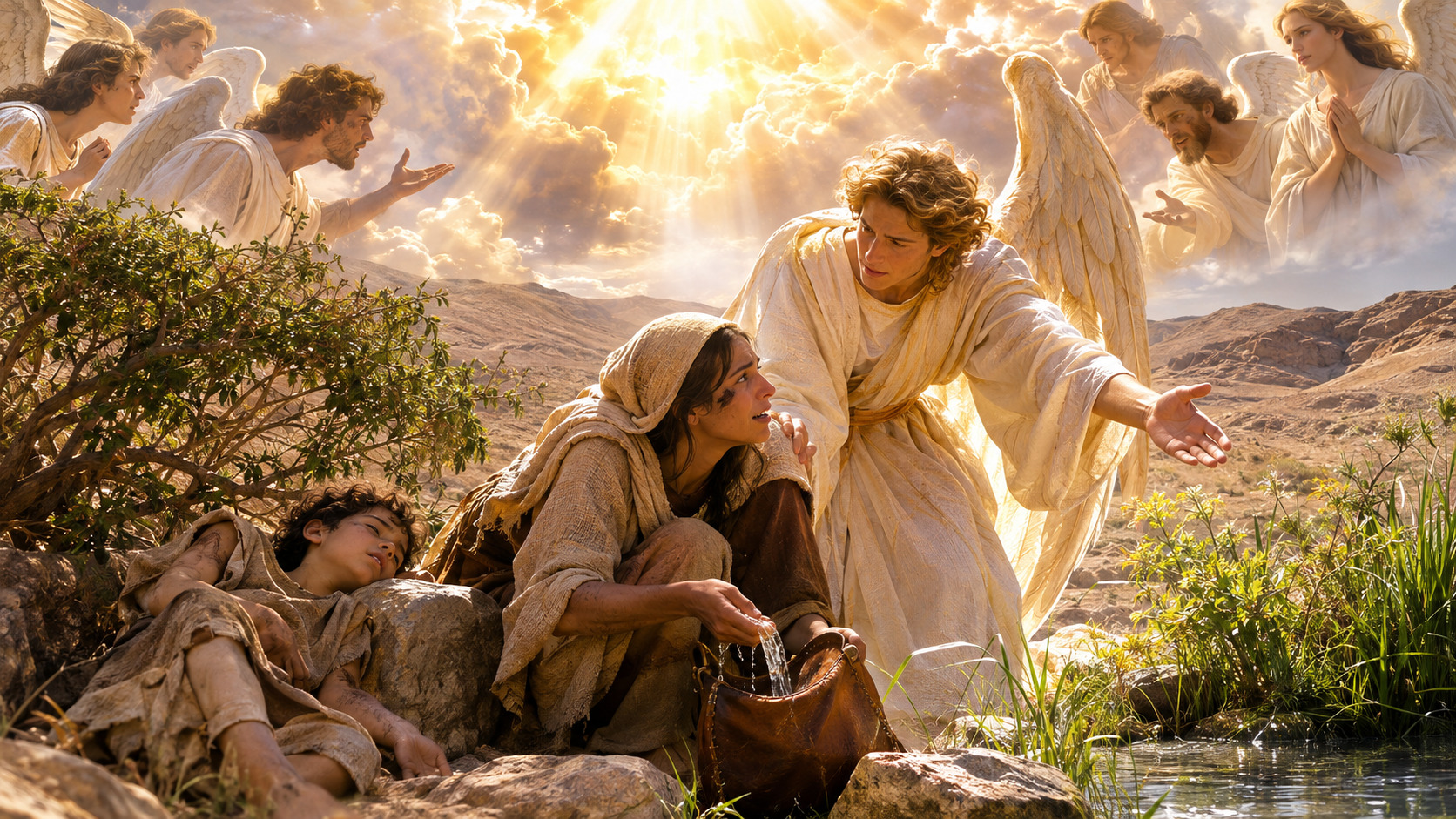
It all begins when Sarah sees Yitzhak and Yishmael playing together, and sees that Yishmael is trying, no less, to harm Yitzhak. She says to Avraham our father: I do not like what is happening here. “Drive out this maidservant and her son, for the son of this maidservant shall not inherit with my son, with Yitzhak.” Yishmael and Hagar must now be sent away.
Avraham our father’s reaction: “The matter was very bad in Avraham’s eyes, on account of his son.” It hurt him very much, because, as the Torah says, “on account of his son”: after all, he too is Avraham’s son.
And we know that Avraham our father is the man of chesed: the sefirah of Chesed belongs to Avraham, and the one who does kindness to all of humanity in his time is Avraham. How can you ask him, no less, to throw out Hagar, who bore your first son, and to throw the son out of the tent too? It is very hard. “The matter was very bad in Avraham’s eyes, on account of his son.”
On the other hand, we see Avraham rise in the morning and do what Sarah asks of him, with the approval of the Holy One, blessed be He: “Avraham rose early in the morning, took bread and a skin of water.”
And Rashi asks right there: why does he send him away with only bread and water, and not with silver and gold? Rashi answers: “לְפִי שֶׁהָיָה שׂוֹנְאוֹ עַל שֶׁיָּצָא לְתַרְבּוּת רָעָה” — because he hated him for having gone astray.
So I don’t understand: does it hurt you or not? If he went astray, good riddance: I have my wife’s approval, I have the approval of the Holy One, blessed be He — I get rid of him gladly. So does Avraham love him or not? On one hand the verse says it hurt him deeply; on the other, according to Rashi in the name of the midrash, he sends him off with bread and water — not even a few coins. Why? Because he hated him.
Before we discuss this question, there was something that troubled Avraham our father more deeply, something much more inward. To crack it open there is a surprising midrash: “She sought out wool and linen — that is what is written: drive out this maidservant.” What is the connection between “she sought out wool and linen” and “drive out this maidservant”?
Where does the verse come from? From “Eshet Chayil,” which we say on Friday night: “She seeks out wool and linen and works willingly with her hands.” Who wrote Eshet Chayil? King Shlomo. Some say he wrote this song about his mother Bat-Sheva; and some say King Shlomo, with divine inspiration, restored what Avraham our father had written about Sarah his wife. So the song Eshet Chayil speaks of Sarah our mother — and at the letter dalet: “She sought out wool and linen.”
Why is it hard for Avraham to send Yishmael away? Because Avraham our father kept the whole Torah, even before Sinai. The Avot kept the Torah before it was given. For example, when the angels came to announce the birth to Avraham, it was Pesach: the proof is that he made them cakes, matzot — and Lot too made them matzot.
It follows that Avraham also kept the verse in parashat Ki Tetze: “If a man has two wives, one loved and one hated, and they bear him sons, the loved one and the hated one… he may not give the firstborn’s right to the son of the loved one over the son of the hated one, who is the firstborn; for he must acknowledge the firstborn, giving him a double portion of all he has.”
That is Avraham. Avraham our father has two wives: one loved, Sarah; and one “hated,” meaning loved less, Hagar. And Avraham our father’s firstborn son is Yishmael, Hagar’s son. What does the Torah command in such a case? You may not prefer Yitzhak, the son of the loved one, over the other’s son, who is the firstborn.
So Avraham our father says: how can you ask me, Sarah, to transgress a prohibition of the Torah that tells me “he may not give the firstborn’s right”? I cannot prefer Yitzhak over Yishmael and send Yishmael away.
Sarah our mother comes and says: “She sought out wool and linen” — I ask you to study what is learned from wool and linen. In the book of Devarim it is written: “You shall not wear shaatnez, wool and linen together.” And the next verse: “You shall make yourself fringes on the four corners of your garment.” Our Sages learned: since the mitzvah of tzitzit is placed right beside the prohibition of wool and linen, tzitzit may be made of wool and linen together. Why? Because “you shall not wear shaatnez” is a prohibition, and “you shall make yourself fringes” is a positive commandment. And we have a rule in halakhah: “עֲשֵׂה דּוֹחֶה לֹא תַעֲשֶׂה” — the positive overrides the prohibition.
So Sarah our mother says: “She sought out wool and linen — that is what is written: drive out this maidservant.” You, Avraham, do not want to send him away because you have a prohibition: “he may not give the firstborn’s right.” But I tell you there is a positive commandment: “Whatever Sarah tells you, listen to her voice, for through Yitzhak shall offspring be called yours.” And the positive overrides the prohibition. So there is nothing to be done: Yishmael must be sent away. That is how the midrash answers this point.
But we are still left with the question: what is happening in Avraham our father’s heart? Does he love Yishmael or not? According to Rashi, since he sent him away with only bread and water, it says he hated him for going astray. The plain meaning says: “the matter was very bad in his eyes.”
Let us go to another place. After he sends him away comes the next chapter, the Akedah of Yitzhak: “After these things, God tested Avraham. He said to him: Avraham. He said: here I am. He said: take your son.” Avraham asks: which one? I have two. — “Your only one.” — Both are only ones to me, each to his mother. — “Whom you love.” — But I love them both. — “Yitzhak.” That’s it, no more arguing.
According to this teaching, what comes out? Does Avraham love Yishmael? He loves him. Your son — both are my sons; your only one — both are only ones; whom you love — I love them both. So according to this midrash, Avraham loves Yishmael. Then how did you tell me earlier that he hated him?
Then comes a third verse that decides between them. We have a fine proof by going back to parashat Lech Lecha, chapter 15, verse 15. To remember it: fifteen, fifteen.
The Holy One, blessed be He, says to Avraham our father, at the Covenant Between the Parts: “And you shall come to your fathers in peace; you shall be buried in a good old age.” What does “you shall be buried in a good old age” mean? Rashi brings in the name of the midrash: He told him that Yishmael would do teshuvah in his lifetime.
And indeed, when we reach the end of Avraham our father’s life — we will see it in parashat Chayei Sarah — it is written: “Yitzhak and Yishmael his sons buried him.” What is wrong with this verse? It should have said “Yishmael and Yitzhak his sons buried him,” because who was born first? Who is the firstborn? Yishmael.
And yet the Torah writes “Yitzhak and Yishmael.” This teaches that Yishmael did teshuvah and said: although I was born first, you are the master of the house; you, Yitzhak, are the true firstborn. That is why he puts him first. From here we see that he did teshuvah.
What do we learn about Avraham our father? Avraham our father loves Yishmael in the depths of his heart. Outwardly, because he went astray, he acted as if he hated him: he sent him away with bread and water. But inside, Avraham remembers what the Holy One, blessed be He, promised him at the Covenant Between the Parts: that Yishmael would do teshuvah.
Because he knew that deep down his son would do teshuvah, he loved him all the time. And indeed, in the end, Yishmael did teshuvah, and everything returned to its place in peace.
You will ask me: if Yishmael did teshuvah, what do all these Yishmaelites want from us today?
Pay close attention: there is a very important, essential detail here that few people notice, and that is how they muddle our minds. The Egyptians are Muslims, right? Are they sons of Yishmael? No. Many think every Muslim is a Yishmaelite, but that is not true. For Egypt it is written explicitly in parashat Noach: “The sons of Cham: Kush, Mitzrayim, Put and Canaan.” The Egyptians are indeed Arabs and follow the religion of Islam, but they belong to Cham; they have no connection to Yishmael. The same goes for other peoples: the Torah lists in Bereishit different peoples who are not related to Yishmael.
Those who claim today to be sons of Yishmael are not the original sons of Yishmael the Torah speaks of; those have dissolved and no longer exist. They attach themselves to Yishmael in the hope of saying that Avraham is their father too. And in their book, if you read the story of the Akedah, whom does Avraham bind on the altar? Yishmael. They turned it all upside down: Yitzhak’s story they transferred to Yishmael, to take on Yishmael’s prestige.
I was asked: how did both a Yitzhak and a Yishmael come from Avraham our father? He educated everyone around him! That is exactly the answer I wanted to give.
Let us see when Yishmael was born and when Yitzhak was born. Yishmael was born when Avraham was still called Avram: the heh had not yet been added, and he had not yet made the brit milah. Avraham was eighty-six when Yishmael was born. For Yitzhak was born when he was a hundred; a year before, Yishmael’s brit was made, at thirteen. So Avraham fathered Yishmael at eighty-six, without brit milah, and he was not yet called Avraham, but Avram.
Let us see what can come out of such a thing. If I do the gematria: Avram, without the heh, 243; Hagar, 208. 243 plus 208: 451 — the gematria of Yishmael. Do you see? Yishmael comes out when Avraham does not yet have the name “father of a multitude of nations” and has not yet made the brit.
If one may describe it so, Yishmael is in fact the dirt that comes out of Avraham our father before he produces Yitzhak — with the full name Avraham, which is 248, like the two hundred and forty-eight limbs: he is complete in all his limbs, and he is after the brit milah, having made a covenant with the Holy One, blessed be He. From what purity Yitzhak comes, and from what dirt Yishmael comes.
Without Yishmael, Yitzhak would not have come out so pure. In fact, he cleaned the pipe. It is like a pipe that has not been opened for a long time, where no water flows: when you open it for the first time, what comes out? Yellow water — that is Yishmael. Then clean water comes out: that is the seed of Yitzhak.
That is why “Yitzhak” is also written in the future tense — “he will laugh”: whatever the Yishmaelites do to us, he who laughs last laughs best. And then will be fulfilled “Then our mouth will be filled with laughter, and our tongue with song.” With God’s help, may Mashiach come very soon, build the Temple, and may the truth come to light, with God’s help. Blessed be God forever, amen and amen.
Genèse / Genesis / בראשית 21,9–14
Rachi sur Genèse / Rashi on Genesis / רש״י על בראשית 21,14
Proverbes / Proverbs / משלי 31,13
Genèse / Genesis / בראשית 18,6
Genèse / Genesis / בראשית 19,3
Deutéronome / Deuteronomy / דברים 21,15–17
Deutéronome / Deuteronomy / דברים 22,11–12
Genèse / Genesis / בראשית 22,1–2
Rachi sur Genèse / Rashi on Genesis / רש״י על בראשית 22,2
Genèse / Genesis / בראשית 15,15
Rachi sur Genèse / Rashi on Genesis / רש״י על בראשית 15,15
Genèse / Genesis / בראשית 25,9
Genèse / Genesis / בראשית 10,6
Genèse / Genesis / בראשית 16,16
Test yourself
Five questions on the shiur. Choose an answer.
Result
Shalom Bayit — The Mouth at Home
My covenant of peace — peace begins at home. Reveal a Shalom Bayit card.
Gematria — Rav Ménaché
Shalom, Mashiah, Yisamech — secrets of the letters by Rav Ménaché zatsal.
🔢 Gematria CourseAll Parashot
All shiurim of M. Yéhouda Himi — from Bereshit to Devarim and the festivals.
📚 All ParashotBooks
Torah wisdom in thriller format — Éditions Gueoula.
Guardians of the Rift
Forty-nine gates open — the fiftieth hides in a single moment. An ancient secret resurfaces, and one man stands between the rift and the world. Drawn from Talmud and Kabbalah.
📖 Read the free excerpt · Book $9.90