Lot —
Why Avraham Saves Him
Lot is an ambivalent figure: Avraham looks after him and saves him, yet he also proposes that they part. It begins at the end of Parashat Noach, in the generations of Terach. The shepherds quarrel, Avraham and Lot part, and only after the separation does Hashem reveal Himself to Avraham: according to the Zohar, “Lot” in Aramaic means cursed. The four kings conquer Sodom and take Lot captive, and Avraham sets out to save him with his three hundred and eighteen disciples. Why? Several answers: he is Sarah’s brother, Lot kept silent in Egypt, and above all the desecration of Hashem’s Name. The inner reason: from Lot come Moav, Ruth, David and King Mashiach. So too with Moshe, and with David and Shimi ben Gera.
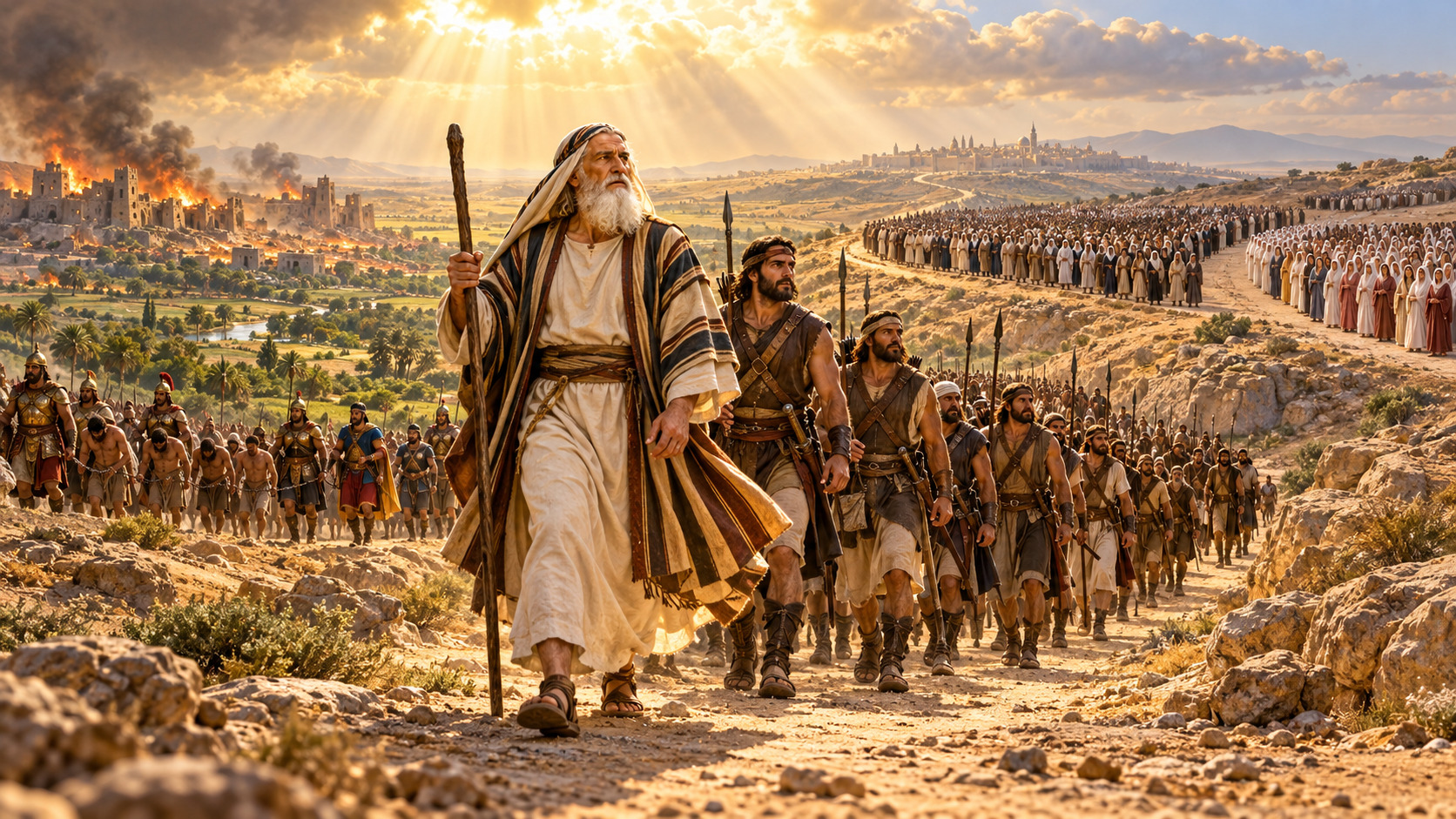
Lot is a very ambivalent figure. On the one hand, Avraham our father looks after him, surrounds him and saves him when needed; on the other hand, he himself proposes that they part. We need to understand what lies behind this. It begins already at the end of Parashat Noach, where the ten generations from Noach to Avraham are told: Terach begot Avram, Nachor and Haran, and Haran died after begetting Lot. When they set out toward the land of Canaan they get stuck in Ur Kasdim, and after Terach’s death Avraham goes further and takes with him Lot, the son of Haran, his brother’s son.
Lot stays close to Avraham our father all along the way: from Ur Kasdim to the land of Canaan, and from there to Egypt when there is famine in the land. After Pharaoh releases Avraham, his wife and all that he has, they go up from Egypt, and the Torah says: “and Lot with him, to the Negev.” Avraham watches over Lot, a kind of supervisor over him.
On the way up from Egypt, Avraham is very rich in livestock, silver and gold, and Lot too has flocks, herds and tents; the land could not support them dwelling together. There was a quarrel between the shepherds of Avraham’s livestock and those of Lot’s. What was the quarrel? Rashi explains: Lot’s shepherds said among themselves: we know that your master, Avraham, is barren, he has no children, he will die, and his only heir is Lot; so we inherit Avraham’s portions in the land of Canaan, and therefore we allow ourselves to graze our sheep in your fields. The shepherds speak as their master speaks: there is an understanding here that in Lot’s mind he is going to inherit Avraham.
Avraham says to Lot: “Let there be no strife between me and you, and between my herdsmen and yours, for we are brothers.” If we are brothers, what should we have done? Make peace and be together. But Avraham does not say that: “Is not the whole land before you? Separate from me: if left, I go right; if right, I go left.” Let us part; choose whichever direction you want. Lot looks and sees the plain of the Jordan, Sodom and Gomorrah. Before Sodom and Gomorrah sinned, it was an oasis. He chooses that region. Avraham settles in the land of Canaan, and Lot settles in the cities of the plain and pitches his tent as far as Sodom. Avraham understands that it is not good for them to be together, and each sits in his own corner.
It is not only Avraham who understands that it is not good for them to be together; the Holy One, blessed be He, also tells Avraham: be strong and blessed. How do we see it? “And Hashem said to Avram, after Lot had separated from him”: until Lot separated from Avraham our father, the Holy One, blessed be He, did not reveal Himself to him. The Zohar asks why: why wait until Lot parts from Avraham before Hashem reveals Himself to him? Apparently there is something negative in Lot. The Zohar says: “Lot” in Aramaic means curse. Aram, the region of Haran, was where this language was spoken, and they called him Lot, cursed. By the language, Lot is cursed, and there is no blessing in him; until he separated from Avraham our father, even Hashem did not reveal Himself to him.
If so, a great question arises. Right after the Holy One, blessed be He, promises Avraham the land, the Torah tells of the war between four kings and five kings. The four: Amrafel king of Shinar, Aryoch king of Ellasar, Kedorlaomer king of Elam and Tidal king of Goyim. The five: Bera king of Sodom, Birsha king of Gomorrah, Shinav king of Admah, Shemever king of Tzevoyim, and the king of Bela. Sodom is among the five, and who lives in Sodom? Lot. The four win, they are stronger, and they take Lot captive.
What should Avraham our father have said? Blessed is He who rid us of him; they did the job for us, what more do we need? But “the fugitive came,” said to be Og king of Bashan, who escaped from the Flood, and ran to Avraham the Hebrew and told him: listen, they took Lot captive. “Avram heard that his brother was taken captive”: suddenly he is his brother! You wanted to part from him, and now suddenly he is his brother? “He armed his trained men”: Avraham musters three hundred and eighteen men, leaves everything, goes as far as the Damascus area, saves Lot and brings him home. Some say he took only one, Eliezer, Damesek Eliezer, and Eliezer in gematria is three hundred and eighteen. Eliezer was a great hero: he was Nimrod’s son. When Nimrod wanted to throw Avraham into the fiery furnace and saw an angel come down and cool it, so that he came out unharmed, he said to him: I give you my son as a gift, to be your servant. And some say that Eliezer left his father and said: I join to be Avraham’s servant.
The question is: why save him? You parted from him earlier, and the Holy One, blessed be He, told you: be strong and blessed; you saw that the Holy One, blessed be He, speaks with you only when Lot is not beside you, so why bring him back next to you? One answer: he is Sarah’s brother. A second answer: in Egypt, when Avraham said to Pharaoh “Say you are my sister,” Lot could have gone behind Pharaoh’s ear and told him: he is deceiving you, she is his wife. But he kept silent, and kept faith with Avraham our father. Measure for measure, Avraham also saves him. In addition, Avraham our father is the symbol of chesed: Avraham is chesed, Yitzchak gevurah, Yaakov tiferet. He cannot remain indifferent; he even prays for the people of Sodom and Gomorrah, whereas his nephew did not pray. And still the question remains: what drives Avraham to fight like this to save Lot?
There is another answer. When the five kings surrendered to the four kings, the whole reason for the war, our Sages say, was to capture Lot. They thought it was Avraham our father, because the family face is similar, and they were sure they had taken Avraham captive, and published it in all the news of the world. Who was Avraham at that time? Avraham the Hebrew, who came and told all humanity: you are simply fools to worship idols, there is a God in heaven. Everyone looked for a way to get rid of him: you are ruining our livelihood. Imagine a factory of statues, and one Jew comes and says: everything you do is nonsense; the factory goes bankrupt, because no one buys statues any more. So what is the problem? In Devarim, chapter 21, there is a commandment: if a man is sentenced to death, he is hanged, but “you shall not leave his body overnight on the tree, but you shall bury him that day, for a curse of God is the one hanged.” What is the connection? Since man was created in the image of God, leaving him hanging and degraded on the tree degrades the image. Rashi brings a parable here: a king had a twin brother who turned to bad ways, and they sentenced him and hanged him on a tree; everyone who comes to the land and does not know says: the king is hanged! But it is only his brother. Meanwhile, they think the king is hanged. So here: if people think Avraham was captured, they will say: where is his God? We captured him and did to him what we wanted. To prevent this desecration of Hashem’s Name, Avraham leaves everything and goes to save Lot.
There is one more inner reason. When the Holy One, blessed be He, overturns Sodom and Gomorrah, Lot and his family are saved and flee to the mountain. Lot and his two daughters remain there, and they were sure that another Flood had happened and everyone was wiped out. They find there a jar of wine that Noach had prepared and kept in the cave, and they give him to drink. The elder one comes at night, he is drunk, and then she comes to him, and a child is born whom they call Amon. The next day the younger one, and from her Moav is born. From Moav came Balak king of Moav, and later Eglon king of Moav. And Eglon had two daughters, one Orpah and one Ruth. Ruth married Boaz, and Boaz begot Oved, and Oved begot Yishai, and Yishai begot King David, and from David, with Hashem’s help, comes King Mashiach. Now we understand: when Avraham goes and saves Lot, he does not save him because of Lot himself, but because of what was destined to come from him. Had he not saved Lot, we would have no King Mashiach. Nothing here is by chance: it is a creation of long range.
We have an opposite example with Moshe our teacher. When he goes out and sees an Egyptian man striking a Hebrew man, one of his brothers, what does he do? “He looked this way and that, and saw that there was no man, and he struck the Egyptian and hid him in the sand.” What does “he saw that there was no man” mean? Not that he looked around and saw there were no witnesses. Moshe saw, through his prophetic vision, whether anything was destined to come from this Egyptian. Had something come from him, perhaps he would not have done anything to him. Since he saw that there was no man, that nothing was destined to come from this Egyptian, “he struck the Egyptian.”
One more example: when Avshalom his son rebels against King David and he has to flee Jerusalem, he meets Shimi ben Gera, of the family of Shaul, the rival family. He finds an opportunity, begins to curse David, takes stones and dust and begins to throw them at him, and says to him: you deserve it, what is happening to you now is what you did to Shaul. Yoav ben Tzeruyah, the commander of the army, says: how does he dare to insult the king like this? Let me take off his head. And King David says: no, do not touch him. Everyone asks: there is a halakha that a king who forgoes his honor, his honor is not forgone; why do you let him go on living? But at that time Shimi ben Gera had no children yet, and David saw that a child was destined to come from him, so he said: do not touch him, leave him. Later, when King David is on his deathbed, he calls Shlomo and says: do you remember what Shimi ben Gera did to me? At the first opportunity, kill him. Why now? Because in the meantime a son was born to Shimi ben Gera, and from this son came Mordechai the Jew, a man of Binyamin. Until a child was born to Shimi from whom Mordechai would come, who saved Israel, it was forbidden to touch him; after he fulfilled his purpose, it was possible to kill him. These examples are not one-time events; we see this throughout the Tanakh. And the first is Avraham our father: had it not been that Moav was destined to come from Lot, and from Eglon, Ruth, from whom come King David and later King Mashiach, he would not have been worth saving. But because of the future that comes from him, he is worth it.
Test yourself
Five questions on the shiur. Choose an answer.
Result
Shalom Bayit — The Mouth at Home
My covenant of peace — peace begins at home. Reveal a Shalom Bayit card.
Gematria — Rav Ménaché
Shalom, Mashiah, Yisamech — secrets of the letters by Rav Ménaché zatsal.
🔢 Gematria CourseAll Parashot
All shiurim of M. Yéhouda Himi — from Bereshit to Devarim and the festivals.
📚 All ParashotBooks
Torah wisdom in thriller format — Éditions Gueoula.
Guardians of the Rift
Forty-nine gates open — the fiftieth hides in a single moment. An ancient secret resurfaces, and one man stands between the rift and the world. Drawn from Talmud and Kabbalah.
📖 Read the free excerpt · Book $9.90