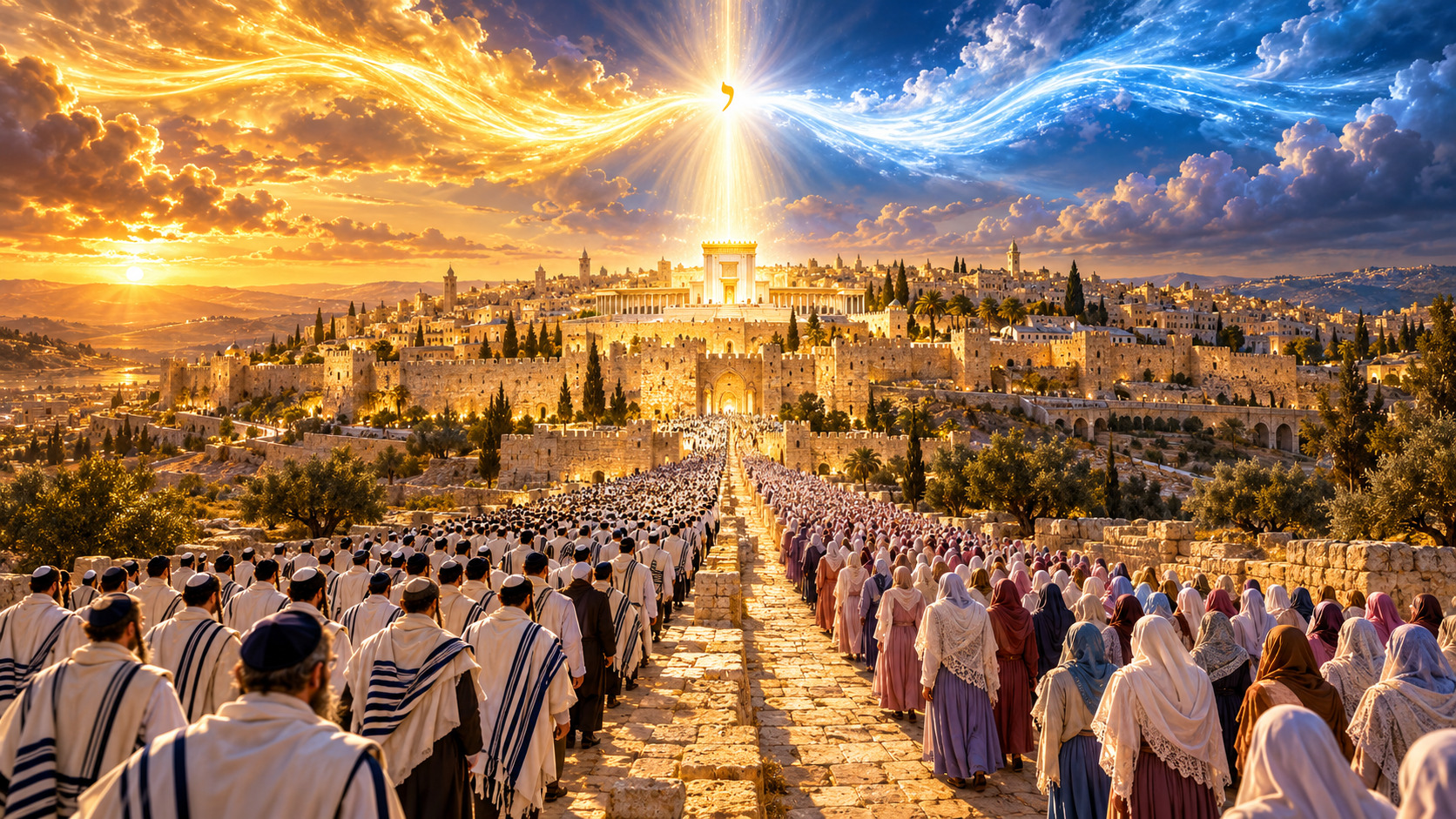
Jerusalem —
Two Names and a Yod of Mercy
After the war, Malki-Tzedek king of Shalem comes out to meet Avraham, and the Midrash says he is Shem, son of Noah. He calls Jerusalem “Shalem,” and Avraham calls it “Yireh” after the Akeda, when he demands that Hashem forgive the grandchildren of Yitzchak. Jerusalem joins the two names, judgment and kindness. Throughout the Tanakh it is written without a yod, except in five places, and in Yirmiyahu Hashem plants the yod, the attribute of mercy. At the end: the dispute between Sarah and Avraham, and Targum Yonatan, which teaches shalom bayit as a segula for having children.
After the war between the four kings and the five kings, in which the four powerful kings won and the king of Sodom was among the defeated, the Torah says in Genesis 14:17: “And the king of Sodom went out to meet him after his return from smiting Kedorlaomer and the kings who were with him.” The Midrash says that Kedorlaomer was the son of Malki-Tzedek, king of Shalem. This is a very important detail.
After the war, Malki-Tzedek king of Shalem also went out to meet Avraham. Even though Avraham our father had struck down and killed his son in the war, Malki-Tzedek wanted to show that he was not angry with him and that he accepted the judgment, so he went out to meet him and brought out bread and wine. The Torah tells us, as if in parentheses: “and he was a priest of El Elyon.” Who is the priest of El Elyon? The verse can be read as referring to Avraham, who is considered a priest of El Elyon, and Malki-Tzedek is generous toward him. But the plain meaning is that it is the same Malki-Tzedek, king of Shalem. And he blessed him: “Blessed be Avram to El Elyon, Maker of heaven and earth, and blessed be El Elyon who delivered your enemies into your hand,” and he gave him a tithe of everything. The Midrash stops at the fact that Avraham hears Malki-Tzedek say “Blessed be Avram to El Elyon,” that is, he puts Avraham before El Elyon. This is a point for which Avraham will later have to pay a small price.
The Midrash says that Malki-Tzedek is none other than Shem, son of Noah. Avraham meets him at the end of Shem’s days, a kind of overlap. And now notice the city: who is the king of Shalem, and what is Shalem? Jerusalem. That is, Malki-Tzedek, Shem son of Noah, calls Jerusalem “Shalem.”
After the Akeda was over, Hashem says to Avraham: well done, you passed the test. Avraham says to Him: wait, wait, I am not leaving here for free. I passed a very hard test, and Yitzchak passed a very hard test, and I demand a price for it. What is the price? “As it is said to this day, on the mountain Hashem will be seen”: I ask You for a promise, Hashem, that if the grandchildren of my son Yitzchak sin, You will forgive them in the merit of the Akeda that took place here today. Avraham was not willing to move from the place until Hashem opened this for him, that if the grandchildren of Yitzchak sin, He forgives them in the merit of the Akeda. That is why we recall it on Rosh Hashana and Yom Kippur: in the merit of the Akeda of Yitzchak our father.
And so we understand that the name Jerusalem is a joining of two names. The name Avraham gave, “Yireh”: “he called that place Yireh.” And the name Shem, son of Noah, gave, “Shalem.” Jerusalem is a joining of “Yeru” and “Shalem.” And Hashem said: I do not want to disappoint Avraham on the one hand, nor Shem son of Noah on the other.
Throughout the entire Tanakh, even though we say “Yerushalayim” with a yod, the word is written without a yod, even in Tehillim, except in five places. And these are the five: in Yirmiyahu, “Zion shall be plowed as a field, and Jerusalem shall become heaps.” In Megillat Esther, “who had been exiled from Jerusalem with the exile.” In I Chronicles, “Shimea, Shobab, Nathan, and Solomon,” who were born to David in Jerusalem. In II Chronicles, “He was twenty-five years old when he began to reign, and he reigned twenty-nine years in Jerusalem; and his mother’s name was Yehoaddan of Jerusalem.” And in II Chronicles, “After this Sennacherib sent... against Hezekiah king of Judah and against all Judah that were in Jerusalem.”
First we must understand what Jerusalem in the plural is. Our Sages mention Jerusalem in the plural, like “eyes” and “feet”: not one Jerusalem but two, the Jerusalem below and the Jerusalem above. Hashem swore that He will not enter the Jerusalem above until Israel enter the Jerusalem below.
When I say “Malki-Tzedek, king of Shalem,” I hear “tzedek” and “shlemut”: there is severity here, judgment, justice and truth. But Avraham calls it “Yireh,” and Avraham is the man of kindness. “As it is said to this day, on the mountain Hashem will be seen”: I know that I did something unimaginable, the Akeda, but I take into account, says Avraham our father, the man of kindness, that there is no righteous person on earth who does good and does not sin. Yitzchak is righteous, but from him came Yaakov and the twelve tribes, and they will not be perfect. They need to do teshuva, they need atonement, and they have things to atone for: urges and desires. And I, Avraham our father, the man of kindness, ask first for kindness. So there is a combination here of “Yireh,” kindness, with “Shalem,” wholeness and judgment. And Hashem says: I do not give up this harmony. Even if there is a Jerusalem below and a Jerusalem above, it remains Jerusalem.
But in Yirmiyahu, and when you say Yirmiyahu the prophet of destruction comes to mind, Hashem says: here I must mix in My attribute of mercy. And He plants in the word “Shalem” His letter yod, which is the attribute of mercy. And this is the strength that will be given to the people of Israel in the destruction, which Yirmiyahu represents, to rise to life again: there is a seed of yod inside Jerusalem. Not only do we say it, we also write it. This is the promise that, with Hashem’s help, a complete redemption will come afterward. In Megillat Esther and in Chronicles, books written after the destruction, there is this hope: by the strength of what was given to us in the book of Yirmiyahu there will be a return to Zion, and the Jerusalem below will join the Jerusalem above. We will both say Yerushalayim and write Yerushalayim. This is the completion: we joined the attribute of judgment with the attribute of kindness, and together we reach what we call Tiferet. Avraham is kindness, Yitzchak is strength, and Yaakov is Tiferet. The people of Israel is Yaakov, Tiferet, the combination of these two forces together. All this we can draw from the word “Jerusalem,” with which we walk, with Hashem’s help, until the building of the third Beit Hamikdash, amen.
In Tehillim, in Psalm 122, a song of ascents of David: “I rejoiced when they said to me, let us go to the house of Hashem. Our feet were standing in your gates, Jerusalem.” Here too Jerusalem is without a yod, as we said; only in Yirmiyahu do we have Jerusalem with a yod. And King David says: “Jerusalem, built as a city joined together.” The condition for it to be built is that it be joined together: that there be peace between judgment and kindness. “There the tribes went up, the tribes of Yah, a testimony to Israel, to give thanks to the name of Hashem,” and “for there thrones were set for judgment,” that is, there is judgment here. What is the condition? “Pray for the peace of Jerusalem”: if you make peace, you join these two forces, and then there will be peace.
We have the dispute between Sarah and Avraham our father, after Sarah gives Hagar to Avraham, an initiative of Sarah. Genesis 16: “And Sarai, Avram’s wife, took Hagar the Egyptian, her maid, after ten years of Avram’s dwelling in the land of Canaan, and gave her to her husband Avram to be his wife. And he came to Hagar, and she conceived.” Up to here everything is fine. But as soon as Hagar conceived, she began to act arrogantly: “and her mistress was despised in her eyes.” And Sarah says to Avraham: “My wrong be upon you... Hashem judge between me and you.” “Judge” means judgment: Sarah is bringing judgment upon Avraham our father. This is a very serious thing. Until now we are used to Sarah our mother being righteous, so how could Sarah bring judgment upon Avraham? There is a Midrash in the name of Rabbi Chiyya: whoever stirs up the attribute of judgment against his fellow does not come out of it clean. Sarah deserved to reach Avraham’s years. Avraham died at 175 and Sarah at 127, and 38 years of her life were withheld for this word. And according to this reading, Sarah brought judgment and was punished for it.
Targum Yonatan ben Uziel explains it completely differently. Sarah said to Avraham: my wrong be upon you. I was sure that you would do me justice, since I left my land and my father’s house and came with you to a foreign land, and because I was not bearing I put my rival in your bosom, and she saw that she had conceived and my honor was belittled before her. We are usually used to thinking that this is judgment. But notice: Sarah says: see how she insults me. I was insulted, and in the merit of having been insulted and not striking back and still loving you, “Hashem judge between me and you”: Hashem will see the love that remained between us, and in its merit, from now on, I too will have children. What do we learn from Targum Yonatan? When there is love between a man and his wife and closeness between them, this shalom bayit brings blessing, and by its strength she will conceive and give birth. This is a very beautiful lesson: one of the segulot for having children is that husband and wife love each other and live in peace.
Test yourself
Five questions on the shiur. Choose an answer.
Result
Shalom Bayit — The Mouth at Home
My covenant of peace — peace begins at home. Reveal a Shalom Bayit card.
Gematria — Rav Ménaché
Shalom, Mashiah, Yisamech — secrets of the letters by Rav Ménaché zatsal.
🔢 Gematria CourseAll Parashot
All shiurim of M. Yéhouda Himi — from Bereshit to Devarim and the festivals.
📚 All ParashotBooks
Torah wisdom in thriller format — Éditions Gueoula.
Guardians of the Rift
Forty-nine gates open — the fiftieth hides in a single moment. An ancient secret resurfaces, and one man stands between the rift and the world. Drawn from Talmud and Kabbalah.
📖 Read the free excerpt · Book $9.90