Noach, Moshe and Yonah — the Righteous Man’s Repair
“Noach was a righteous man in his generations”: praise or reproach? The shiur distinguishes the righteous man in a fur coat from the righteous man at the stove, hears mercy behind the announcement of the Flood, compares Noach with Moshe, who prays for Israel, then with Yonah — his gilgul according to the Zohar — who repairs by saving Nineveh. The fish, the dove and the two forms of the Name Elokim complete one teaching: to be righteous is to care also about those outside.
The Torah presents Noach as a righteous and wholehearted man. Rashi records two readings of “in his generations”: for some it is praise — righteous in the midst of a corrupt generation, a pearl among pieces of glass; for others, reproach — in Avraham’s generation he would hardly have counted. But how can one read as a reproach what the Torah itself testifies, that he was righteous?
A first answer: to count for nothing is to efface oneself. Moshe says “and what are we?” — mah, nothing — and he is the one through whom the Torah reaches us from Sinai. A person who considers himself nothing before Avraham is precisely a righteous person, so there is no contradiction with the text. But a question remains: if the Torah says “righteous,” what does it ask of him?
When the verse says “Noach, a righteous man,” it is not only praise: it is a demand — what do you do with your righteousness? The shiur distinguishes two kinds of righteous person. Picture a Beith Haknesset with snow outside and people shivering. The one who is truly righteous looks for a stove so that everyone can warm up; the other comes in, puts on his fur coat and sits in his corner: a righteous man in a fur coat — righteous toward whom, with everyone around him in the cold? Avraham is the righteous man of the stove: he does not keep the knowledge of Hashem to himself, but makes His Name known around him, even at the price of the burning furnace. Noach builds an ark and takes shelter in it.
Before the decision, the Torah writes “Vayar Hashem” — with the Name of mercy — and then “Hashem regretted having made man, and was grieved in His heart.” Even when He sees the world’s corruption, He looks with eyes of mercy: what father wants to lose his children? Noach holds on to strict judgment: “with Elokim Noach walked” — the Name of Din. He hears the sentence and nothing else. Whoever hears this grief can plead: “Wait, some can still return; let me try.” Noach did not.
Moshe, too, is offered a fresh start from himself, just as Noach was. Moshe answers by praying: if You do not forgive, erase me from Your book. Where Noach obeys and stays silent, Moshe fights. The shiur stresses both the resemblance — the Arizal teaches that Moshe is a gilgul of Noach, come to repair — and the difference: prayer for one’s generation. Nor was the earlier humanity primitive: Adam, Lemech, Shem and Ever were giants of Torah, close to the Shekhinah. Hashem spoke to Noach directly.
The reproach is real: Noach did not escape the ordeal. He spends a year in the ark without daylight, among the animals — it is said that the lion injured him — and on leaving he drinks wine to shake off his depression, as the shiur explains. Had he had no failing, Hashem could simply have set him apart on a mountain.
The Zohar reads “he sent forth the dove” as an allusion to Yonah the prophet. The parallels are striking: Yonah flees his mission, goes down to Yafo, boards a ship — like Noach entering the ark; there are forty days of rain, and forty days until Nineveh is overturned (Yonah 3:4); and he is thrown into the sea so that it will calm (Yonah 1:12 and 1:15) — what Noach had not done: give himself up to save those around him. The Flood is called “the waters of Noach” (Isaiah 54:9): it is charged to his account. Yonah comes to repair it.
Why does Hashem send a fish? Because only the fish were not affected by the Flood and had not touched the sin that caused it. “The earth was filled with chamas” (Genesis 6:11) — robbery; and “all flesh had corrupted its way” (6:12) — species had mixed. Yet under the water there are no borders, and no fish mates with another species; one who lives that way by nature is not guilty of theft. That is why no sacrifice is brought from fish. The fish alone could help Yonah repair what Noach had not repaired. It is also explained: Yonah is first swallowed by a male fish, where he is comfortable and does not pray; Hashem has him swallowed by a pregnant female — cramped, he prays. This faithful couple of fish is also the opposite of the generation of the Flood.
Why does Yonah flee when he need only announce that Nineveh will be overturned? Here is a deep explanation. Pharaoh, the only survivor of the sea, repented and became king of Nineveh. The souls of the generation of the Flood, already destroyed, were entitled to repair by being reincarnated in the children of Israel in Egypt; this is why Pharaoh orders the boys thrown into the water: to prevent that repair. Yonah, Noach’s gilgul, does not want to help the one who wanted to drown Israel. There is also the fear: if Nineveh repents and Israel does not… Hashem answers: you will repair what Noach did not do. Yonah gets round it: he does not go to the king, who would repent at once, but “begins to enter the city, a day’s walk” — toward the people. “The people of Nineveh believed in God” — and only then “the word reached the king.” Thus Noach is repaired.
If Noach found favor, why does he live the ark as an ordeal? Because “vayimtsa chen” is not an accomplished fact: it will be at the end of the road, when Moshe prays for his generation and Yonah saves Nineveh. He is a righteous man who still has something to repair. The one who is told “you are righteous” is handed a task.
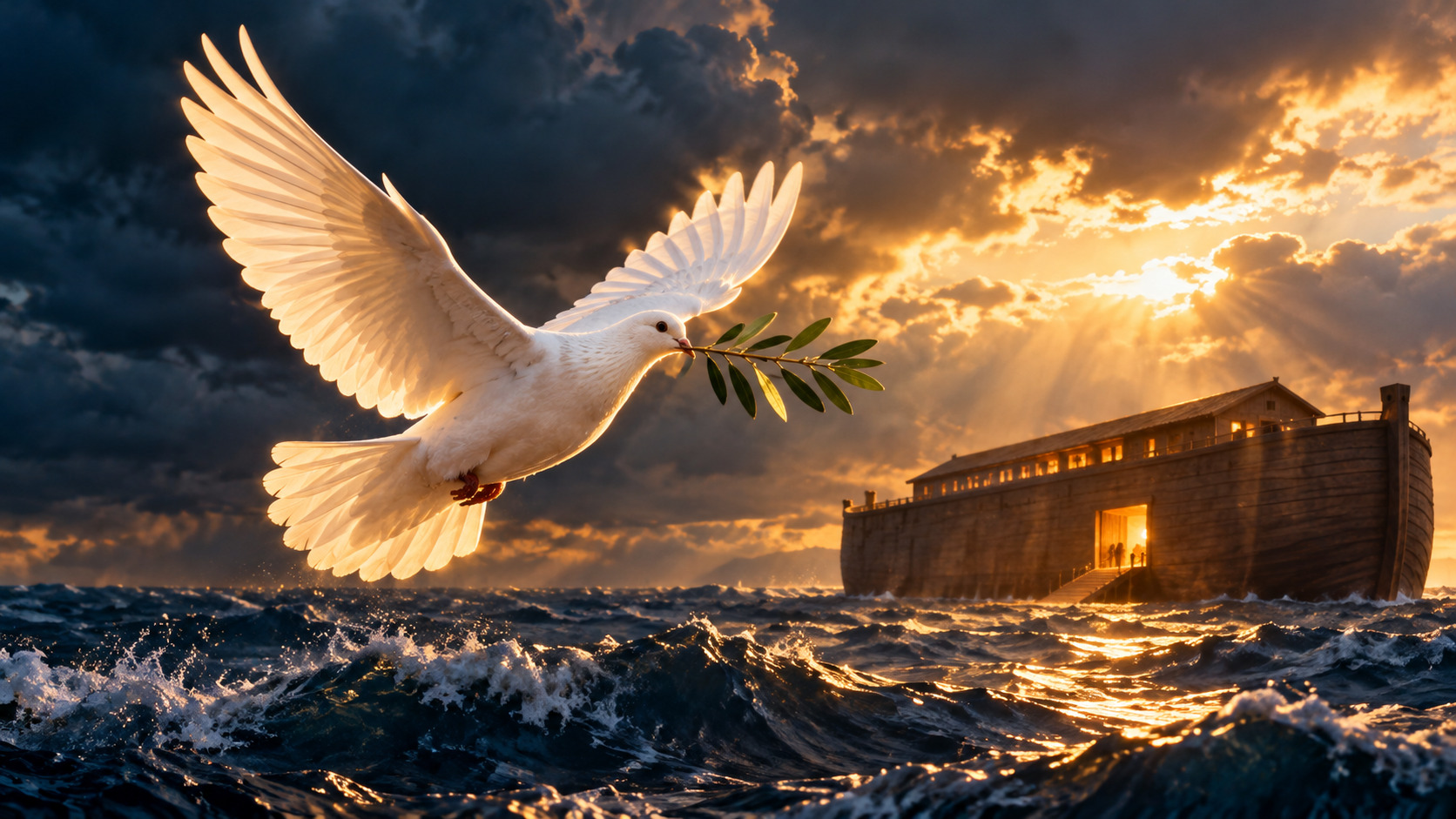
The shiur also decodes the episode of the dove. The dove is Knesset Israel (“my dove in the clefts of the rock,” Song of Songs 2:14). After the raven was sent, the first time she finds no place to set her foot: the destruction of the First Temple. She returns to the ark; the second time she comes back with an olive leaf — “taraf,” plucked — which evokes Yosef (“taroph toraf Yosef,” Genesis 37:33), hence Mashiach ben Yosef: we are in the night of exile, and dawn is near. The third time she does not return (Genesis 8:12): no more destruction, the complete Redemption and the Third Temple.
The Name Elokim (86, like “haTeva,” nature) is the Name of Din. Replacing each letter by the one before it gives אכדטם, its softened form; replacing each by the one after gives במוכן, its intensified form. Din grows heavier when, instead of trusting Hashem, a person touches what is “prepared” for someone else: “no man touches what is prepared for his fellow” (Yoma 38b). The generation of the Flood had removed both: no bitachon (75 = “ad,” 74, plus 1 — “Trust in Hashem forever,” Isaiah 26:4) and robbery. Noach kept both: he trusted, and he did not touch what was not his; that is why he entered the ark. “I am the first, and I am the last, and besides Me there is no Elokim” (Isaiah 44:6): whoever clings to gentleness and keeps from “bamuchan” is not touched by severity.
No one may sit down and say: I have saved my own soul, I am righteous, what do I care what happens outside. Righteousness is measured by what we see around us, to the right and to the left: what people need, materially and spiritually. When we give of ourselves, we prevent the next flood. May we be among those who hasten the coming of Mashiach Tsidkenu, speedily and in our days.
Test yourself
Five questions on the shiur. Choose an answer.
Result
Shalom Bayit — The Mouth at Home
My covenant of peace — peace begins at home. Reveal a Shalom Bayit card.
Gematria — Rav Ménaché
Shalom, Mashiah, Yisamech — secrets of the letters by Rav Ménaché zatsal.
🔢 Gematria CourseAll Parashot
All shiurim of M. Yéhouda Himi — from Bereshit to Devarim and the festivals.
📚 All ParashotBooks
Torah wisdom in thriller format — Éditions Gueoula.

Guardians of the Rift
Forty-nine gates open — the fiftieth hides in a single moment. An ancient secret resurfaces, and one man stands between the rift and the world. Drawn from Talmud and Kabbalah.
📖 Read the free excerpt · Book $9.90