Toldot —
Father of a Multitude of Nations
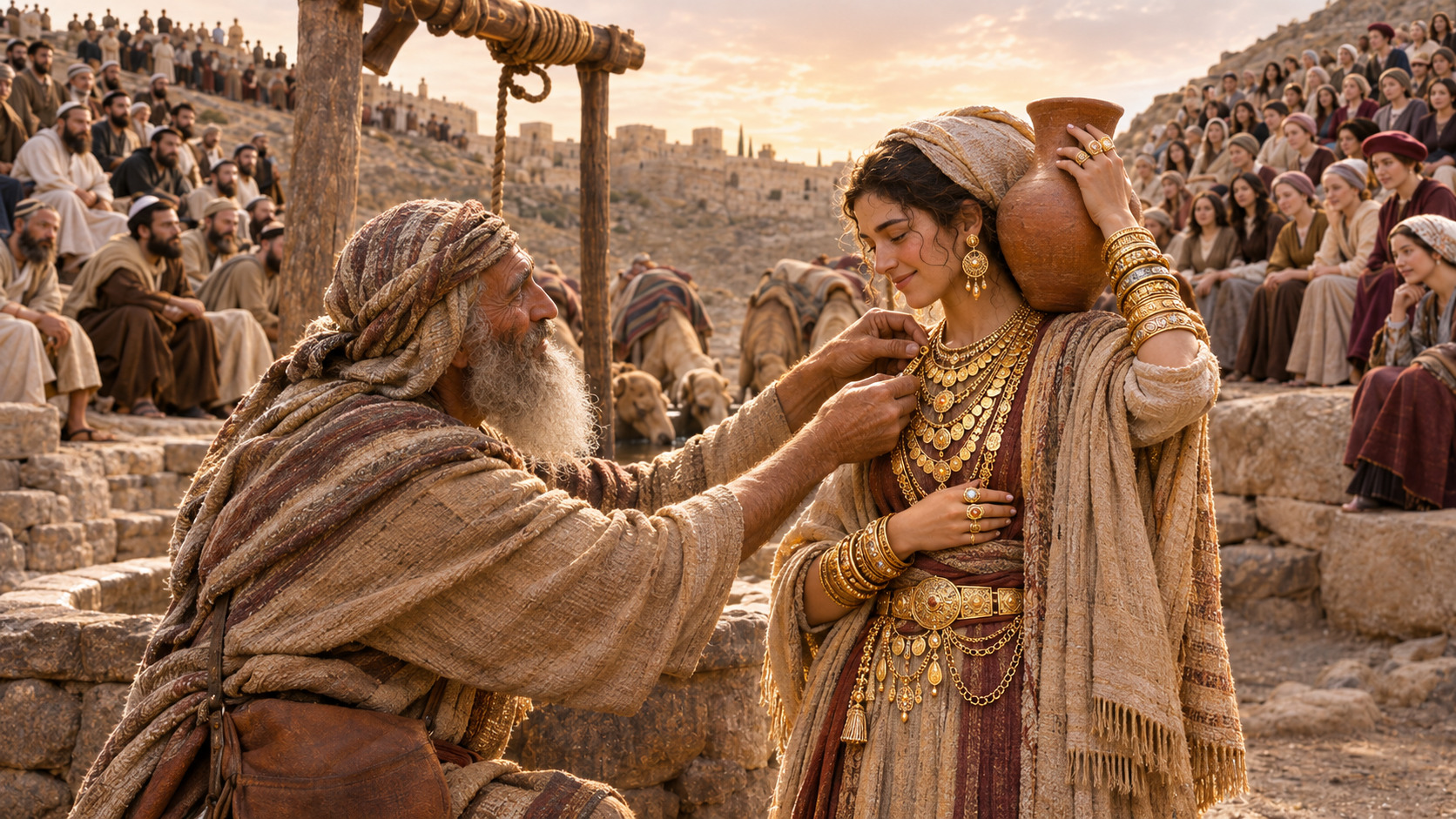
Avraham makes Eliezer swear not to take a wife for Yitzhak from the daughters of Canaan. Yet Eliezer is his disciple: “Dammesek,” the one who draws and gives drink from his master’s Torah, whose face so resembled Avraham’s that Lavan greets him with “Come, blessed of Hashem.” But he descends from Cham through Nimrod, and Avraham answers him: “My son is blessed and you are cursed, and the cursed cannot cleave to the blessed.” So how could Sarah give Avraham Hagar, Pharaoh’s daughter, who also descends from Cham? And why does the Torah list the sons of Keturah without telling us what came of them? M. Himi answers with a midrash: Avraham married three different women — Sarah, from Shem; Hagar, from Cham; Keturah, from Yefet — because Hashem had told him “I have made you the father of a multitude of nations.” Like Adam and like Noach, he had to build the whole world, and “the world is built on kindness.” But Yitzhak had to remain a pure root, until Mashiach.
Words of Torah do good when they are shared. Send this shiur to your family and friends on WhatsApp.
📲 Send on WhatsApp👥 Join the Gueoula groupToday, with Hashem’s help, is the twenty-ninth of Cheshvan, erev Rosh Chodesh. We are still within the days when one may speak of the parasha that has just passed — until Tuesday one may still speak of it. But, with Hashem’s help, we will connect it to this week’s parasha as well.
And there is a very interesting question.
We know from last week’s parasha that Avraham says to Dammesek Eliezer, his servant: “You shall not take a wife for my son from the daughters of the Canaanite, among whom I dwell.”
And he tells him: I am sending you to my family, to Nachor; go and bring me from there a wife for my son, for Yitzhak. And he makes him swear.
So what is the problem? Why am I asking what the problem is? You will understand.
Dammesek Eliezer was the faithful servant of Avraham Avinu. Why is he called “Dammesek”? Because “Dammesek” is two words: “doleh u-mashkeh” — he draws and gives drink from his master’s Torah.
And it is written of the servant: “the elder of his household, who ruled over all that was his” — “ha-moshel be-chol asher lo”: he ruled over his master’s Torah. That is, Eliezer was a talmid chacham, thoroughly versed in the Torah of Avraham Avinu, who drew from his master’s Torah and gave others to drink.
And what does “zaken,” elder, mean? The Sages say, in the name of the midrash, that it is like what is said of Yosef. What does “ben zekunim” mean? One explanation is that he was the son of his old age. But that cannot be, since there was Binyamin, who was younger.
So we need another explanation of “ben zekunim”: “she-hayah ziv ikonin shelo domeh lo” — the radiance of his face resembled his. That is, Yosef looked like his father, Yaakov Avinu. The word “zaken” here means that the face is alike.
The same is said of Eliezer. Eliezer was so attached to Avraham Avinu, he had learned so much of his Torah, that his face had become like the face of Avraham Avinu. That is why it is written: “zekan beito.”
So much so that when Lavan meets Eliezer, he says to him: “Come, blessed of Hashem!”
How does he know what Avraham Avinu looks like? Very simple: it is the family. Avraham Avinu is the son of Terach, who fathered Avram, Nachor and Haran. And Nachor fathered Betuel, who fathered Lavan. They are all one family. Eliezer’s face was truly like the face of Avraham Avinu.
And when Avraham tells him, “You shall not take a wife for my son from the daughters of the Canaanite,” Eliezer says: but wait, I have a daughter who grew up with us. You raised her; she grew up here, with you, Avraham Avinu. You know her. What is the problem with her marrying Yitzhak?
Avraham Avinu answers him: “My son is blessed and you are cursed, and the cursed cannot cleave to the blessed.”
And despite all this — he draws and gives drink from his master’s Torah, his face shines like Avraham’s, and more than that: Dammesek Eliezer merited to be among the nine people in all of world history who entered Gan Eden in body and soul — there is nothing to be done: he is cursed.
Why? Because he is a descendant of Cham. How do we know? Cham fathered Kush, Mitzrayim, Put and Canaan. And Kush fathered Nimrod. Nimrod wanted to throw Avraham Avinu into the fiery furnace, and when Avraham Avinu came out of the furnace safe and sound, Nimrod said: I give you my son as a gift. Who is his son? Eliezer.
So in the end, Eliezer is of the sons of Cham.
And Noach cursed Cham. He said: “Cursed be Canaan!” He did not want to curse Cham directly; he cursed his fourth son, Canaan. Why? Because Cham had prevented him from having a fourth son; so he cursed him in his own fourth son.
It follows that the children of Israel, the people of Israel, cannot marry into Cham. So far we have understood everything, right?
And then comes a very great question. When Sarah cannot have a child, what does Sarah say? “Please come to my maidservant; perhaps I will be built up through her.”
Who is Hagar? Hagar is the daughter of Pharaoh, king of Egypt — no less. When Avraham went down to Egypt because of the famine, Pharaoh wanted to take Sarah. And then what happened? He said to him: “Here is your wife; take her and go.” And he also gave him his daughter Hagar as a gift. And he said to her: better to be a maidservant in Avraham’s house than a princess in Pharaoh’s house.
So how can this be? Sarah gives Hagar to Avraham as a wife. She could no longer remain a maidservant. Sarah said: I have no problem with Hagar now being your wife; she will have a child, and through her I will be built up.
But Hagar is Pharaoh’s daughter. And Pharaoh is Egypt. And Egypt is the son of Cham — of Cham, and of cursed Canaan.
That is exactly the point — pay attention. Who actually wronged Noach? Canaan? Not at all! It was Cham who maimed him. So why does Noach say “cursed be Canaan”? You, Cham, maimed me so that I would not have a fourth son; so I curse your fourth son, Canaan.
But whom is he really cursing? Cham. “He shall be a slave of slaves to his brothers. May Elokim enlarge Yefet, and may he dwell in the tents of Shem, and let Canaan be their servant.”
So if Cham is cursed, what comes from him is too: Egypt, including Hagar.
So how does Sarah give Hagar to Avraham as a wife, so that Yishmael should come from her? That is a first question. So far it is one question: Hagar is Pharaoh’s daughter.
Let us sum up. Here is Eliezer, the son of Nimrod, the grandson of Kush. And from Egypt, which also comes from Cham, comes Hagar.
This is the question I am asking: how can Avraham tell Eliezer “do not bring me a wife from the daughters of the Canaanite,” when he himself, Avraham Avinu, was with Hagar to father Yishmael — and Hagar comes from the same cursed stock? Did you understand the question?
I want to strengthen the question even more. At the end of the parasha it is written: “And these are the generations of Yishmael, son of Avraham.” Fine — that is his line.
But before that it is written: “Avraham took another wife, and her name was Keturah.” We all know how to say that this is Hagar — that is what the commentators say. But it says Keturah; it does not say that she is Hagar.
Rashi explains why she is called Keturah. Two explanations. Pay attention to the first: “she-na’im ma’aseha ke-ketoret” — her deeds were pleasing like incense, ketoret.
Wait, wait. In the word “ketoret” we also hear the incense of idolatry, don’t we? How could the incense of idolatry be pleasing? Keep the question.
Rashi’s second explanation: “she-kashrah pitchah” — she had tied her opening: she did not unite with any man from the day she separated from Avraham.
The word “Keturah” comes from “keshurah,” tied. How do we know? Tav and shin interchange. And the word “ketoret,” incense: why is it called “ketoret”? Because it binds heaven and earth. That is why it is called “ketoret”: it ties heaven to earth.
So she bound herself in modesty, so that no one would come to her, until Sarah died, and then she would be brought back to Avraham. That is how we have always learned it.
Now I want to tell you a chiddush. All right? What is the chiddush? It is not written that Keturah is Hagar — it is the commentators who say she is Hagar. There is a midrash, in the Yalkut Shimoni, that says that in fact Avraham Avinu married three women.
One is called Sarah, one is called Hagar, and one is called Keturah. Three completely different women.
Sarah is from the seed of Shem. Right? Shem, who fathered Ever, and from there we reach Terach, and Terach fathered… and so on. So Sarah is linked to Shem.
Hagar is linked to Cham, as I have been explaining all along: Cham fathered Mitzrayim, from Mitzrayim came Pharaoh, and Pharaoh fathered Hagar.
And Keturah is linked to Yefet. That is why her deeds were “like ketoret”: the ketoret of those who served idols.
Yefet is, in fact, the peoples of Europe.
— And Esav?
No, not yet. Edom will come later. How do we know about Esav? Because Esav took Machalat, the daughter of Yishmael, and also Basmat, the daughter of Elon the Hittite. But Yefet — that is the branch of Yefet.
So it turns out that Avraham Avinu married three women: one, Sarah, from Shem; one from Cham, that is Hagar; and Keturah, who is in fact linked to Yefet. And why is this important? Why is it important to say this?
Before I answer, one more small question, and I will close the whole picture for you. All right?
Usually, when the Torah details lineages, it is always to tell us what came out at the end. For example, with Noach, the whole list is given to reach Terach, to say that from all this came Avraham Avinu. Before that, the whole list from Adam is given to say that Noach came from it. The list is unrolled to say that from it came Avraham, from it came Yitzhak. Very good.
Here it says, “Avraham took another wife,” and the Torah does not tell us what came out of this list. We get Zimran, Yokshan, Medan, Midyan, Yishbak and Shuach; Sheva and Dedan; Ashurim, Letushim and Le’umim; Eifah, Efer, Chanoch, Avida and Elda’ah — “all these are the sons of Keturah.” So what came of them? The Torah does not say that anything came of them.
And not only that: he sent them away from Yitzhak his son. So why does the Torah detail all this, if they are worth nothing and do nothing for us?
And here, in fact, is the answer to all the questions together. What did the Holy One, blessed be He, tell Avraham Avinu? “Av hamon goyim” — you will be the father of a multitude of nations.
For Avraham Avinu to be the father of all the nations, he must take from all the nations. He cannot make do with Ever alone; he cannot make do with Shem alone. He must have a connection with Shem, with Cham and with Yefet. Otherwise, how will he be the father of a multitude of nations?
He marries Sarah, and he will bring forth the Jewish people. He marries Hagar, and he will bring forth the whole tribe of Cham: Kush, Put, Canaan, Mitzrayim and so on. And he will bring forth Yefet too: from Keturah he will bring forth this list, with which I have nothing to do right now.
It turns out that the seed of Avraham Avinu must be present in every single part of humanity, to fulfill what the Holy One, blessed be He, told him: you will be the father of a multitude of nations.
For who was the first father of a multitude of nations? Adam. That is why we are all called “bnei adam,” the children of Adam, of the first man.
But he spoiled it; it had to be repaired. They searched and searched and searched, and found Noach. Noach starts everything again from the beginning, because there was no one else: there was only Noach, Shem, Cham and Yefet, and their wives. Starting again from the beginning. But Noach too stumbled. What to do? They searched and searched and searched — ten generations — and we reached Avraham.
So Avraham has to step into Noach’s shoes. How will he step into Noach’s shoes? He took three wives, linked to Shem, to Cham and to Yefet — and so he became the father of a multitude of nations.
So now, our question. You ask Avraham Avinu: how can you marry a Canaanite? — No, I need it. Why? Because from me, I am building the whole world.
It is as if you asked how everything actually began with the first man. There were Adam and Chavah. How did mankind multiply? Kayin and Hevel were born, right? With whom would they have children? So the midrash says that a twin sister was born with Kayin, and two twin sisters with Hevel. Ah! — So Hevel was with his sister? — Yes.
“Olam chesed yibaneh” — the world is built on kindness. To build the world, what we call a forbidden union was possible. At the beginning it was not considered a forbidden union. Why? Because it was to build the world. That is why we do not speak of a forbidden union when Kayin unites with his sister: it is perfectly in order, all is well.
Now it is not good. But then — “the world is built on kindness.” Later, when the Torah comes, it will be written, in the passage of the forbidden unions, that a brother and sister may not be together — “chesed hu” — it is not permitted. But before that, it was possible.
It is the same with Avraham Avinu. Avraham Avinu must build the whole world; you must be the father of a multitude of nations. So you may go with Hagar: that is in order, no problem.
But when it comes to giving you, Eliezer, my son — that my son Yitzhak should marry your daughter — no, sir, that will not happen. Why? Yitzhak must be an unblemished offering. He needs only a girl from my family, because the root of Ever — “Ivri,” Hebrew, Jewish — must remain pure until the coming of Mashiach.
That, in fact, is what we have learned here, and I think that is enough for you today. Blessed is Hashem forever, amen and amen.
Genèse / Genesis / בראשית 24,2–4
Genèse / Genesis / בראשית 15,2
Genèse / Genesis / בראשית 37,3
Rachi sur Genèse / Rashi on Genesis / רש״י על בראשית 37,3
Genèse / Genesis / בראשית 24,31
Genèse / Genesis / בראשית 11,27
Genèse / Genesis / בראשית 24,39
Rachi sur Genèse / Rashi on Genesis / רש״י על בראשית 24,39
Genèse / Genesis / בראשית 10,6–8
Genèse / Genesis / בראשית 9,25–27
Rachi sur Genèse / Rashi on Genesis / רש״י על בראשית 9,25
Genèse / Genesis / בראשית 12,10–19
Genèse / Genesis / בראשית 16,1–3
Rachi sur Genèse / Rashi on Genesis / רש״י על בראשית 16,1
Genèse / Genesis / בראשית 25,1–12
Rachi sur Genèse / Rashi on Genesis / רש״י על בראשית 25,1
Genèse / Genesis / בראשית 26,34
Genèse / Genesis / בראשית 28,9
Genèse / Genesis / בראשית 17,5
Words of Torah do good when they are shared. Send this shiur to your family and friends on WhatsApp.
📲 Send on WhatsApp👥 Join the Gueoula groupTest yourself
Five questions on the shiur. Choose an answer.
Result
Shalom Bayit — The Mouth at Home
My covenant of peace — peace begins at home. Reveal a Shalom Bayit card.
Gematria — Rav Ménaché
Shalom, Mashiah, Yisamech — secrets of the letters by Rav Ménaché zatsal.
🔢 Gematria CourseTorah Study
Go deeper into Genesis 25:1 and Rashi’s two explanations of the name Keturah.
📝 Beith HamidrachAll Parashot
All shiurim of M. Yéhouda Himi — from Bereshit to Devarim and the festivals.
📚 All ParashotBooks
Torah wisdom in thriller format — Éditions Gueoula.

Guardians of the Rift
Forty-nine gates open — the fiftieth hides in a single moment. An ancient secret resurfaces, and one man stands between the rift and the world. Drawn from Talmud and Kabbalah.
📖 Read the free excerpt · Book $9.90