Toldot —
As Water Reflects a Face
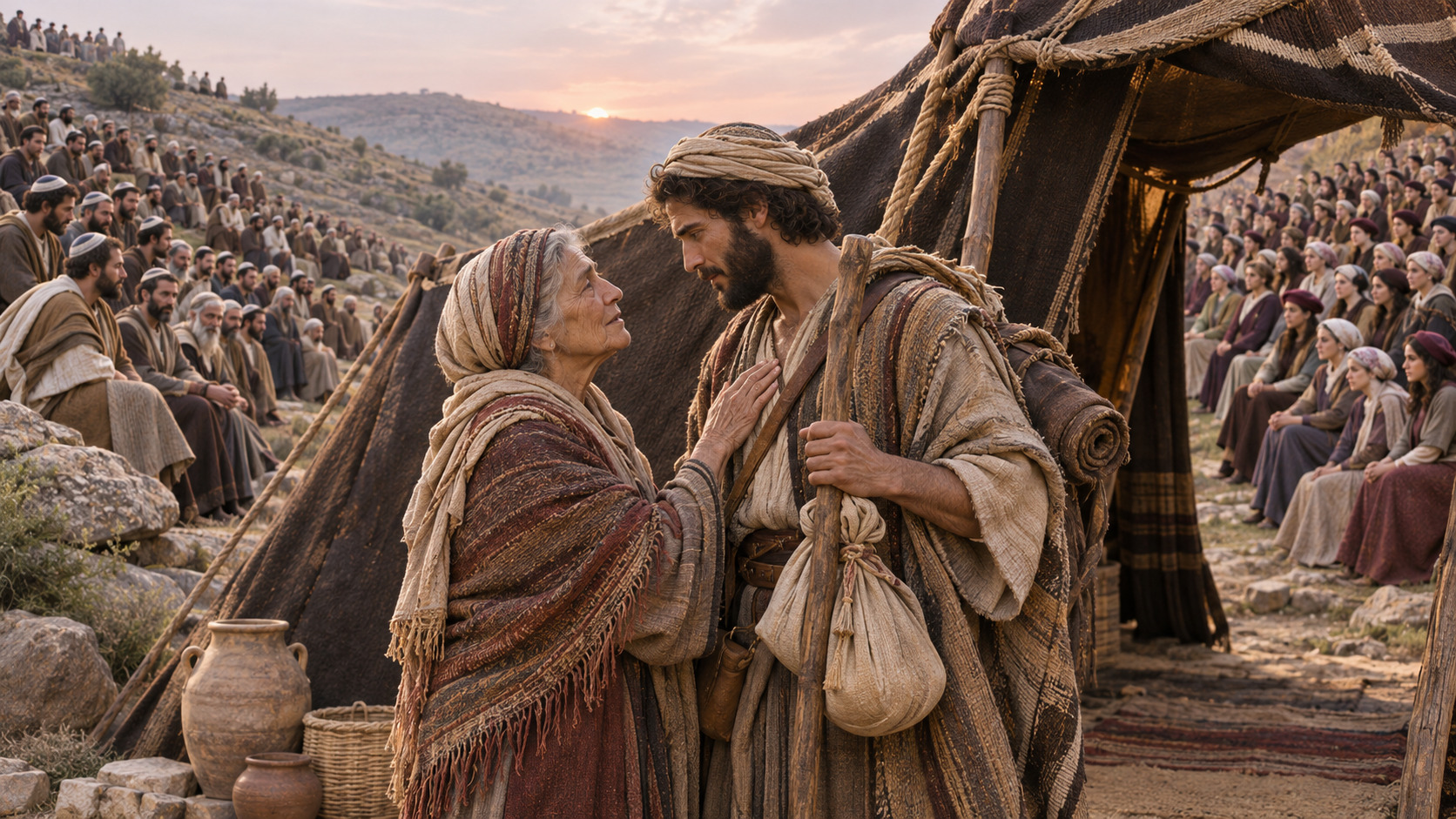
Esav despised the birthright, then said in his heart: “I will kill my brother Yaakov.” Rivka learns of it through ruach hakodesh and sends Yaakov to Lavan, “until your brother’s anger turns away from you.” But how will she know that Esav has calmed down? The Or HaChaim answers in two steps: time cools anger, and the real test is that Yaakov can be mentioned before Esav without him flaring up. But the heart can stay closed even when the face is silent. So M. Himi turns to another Or HaChaim, on Yosef’s brothers: “as water reflects a face, so the heart of man to man” — when one recognizes the other, the other ends up recognizing him too, unless he refuses to see. That is the sign Rivka gives Yaakov: the day you miss your brother, he will miss you too. And indeed, in Vayishlach, Esav is both “Esav” and “my brother,” and they embrace and weep. The shiur ends with an experiment carried out in the United States, and with a simple lesson: if we want people to be kind to us, let us be kind to them.
Words of Torah do good when they are shared. Send this shiur to your family and friends on WhatsApp.
📲 Send on WhatsApp👥 Join the Gueoula groupRosh Chodesh Kislev — may it come upon us for good, thank Hashem. So let us learn about this week’s parasha, which we will read with Hashem’s help: parashat Toldot.
It begins with “These are the generations of Yitzhak son of Avraham: Avraham fathered Yitzhak.” Then we see the birth of the twins, Yaakov and Esav, and there is the matter of the sale of the birthright: Yaakov buys the birthright from Esav.
And even so — although Yaakov Avinu buys the birthright from Esav, at the end of the passage: “Yaakov gave Esav bread and a stew of lentils; he ate, he drank, he rose and went, and Esav despised the birthright” — that is, although there was a proper, lawful transaction here, we know that later on Esav does not take it seriously.
How do we know that he does not take it seriously?
Because later, when Rivka understands that Yitzhak intends to bless Esav, she tells Yaakov to go and disguise himself, and so on — we know the whole story. And Yitzhak blesses Yaakov.
Esav comes back from the field, he prepares delicacies for his father, and Yitzhak says to him: “Who are you?” He answers: “I am your son, your firstborn, Esav.” “And Yitzhak trembled with a very great trembling,” and he said: “Your brother came with cunning and took your blessing.”
And then Esav says: “Is it because he was named Yaakov that he has supplanted me twice? He took my birthright, and now he has taken my blessing.”
So we see here that Esav says: what does this mean? He cheated me, he took the birthright from me. This connects to what was said earlier, “and Esav despised the birthright.” And now he has taken my blessing as well.
As a result, Esav does not calm down: “Esav hated Yaakov because of the blessing with which his father had blessed him, and Esav said in his heart: the days of mourning for my father are approaching, and I will kill my brother Yaakov.” That is his plan.
“The words of Esav, her elder son, were told to Rivka.” Who told her these words? It is written, after all: “Esav said in his heart.” So how were they told to Rivka?
This teaches that it was through ruach hakodesh. For we know that the Mothers were also like prophetesses. Through ruach hakodesh she heard, as with an inner ear, what was turning in Esav’s heart.
And then she calls Yaakov, her younger son, and says to him: “Behold, your brother Esav consoles himself about you by planning to kill you.”
And now we begin the shiur. “And now, my son, listen to my voice: arise, flee to Lavan my brother, to Charan. Stay with him a few days, until your brother’s fury subsides; until your brother’s anger turns away from you and he forgets what you did to him. Then I will send and bring you from there. Why should I be bereaved of you both in one day?”
From where will Rivka know that Esav has calmed down? How can she know? His plan is in his heart, and no doubt he will keep it in his heart until the days of mourning for his father draw near, to kill Yaakov his brother. So how will Rivka know he has calmed down? How will she really know?
So the Or HaChaim HaKadosh explains. He says this: “until your brother’s fury subsides” — as time passes over the event, the fury cools down from its boiling by itself. How do we say it? Time does its work; time heals.
And she said further: “until your brother’s anger turns away from you.” That alone is not enough, that he calms down; it must be “until your brother’s anger turns away from you” — that is, even if you are mentioned before him, he will not flare up.
That is, Esav must also calm down inside with time; time heals. But what is the test we will make? When Yaakov is mentioned before Esav, we must see how he reacts. Once it appears that, when Yaakov is mentioned to him, he no longer gets angry, that will be the sign that he has calmed down. That is the precision: “until your brother’s fury subsides,” and then “until his anger turns away from you” — when you are mentioned he will not be angry, and from that we will understand that he has calmed down.
But that still says nothing. Why? Because it may still be that deep inside… even if, outwardly, he does not show that he is angry when Yaakov is mentioned, that does not mean that inside he is not angry.
So how will we know whether he is angry or not? Here we want to learn a very important principle, which we learn from the meeting of Yosef’s brothers with Yosef.
At the brothers’ first meeting with Yosef, the verse tells us: “Yosef saw his brothers, he recognized them, and he made himself a stranger to them.” And then: “Yosef recognized his brothers, but they did not recognize him.”
The simple meaning, as Rashi says: when he parted from them, they already had beards, but he did not yet have a beard. He was seventeen in all; he had not yet grown a beard. He recognizes them older, because he already knows what they look like with beards. But they parted from him when he was still beardless.
And now he stands before them at what age? Thirty, plus the seven years of plenty, plus two years of famine: he stands before them at thirty-nine. He certainly has a beard. So they do not recognize him. That is how Rashi explains it.
But the Or HaChaim HaKadosh explains something very beautiful, and this is the principle we must learn. He says: “Even though he recognized them because he had left them bearded — by human nature, when recognition is born in the heart of one of the two, memory awakens in the heart of the other as well.”
What is he telling us here? There is a principle in relations between people: “as water reflects a face, so the heart of man to man.” That is, when someone begins to send you the message that he is kind, pleasant and so on, you have no choice but to pick up these signs, this body language that says he is kind, and you too begin to be kind.
He says: “for hearts reveal hidden secrets,” and it can be noticed “in the eyes, on the forehead, in speech.” That is, when you stand before someone who speaks to you with kindness and openness, you feel comfortable enough to be open with him too. One reflects the other. “And the recognition keeps growing until the examination is complete.”
“Even so, the verse tells us that they did not recognize him.” That is: Yosef recognizes them. But they, instead of picking this up, were not ready to recognize him. They said to themselves: the last thing we want is that this really be Yosef standing before us now. Why? Because then they would immediately have understood the magnitude of the shame.
That is, in their hearts they pushed away the possibility of picking up his positive messages. “And the reason: because they saw him at the height of greatness” — they see that he is already a king; the last thing they would think of him is that he is Yosef. That is why they did not recognize him: they were not ready to pick up these signs, this body language. And that is why “they settled the examination and pushed away from their hearts the thought of this thing.”
Why do I bring this in connection with Yaakov and Esav? This is what Rivka is really telling Yaakov: do you know what the sign is for you to understand that Esav no longer holds it against you? When you are in Charan and you begin to feel that you miss Esav, that you want to be his brother, that you want to bring back the brotherhood — that is the sign that in his heart too this change has already begun.
“As water reflects a face,” as the Or HaChaim HaKadosh says: “for hearts reveal hidden secrets.” When your heart begins to feel that you want to be close to Esav, it is the sign that in Esav’s heart there is now the feeling that he misses you and wants you.
She tells him: Yaakov, when you, Yaakov, begin to feel positive towards Esav — despite what he did to you, and despite the fact that because of him you have now been twenty years in Lavan’s house — and you feel that something is missing, that is the sign that in Esav’s heart too… It is like antennas, it is telepathy. And all the more so Yaakov and Esav. Why? Because they are twins. In the end, they grew in the same womb. So when you feel it, he will feel it too. And that is the sign that the time has come to return home.
Where do we see proof that this is true? Look at parashat Vayishlach. What is written, and how many times? It is written: “Yaakov sent messengers before him to Esav his brother.” Don’t we know that Esav is his brother? “Esav his brother, to the land of Seir.” And he commands them: “Say to my lord, to Esav: I have sojourned with Lavan,” and so on.
“The messengers returned to Yaakov, saying: we came to your brother, to Esav.” So there are already both faces: they feel that here there is both a brother and Esav — “your brother,” “Esav.” And Yaakov was afraid, and so on; and he says: “Save me, please, from the hand of my brother, from the hand of Esav.”
That is, both faces are at play in their hearts: they feel the same thing.
And indeed, when they meet, the meeting is very moving. It is true, there is the midrash that says Esav tried to bite him; but according to the simple meaning: “he kissed him, and they wept.”
That is, Rivka’s prophecy came true. She says: when you both feel this desire to be together, that will be the moment when, in fact, he has forgiven you. And that is what we learn here.
I will finish with an experiment. An experiment was carried out in the United States, several decades ago. Psychologists took people and brought them into a room.
To some they said: over there, in the corner, there is someone who cannot stand you; he cannot bear the sight of you, he cannot stand you being near him. And to others they said: in the other corner of the room there is someone — don’t ask — who is crazy about you, he loves you, he is always happy to see you.
The researchers told the two characters nothing: they did not tell one that his role was to hate and the other that his role was to love. They said nothing at all. But to the people in the room they said: know that this one hates you, and that one loves you.
What came out? Those who spoke with the one who supposedly hated them — he had been told nothing — spoke to him with reserve, with distance. And indeed, during the evening, a conflict developed between them and they began to quarrel; and he knew nothing. And on the other side, they spoke warmly, and they became really good friends.
What actually happened? The person who knew that the other did not like him came to him from the outset with a body that attacks, that is negative. And the other returned the same. And on the other side, the opposite: if I speak with you knowing that you love me, I speak to you kindly; you are kind to me, I return the kindness, and that is how they became friends.
That is what is called “as water reflects a face, so the heart of man to man.” That is truly the principle we learn from Rivka, and we saw it with Yosef too, since the brothers were not ready to open themselves to Yosef’s signs.
And that, in fact, is the secret we understand: if we want people to be kind to us, we must be kind to them, and it will work, with Hashem’s help. So we will increase brotherhood in the world and bring the Redemption closer, speedily in our days. Chazak!
Genèse / Genesis / בראשית 25,19–34
Genèse / Genesis / בראשית 27,30–45
Rachi sur Genèse / Rashi on Genesis / רש״י על בראשית 27,42
Or Ha’Haïm sur Genèse / Or HaChaim on Genesis / אור החיים על בראשית 27,44
Genèse / Genesis / בראשית 42,7–8
Rachi sur Genèse / Rashi on Genesis / רש״י על בראשית 42,8
Or Ha’Haïm sur Genèse / Or HaChaim on Genesis / אור החיים על בראשית 42,8
Michlé / Proverbs / משלי 27,19
Words of Torah do good when they are shared. Send this shiur to your family and friends on WhatsApp.
📲 Send on WhatsApp👥 Join the Gueoula groupTest yourself
Five questions on the shiur. Choose an answer.
Result
Shalom Bayit — The Mouth at Home
My covenant of peace — peace begins at home. Reveal a Shalom Bayit card.
Gematria — Rav Ménaché
Shalom, Mashiah, Yisamech — secrets of the letters by Rav Ménaché zatsal.
🔢 Gematria CourseTorah Study
Go deeper into the Or HaChaim on Genesis 27:44 and 42:8: “as water reflects a face.”
📝 Beith HamidrachAll Parashot
All shiurim of M. Yéhouda Himi — from Bereshit to Devarim and the festivals.
📚 All ParashotBooks
Torah wisdom in thriller format — Éditions Gueoula.
Guardians of the Rift
Forty-nine gates open — the fiftieth hides in a single moment. An ancient secret resurfaces, and one man stands between the rift and the world. Drawn from Talmud and Kabbalah.
📖 Read the free excerpt · Book $9.90