Toldot —
Esav’s Hair and Yaakov’s Ladder
The 5th of Kislev, the Sunday after Parashat Toldot and toward Vayetze. M. Himi opens with a small idea showing that the Torah also has a sense of humor. “The children struggled within her”: according to Rashi, each one ran in a different direction, or they fought with each other. But if they were in one placenta — after all, Yaakov held Esav’s heel — there was a danger that their bodies would join. So Hashem created Esav with hair: every time Yaakov touched him, he got pricked and jumped back. That is “vayitrotzetzu.” And in depth: an insulating layer, so that there would be no closeness at all between Yaakov and Esav. Then “Yaakov went out”: the departure of a tzaddik from a place leaves its mark — its glory, its splendor and its beauty left — and “vayetze” spelled out in full adds up to 247, like “ziv, hod, hadar.” On the ladder Yaakov saw the kingdoms rise and fall, and in the supernal Chariot he saw his own face in the face of Adam: “achen” — lion, keruv, eagle; “ve’anochi” — yud, Yaakov — “I did not know.” But why a keruv and not an ox? Because after the sin of the golden calf the face of the ox was replaced with the face of a child — and Yaakov saw all of history on the ladder, so he already saw the faces after the calf. Finally, “bagad” in one word: Gad was born circumcised on Shabbat, and the drop of blood was drawn on the ninth day.
Words of Torah do good when they are shared. Send this shiur to your family and friends on WhatsApp.
📲 Send on WhatsApp👥 Join the Gueoula groupToday, with Hashem’s help, is the 5th of Kislev, the Sunday after Parashat Toldot and toward Parashat “Yaakov went out from Be’er Sheva.” We will learn just a small idea from Parashat Toldot, to show that the Torah is not only deep and sweet — it also has a sense of humor.
It is written: “The children struggled within her.” Rashi explains: when she passed a house of idolatry, she felt the baby wanting to come out; and when she passed the study house of Shem and Ever, the baby wanted to come out. She did not understand — she did not know she was carrying twins. “She went to inquire of Hashem,” and they told her: two nations are in your womb, one drawn to idolatry and one drawn to holiness. That is “vayitrotzetzu”: each one ran in a different direction — from the word “to run.”
Rashi brings another explanation: already in the womb they came to blows. One wanted to crush the other’s skull — to break his head. “Lehitrotzetz” is like crushing the head, taking a stone and breaking the head. That is “vayitrotzetzu.”
But there is another, charming explanation. What actually caused this constant movement in Rivka’s womb? There is an interesting question: were the twins in one placenta, one sac, or in two? Some twins each have their own placenta, and some grow in one sac.
It stands to reason that it was one placenta. Why? Because it is written that when Esav wanted to come out, Yaakov held his heel. To be able to hold his heel, he must have been in the same placenta. The Ibn Ezra, it is true, says no — they were in two separate sacs, but Yaakov put his hand from his sac into Esav’s sac and grabbed his foot.
But it stands to reason that it was one placenta. And what is the problem with one placenta? When twins are in the same place, there is a danger of joined limbs: head joined to head, or back to back — Siamese twins, as we say.
So how did Hashem make sure there would be no chance of Yaakov’s body joining Esav’s? He made him with hair. And then — this is the Torah’s sense of humor — every time Yaakov wanted to touch Esav, he got pricked by his hair and jumped back. That is “vayitrotzetzu”: the pricks of the hair made them spring away from each other every time.
When you picture it, it really is funny. But the depth of it: Hashem did not want even in the womb any attachment between Yaakov and Esav. Esav’s hair was an insulating layer, to isolate Yaakov from Esav, so that, God forbid, there would be no closeness between them.
We have reached our parashah: “Yaakov went out from Be’er Sheva and went toward Charan.” Everyone points out the difficulty: why the double language? Either say “Yaakov went out from Be’er Sheva” to Charan, or “he went” — but you do not need both “went out” and “went.” If he went out, he certainly went; he did not just go out, he went out in order to go.
Rashi explains: why mention his going out? To say that the departure of a tzaddik from a place leaves its mark. While the tzaddik is in the city, he is its glory, its splendor, its beauty; when he leaves, its glory, its splendor and its beauty leave. Yaakov’s departure too left its mark: now someone is missing here. There was something holy here, Yaakov was here, his presence made an impression on the city; and now that he has left, he took with him the splendor, the beauty and the glory that were in the city — words that describe holiness, the Shechinah.
But according to the hidden meaning this is no coincidence. Let us take the word “vayetze” and write it in milui — spelled out. What does that mean? For example vav — two vavs, “vav,” as you hear it. Yud — yud, vav, dalet. Tzadi — tzadi, dalet, yud: we do not say “tzaddik,” we say “tzadi.” And alef — alef, lamed, peh. That is what milui means.
If you compute the gematria of “vayetze” spelled out, you get 247 — check the math at home, so we don’t get held up now. And behold, a wonder: the words “ziv,” “hod” and “hadar” — 247! And that is what Rashi says: when he left, its splendor, its glory and its beauty left. Together with the word “vayetze” he took these three things with him — and so, according to the hidden meaning, everything is hinted within the Torah itself.
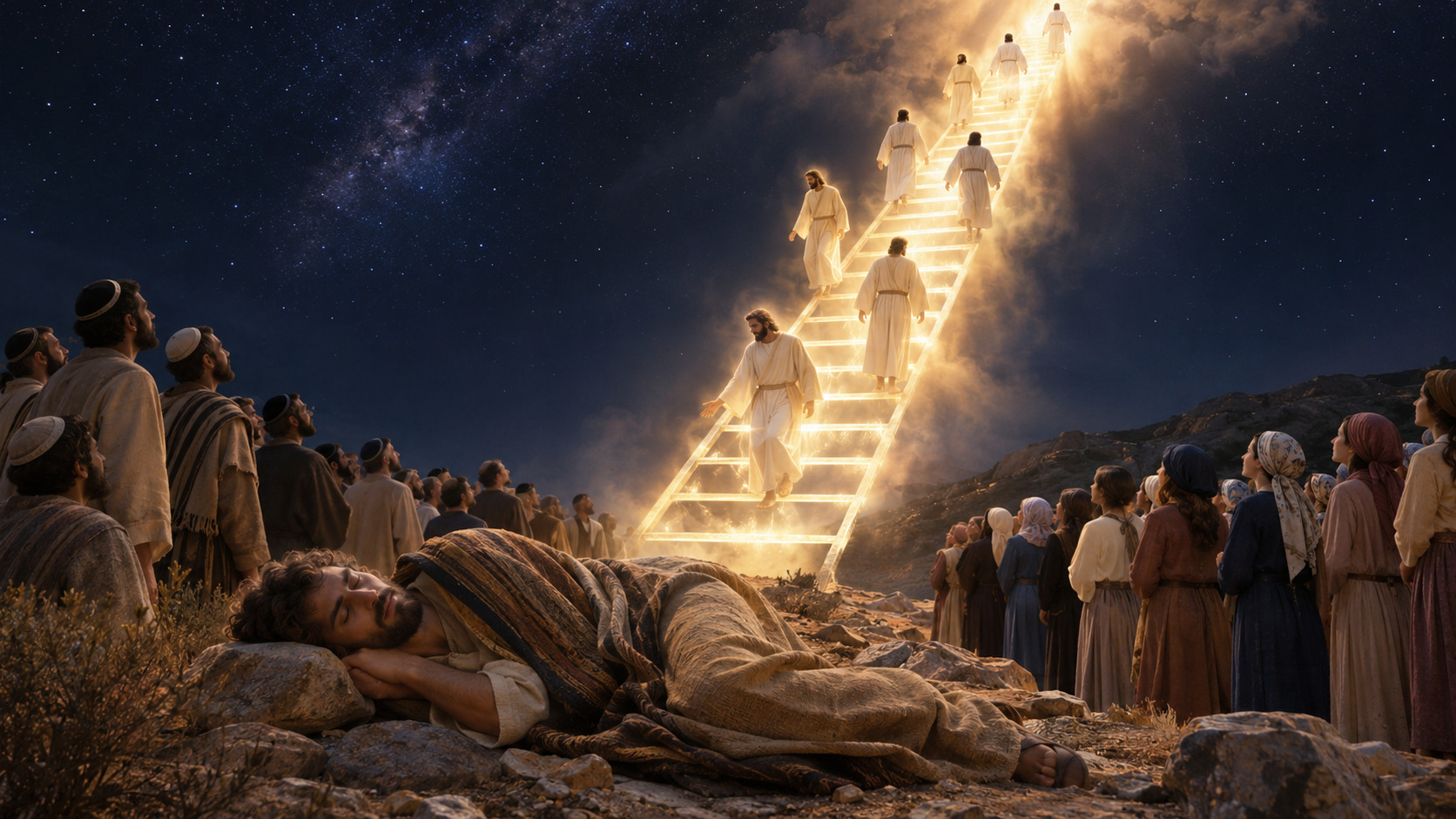
Next: “He dreamed, and behold a ladder set on the ground… and behold angels of God ascending and descending on it.” What does Yaakov avinu actually see? One explanation: Hashem showed him how the kingdoms rise and fall — the kingdom of Babylon, Persia, Edom — four kingdoms. And he became anxious. Here they rise — but they also go down; they do not only rise, they also go down.
When Yaakov avinu wakes up: “Yaakov awoke from his sleep and said: indeed Hashem is in this place, and I did not know.” Simply put: he did not know it was such a holy place. Had he known, perhaps he would not have allowed himself to sleep there. And by the way, where was this place where he slept? On Har HaMoriah.
Our Sages explain by way of midrash: when Yaakov avinu rose up in his dream, he saw the workings of the Chariot, the supernal Chariot. And what does one see in the supernal Chariot? As it is written in Yechezkel: four figures carry it. The eagle — king of the birds; the ox — king of the animals; the lion — king of the beasts; and man — Adam, king of humanity.
And when Yaakov avinu rises and sees this, what does he suddenly see up there? He sees his own face in the face of Adam. And that is what our Sages say, and it is also written in the Zohar: Yaakov’s beauty was Adam’s beauty. If you wanted to know what Adam looked like, you would look at Yaakov and say: that is what Adam looked like. But Yaakov did not know that his face was up there.
And that is what he says: “achen” — an acronym: alef for aryeh, the lion; kaf for keruv — I will explain in a moment what that is, in place of the ox; and nun for nesher, the eagle. I knew there was a lion, an ox and an eagle there. But “ve’anochi” — the yud at the end, the yud of Yaakov — “I did not know”: I did not know that I too was there. That is how it is explained in the name of the midrash.
What do we need to understand here? In Yechezkel and in other places where the Chariot is described, the king of the animals is the ox. So how can I tell you “achen,” where the kaf is keruv? What is a keruv? Not the cabbage we eat! Like the keruvim on the Ark in the Mishkan, the Ark of the Covenant — spreading their wings above. Why are they called keruvim? Not “kerovim,” close ones, with a kuf — it is with a kaf. A child! The word keruv — in Aramaic “k’ravya”; “ravya” means children. And indeed one had the face of a little boy and the other the face of a little girl. That is why they are called keruvim.
So what is up there in the Chariot? Yaakov avinu sees the face of a lion, the face of an eagle, the face of a child, and the face of Adam — which is his own face. So which is it — an ox, or the face of a child?
The point is that the Chariot really did include an ox above. But the moment the Jewish people made the golden calf — so that there would no longer be an accusation above in heaven, since the ox recalls the calf — Hashem replaced the face of the ox with the face of a child, to recall the Ark of the Covenant below. And so there will always be mercy above for the Jewish people.
And now: Yaakov sees the face of the child instead of the face of the ox. What doesn’t fit in my explanation? There had not yet been the sin of the calf! If the faces were replaced only after the sin of the calf — Yaakov avinu is now leaving for Charan, there are not yet twelve tribes, we have not yet left Egypt, we have not yet received the Torah, there has not yet been the sin of the calf. So will you tell me “there is no earlier and later in the Torah”? No.
The secret is this. What did we say at the beginning? I did not tell you for nothing that on the ladder He shows him kingdoms rising and falling. What did He show him? All of history, from here to the end of the generations: how the kingdom of Babylon rises and falls, the kingdom of Persia rises and falls, Greece rises and falls, and Rome — with Hashem’s help it too will fall, soon, together with Yishmael. He sees all the exiles — he is already seeing the film ahead.
And if he sees ahead, which faces will he see up there? Those that exist after the sin of the calf: the faces of the keruvim, the faces of children. That is the depth of it. It is no coincidence — every word here is precise.
“He was afraid and said: how awesome is this place! This is none other than the house of God, and this is the gate of heaven.” He is on Har HaMoriah, connecting exactly to the place from which the Shechinah descends and connects to Jerusalem, and from there to the whole world.
Let me give just one more small idea, like a corner. Later children are born, and Gad is born. Why was he called Gad? “Leah said: ba Gad, and she called his name Gad” — see it, with Hashem’s help, on Shabbat. And Rashi says there: I do not know why it was written as one word.
Perhaps we can find a hint for this. It is known that Gad was born circumcised, on Shabbat. The law is that for one born circumcised on Shabbat, we do not perform a brit on Shabbat — he is already circumcised — but a drop of blood must be drawn, and that does not have to be on the eighth day; it can also be later. So if he was born circumcised on Shabbat, when is the drop of blood drawn? On Sunday.
And that is “ba Gad”: he came on “Gad” — on the seventh day; but the drop of blood was drawn on the ninth day — “bagad.” Blessed is Hashem forever, amen and amen.
Genèse / Genesis / בראשית 25,22–26
Rachi sur Genèse / Rashi on Genesis / רש״י על בראשית 25,22
Ibn Ezra sur Genèse / Ibn Ezra on Genesis / אבן עזרא על בראשית 25,26
Genèse / Genesis / בראשית 28,10–17
Rachi sur Genèse / Rashi on Genesis / רש״י על בראשית 28,10
Yé’hezkel / Ezekiel / יחזקאל 1,10
Words of Torah do good when they are shared. Send this shiur to your family and friends on WhatsApp.
📲 Send on WhatsApp👥 Join the Gueoula groupTest yourself
Five questions on the shiur. Choose an answer.
Result
Shalom Bayit — The Mouth at Home
My covenant of peace — peace begins at home. Reveal a Shalom Bayit card.
Gematria — Rav Ménaché
Shalom, Mashiah, Yisamech — secrets of the letters by Rav Ménaché zatsal.
🔢 Gematria CourseTorah Study
Go deeper into Rashi on Genesis 25:22 and 28:10: “vayitrotzetzu,” and the departure of a tzaddik that leaves its mark — and compute “vayetze” spelled out.
📝 Beith HamidrachAll Parashot
All shiurim of M. Yéhouda Himi — from Bereshit to Devarim and the festivals.
📚 All ParashotBooks
Torah wisdom in thriller format — Éditions Gueoula.

Guardians of the Rift
Forty-nine gates open — the fiftieth hides in a single moment. An ancient secret resurfaces, and one man stands between the rift and the world. Drawn from Talmud and Kabbalah.
📖 Read the free excerpt · Book $9.90