Vayera —
“All Is Foreseen, and Freedom Is Given”
At the seam between Lech Lecha and Vayera, a question: Avraham is chesed and Yitzhak is gevurah — how does chesed give birth to gevurah? The answer is hinted in “va-agadela shemecha”: a heh is added to Avraham, the letter that in the Name Havaya stands for Bina and Malkhut, both of them din — “Bina, dinin mit’arin minah.” Then the brit mila, which draws blood, the color of din. Two acts, spiritual and physical, and Avraham is fit to father Yitzhak, who without gevurah could not have withstood the Akeda. Then a phenomenon: God already named Yitzhak at the end of Lech Lecha — yet in Vayera the angels come, Sarah laughs, and from there comes the name. The angel names Yishmael — and Avraham, who heard nothing, gives the very same name. Two systems, heavenly and earthly: all is foreseen, and freedom is given. What remains for us: “Walk before Me and be whole.”
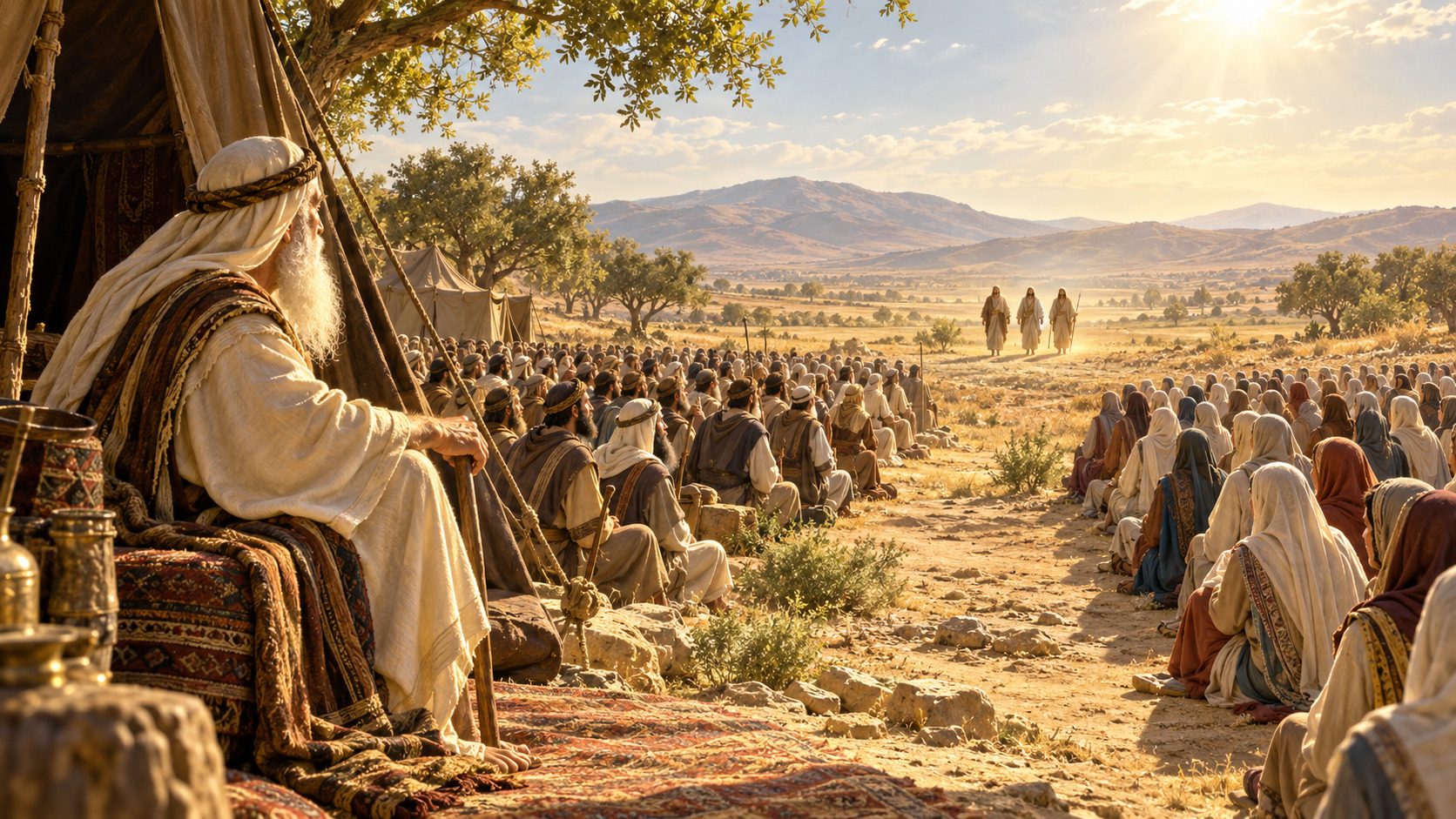
We are at the seam: Sunday after Shabbat Lech Lecha, and before we read Parashat Vayera. “And Hashem appeared to him in the plains of Mamre, as he sat at the entrance of the tent in the heat of the day” — after Avraham Avinu performs the brit. At this seam we can speak about a matter that also touches the preparation for the birth of Yitzhak Avinu.
An interesting question is asked. We know we have the Seven Shepherds: Avraham, Yitzhak, Yaakov, Moshe, Aharon, Yosef and David. Seven, who are also the seven Ushpizin, and who correspond to the seven lower sefirot. We also know that Avraham is chesed and Yitzhak is gevurah. So the question: how does Avraham, who is chesed, father gevurah? We know that chesed produces only more chesed. To say that from chesed comes gevurah — we must understand what preparation Avraham Avinu had to go through so that from chesed would come din, would come gevurah, which is Yitzhak Avinu.
The answer can be found, as a hint, already in the second verse of Parashat Lech Lecha, which we read this Shabbat: “And Hashem said to Avram: Go for yourself from your land, from your birthplace and from your father’s house, to the land that I will show you. And I will make you a great nation, and I will bless you, and I will make your name great, and you shall be a blessing.” What is “I will make your name great” — va-agadela shemecha? One meaning: I will make you famous. And va-agadela shemecha is also quite literal: if until today your name was Avram, a name of four letters, I will enlarge your name, and from four letters it will become five — instead of Avram, Avraham. And so says Rashi: “Va-agadela shemecha — behold, I add a letter to your name; until now your name was Avram, from here on, Avraham.”
If it is about enlarging the name by adding a letter — add a vav and call him “Avrom,” that too enlarges the name. Why add specifically the letter heh? To understand this, we need a short introduction.
The Name Havaya, blessed be He, is clothed in the ten sefirot. How? The yod has a thorn — kotzo shel yod — and it corresponds to the sefira of Keter. Then yod and heh — Chokhma and Bina. Then vav — corresponding to the six extremities, six sefirot: Chesed, Gevurah, Tiferet, Netzach, Hod, Yesod. And the final heh — Malkhut. So in the Name of Hashem there are two hehs: the first heh corresponds to Bina, and the final heh corresponds to Malkhut.
What is special about these two hehs, Bina and Malkhut? They are din. Bina corresponds to Ima, the mother, and the holy Zohar says: “Bina — dinin mit’arin minah,” judgments are aroused from her. That is why women are tougher: they are din. The man is Chokhma, Abba; and the mother is Bina, which is in fact dinin. Why? Because a woman must be strong — she has to give birth. Show me a man who merely thinks he has to be pregnant, and he already faints. If a woman had no dinim, no gevurah, no strength, no firmness — she would not even have the strength to give birth. Hence “Bina — dinin mit’arin minah.” And the final heh, which is Malkhut, is also din, as we say “dina de-malkhuta dina,” the law of the kingdom is law: for there to be a kingdom, for a king to be able to rule, he must also impose din.
Now we understand what is happening here. Avraham is the man of chesed. For him to be able to father gevurah, he must be given a spice connected to din. What is the spice? The letter heh is added to him. Avram will from now on be called Avraham: into his chesed we have inserted a heh, which carries, let us say, a spice of din. Sarai — the same. Until now Sarai was a nice woman, but she has to give birth. How will she give birth? She too receives a heh: Sarai will no longer be called Sarai but Sarah. And so says the Zohar: they took the yod of Sarai, ten, and divided it into two hehs — one heh was given to Avraham, and one heh was given to Sarah.
In parentheses: there is a beautiful midrash. The yod came to complain before the Holy One, blessed be He, and said to Him: What, because I am so small, You do with me whatever You want? Why do You take me from Sarai and divide me? Look for another letter in the Torah and do with it what You want. The Holy One said to the yod: Do not worry. Today you stand at the end of Sarai’s name, in a woman’s name. I am going to upgrade you: I will move you to the beginning of a man’s name. To whom was it moved? To Hoshea bin Nun: “And Moshe called Hoshea bin Nun Yehoshua.” The yod of Sarai became the head of the name of Yehoshua.
The first thing done to Avraham so that he could father Yitzhak is, first of all, the change of name. Second: if he is to bring forth gevurah, there must be something connected to gevurah, to din. What color do we know that is connected to din? Blood — red. Chesed is white. Din, gevurah — blood. So what must Avraham do? Brit mila. The brit he performs, in which he draws blood, is what prepares him to bring Yitzhak, who is gevurah.
And notice: the promise “va-agadela shemecha” stands at the beginning of the parasha. When does the Holy One fulfill it, enlarging his name and adding a heh? Toward the end of the parasha. There it is written: “And Avram was ninety-nine years old, and Hashem appeared to Avram… and I will set My covenant… and your name shall no longer be called Avram, but your name shall be Avraham, for I have made you the father of a multitude of nations.” And immediately afterward comes the second act: “And I will establish My covenant between Me and you… This is My covenant which you shall keep, between Me and you… and you shall circumcise the flesh of your foreskin.” Two acts, right after which Avraham Avinu becomes fit to pass from chesed to din — and he fathers Yitzhak Avinu. This is the first foundation.
The second foundation, which is truly astonishing: for Avraham to be able to father Yitzhak — that is, for gevurah to come out of chesed — he must change. How? Qualities of din, of gevurah, are inserted into him. First of all in his name: a heh is added to him, which is “dinin mit’arin minah,” as we explained — the heh of Malkhut and the heh of Bina in the Name Havaya. And second: he cuts from his flesh and draws blood, to be a man among men, so that afterward he can bring forth gevurah — Yitzhak. Two acts that Avraham must go through, both spiritual and physical, in order to bring Yitzhak in gevurah.
And why must Yitzhak be gevurah? Because he could not have withstood the trial without gevurah. Imagine a man of thirty-seven: they bind him and tell him, we are going to slaughter you now. He would tear the ropes and run. But Yitzhak had the gevurah to withstand the trial: although his soul tells him to flee, he was strong enough to overcome his inclination and be bound upon the altar. And that is the greatest medal the people of Israel ever received. Where did Yitzhak get his gevurah? Already from the start, in order to be born — from Avraham. And afterward Yitzhak had to receive chesed in order to bring forth Yaakov, who has both gevurah and chesed — Yaakov Avinu is Tiferet, which is the blend of chesed and gevurah. If Yitzhak is gevurah, chesed had to be inserted into gevurah so that he could bring forth Yaakov, who has everything together. But let us stay with this picture and not complicate it too much.
And now, an interesting phenomenon. Who gave Yitzhak the name Yitzhak? The Holy One, blessed be He. He tells Avraham at the end of Parashat Lech Lecha, before Yitzhak is even born: “As for Sarai your wife, you shall not call her name Sarai, for Sarah is her name. And I will bless her, and I will also give you a son from her.” “And Avraham fell on his face and laughed, and said in his heart…” — and then: “But Sarah your wife shall bear you a son, and you shall call his name Yitzhak.” That is, the Holy One already tells Avraham that a son will be born to him who will be called Yitzhak.
So let us ask: why do I need the whole story in Parashat Vayera? “And Hashem appeared to him,” He sends angels: go and announce — “behold, Sarah your wife shall have a son.” What is the problem? Avraham could have told Sarah: you know, I had a revelation, and the Holy One told me that you will be pregnant, we will have a child and we will call him Yitzhak. But that is not how it is: as it were, Avraham says nothing to Sarah, as if no one had spoken with Avraham, and now a new parasha begins. He sends angels, they announce, and then Sarah laughs — and because she laughs the son is born and is called Yitzhak: “God has made laughter for me.” But all of this had already been told to us before, with no connection to Sarah. As if this whole sequence were superfluous. Why twice? Here is an example: when the angel appeared to the wife of Manoach, the mother of Shimshon, she went and told her husband: an angel appeared to me. So what is the problem? Avraham could have told Sarah, end of story. That is one question.
Second question: Yishmael. Who gave the name Yishmael when he was born? The angel. Let us see. “And Sarai said to Avram: Behold now, Hashem has kept me from bearing; come, please, to my maidservant, perhaps I shall be built up through her — and Avram listened to the voice of Sarai. And Sarai, Avram’s wife, took Hagar the Egyptian…” Hagar flees from Sarai, and the angel finds her and says to her: “Return to your mistress and submit yourself under her hands.” And then: “And the angel of Hashem said to her: Behold, you are with child, and you shall bear a son, and you shall call his name Yishmael.” Who gives this name? The angel. That is to say, Hagar understands from the angel that the son to be born will be called Yishmael.
And let us see what happens next: “And Hagar bore Avram a son, and Avram called the name of his son whom Hagar bore, Yishmael.” How does Avraham know that he should call him Yishmael? Avraham gives the name Yishmael. And it is not that Hagar went and told Avraham: I am going to give birth, and when a son is born to us, call him Yishmael, because that is what the angel told me. It is as if we have here two different systems: there is the heavenly system, and there is the earthly system.
So what do they actually want to teach here? And with this I will conclude. Avraham Avinu lays the foundations not only of the people of Israel physically — that we have Yitzhak, Yaakov and the twelve tribes — but also the basis, the spiritual DNA. And what does he teach us? That “all is foreseen, and freedom is given.” The Holy One has already determined: a son will be born to you, and I already tell you that he will be called Yitzhak. Now set that aside, and let us see how it unfolds in the ordinary course of life: the angel tells Sarah you will bear a son, she laughs, and because of that he is called Yitzhak. But it was already foreseen that he would be called Yitzhak — and freedom is given, that she calls him Yitzhak. The same with Yishmael: the angel tells Hagar, you will bear a son and he will be called Yishmael. No one knows of it. Avraham sees that Hagar has borne a child — I call him Yishmael. But all is foreseen, and freedom is given. And this is a very, very strong foundation of our faith. It is also the question of free will: if the Holy One knows everything, where is my free will? But I do not know what He knows. There is no contradiction — these are two separate planes.
The Holy One decreed that the people of Israel would go down to Egypt. He decreed: the people of Israel must go down to Egypt. Yosef’s brothers do not know that a decree was issued that they must go down to Egypt in this way. And they throw Yosef into the pit, and things roll on, and so they go down to Egypt. Afterward Yosef tells them: “Do not be grieved, nor angry with yourselves… for it was not you who sent me here, but God.” But they did not know that this was the Divine plan.
So what, in the end, must we know? What the Holy One says to Avraham, and this is what we learn: “Walk before Me and be whole,” “You shall be whole with Hashem your God.” We must conduct ourselves as the Torah dictates to us. The Holy One has His own accounts; we do not know His accounts, and we must conduct ourselves with simple wholeness before the Holy One — and He, what is good in His eyes He will do. With Hashem’s help, may He bring us Mashiach Tzidkenu, and may the redemption come speedily in our days, Amen.
Genèse / Genesis / בראשית 12,2
Rachi sur Genèse / Rashi on Genesis / רש״י על בראשית 12,2
Genèse / Genesis / בראשית 17,1–14
Genèse / Genesis / בראשית 17,15–21
Genèse / Genesis / בראשית 18,1–15
Genèse / Genesis / בראשית 21,6
Genèse / Genesis / בראשית 16,1–16
Nombres / Numbers / במדבר 13,16
Genèse / Genesis / בראשית 45,5–8
Test yourself
Five questions on the shiur. Choose an answer.
Result
Shalom Bayit — The Mouth at Home
My covenant of peace — peace begins at home. Reveal a Shalom Bayit card.
Gematria — Rav Ménaché
Shalom, Mashiah, Yisamech — secrets of the letters by Rav Ménaché zatsal.
🔢 Gematria CourseAll Parashot
All shiurim of M. Yéhouda Himi — from Bereshit to Devarim and the festivals.
📚 All ParashotBooks
Torah wisdom in thriller format — Éditions Gueoula.
Guardians of the Rift
Forty-nine gates open — the fiftieth hides in a single moment. An ancient secret resurfaces, and one man stands between the rift and the world. Drawn from Talmud and Kabbalah.
📖 Read the free excerpt · Book $9.90