Vayera —
“Give Me Your Hand. He Gave Him His Hand”
“God appeared to him” — to whom? The parasha is stitched to the end of Lech Lecha: Avraham has just made the brit, and God comes to visit the sick man on the third day. During the visit three men arrive, and Avraham says: “Adonai, please do not pass by Your servant.” Rashi gives two readings: he is speaking to the greatest of the three, or he is speaking to God and asking Him to wait. What decides it is the vowel: a kamatz under the nun means the holy Name; a patach means an ordinary word. The kamatz corresponds to Keter, the highest of the ten sefirot. From here: welcoming guests is greater than receiving the Divine Presence. Then the Gemara in Berakhot: “Give me your hand” — and a prisoner cannot free himself. Hidden in the outstretched hand is one of the seventy-two Names, י־ל־י. Avraham’s stone hangs on the sun: look at the sky, and pray. Finally Yitzhak and Yishmael: Avram + Hagar = 451 = Yishmael; Yitzhak is born from Avraham with the heh, after the brit. And the decision to send Yishmael away rests on a rule of the Torah: a positive commandment overrides a prohibition.
With God’s help, this Shabbat we read parashat Vayera. “God appeared to him in the plains of Mamre, as he sat at the entrance of the tent in the heat of the day.” Appeared to him — to whom? The verse does not say, and we are expected to know. So the opening of the parasha must be stitched to the end of the previous one. And the end of Lech Lecha tells that Avraham, his son Yishmael and all the men of his household were circumcised with him. Right after: “God appeared to him.”
This juxtaposition is no accident. It says exactly what Rashi says: why, suddenly, does God reveal Himself to Avraham? To visit the sick. Rabbi Chama bar Chanina said: it was the third day after his circumcision — the day the pain is strongest.
The Holy One, blessed be He, who gave us the Torah, keeps it Himself. The Torah teaches the mitzvah of visiting the sick — and God Himself performs that mitzvah: He comes to visit Avraham our father, who is ill from his brit.
He had also helped him: it is written “וְכָרוֹת עִמּוֹ הַבְּרִית” — He made the covenant with him, meaning He held his hand, and together they performed the circumcision. Avraham was ninety-nine: a year later Sarah is remembered and Yitzhak is born, when Avraham is a hundred. So he did not make the brit at eight days, but at ninety-nine years.
I want us to go back over something we once learned, to strengthen ourselves in it and understand how our Torah is sweeter than honey, and that nothing in it is by chance.
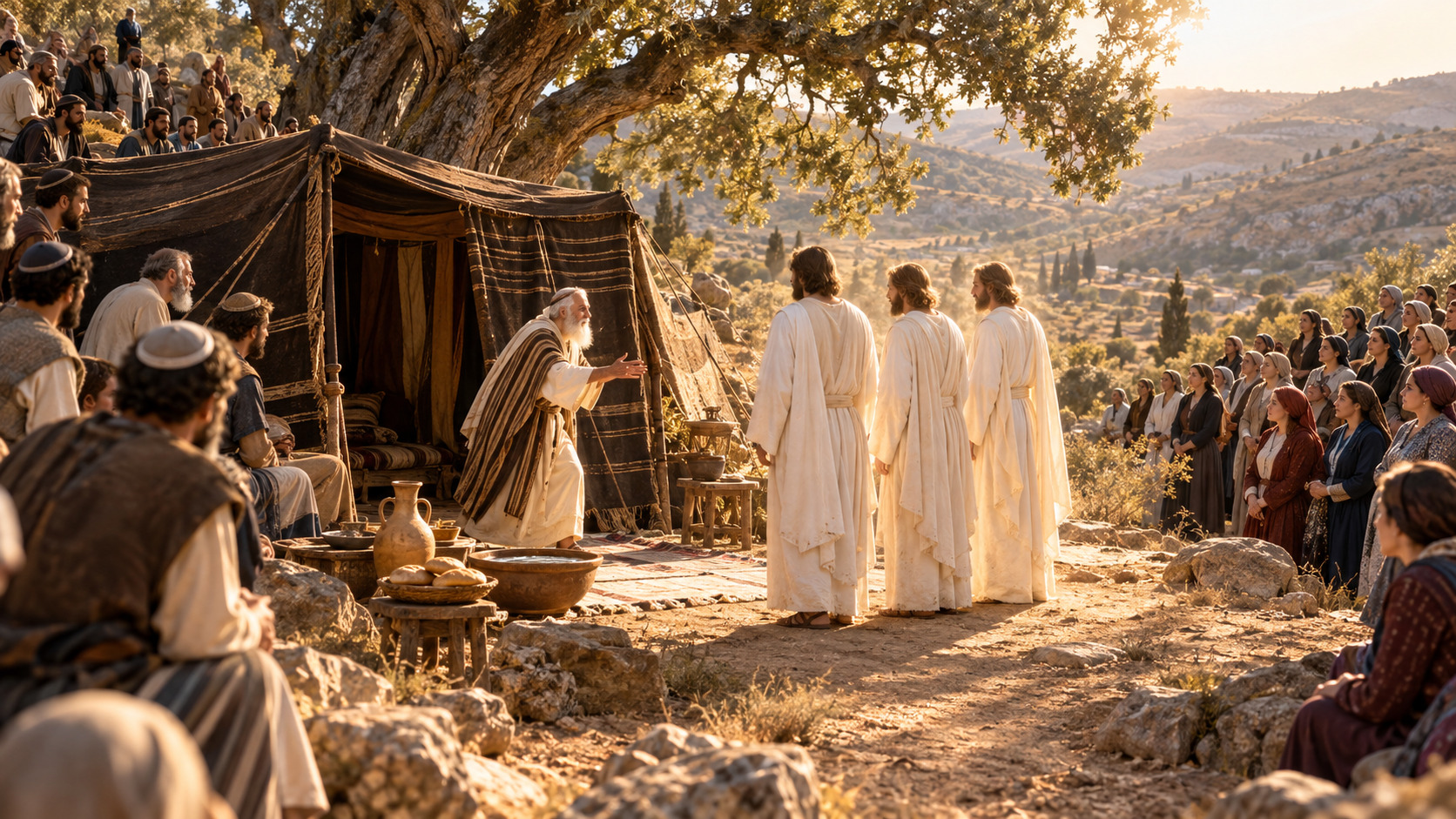
Avraham our father cannot accept being ill and unable to perform the mitzvah of hospitality. He goes out in the heat of the day and watches for guests. God had taken the sun out of its sheath: an especially hot day, so that nobody would be out walking and Avraham would not be troubled. But seeing that Avraham is pained at not performing the mitzvah of hospitality, He sends him three men. Avraham lifts his eyes and sees: “three men standing over him.” He runs toward them from the entrance of the tent and bows to the ground.
Let us study this verse together. I am deliberately not pronouncing the word — you will understand why in a moment. The question is: to whom is Avraham speaking?
Rashi answers and gives two proposals. The first: he spoke to the greatest of them. Avraham sees three men; had he been addressing them, he should have spoken in the plural: “Sirs, if I have found favor in your eyes, do not pass by your servant.” But it is written in the singular. So Rashi says: he addressed all three, but spoke to the greatest, the one who looked most important — for if that one does not move on, his companions will stop with him. On this reading the word is ordinary: it does not mean the Holy One, blessed be He, but these honorable gentlemen.
But this does not quite fit: the word itself is plural — “my lords.” If Avraham is speaking to the greatest of the group, it should have said “my lord, if I have found favor in your eyes.” Make up your mind: either you speak in the plural or in the singular. And when Rashi feels that the explanation he gives is not strong enough, he gives another.
“Davar acher: kodesh hu” — another explanation: it is a holy Name. Avraham is not addressing the group he sees before him at all: he is addressing the Holy One, blessed be He, in person. Remember how the parasha began: God appeared to him — to visit the sick.
Picture the scene. Avraham our father sits at the entrance of the tent; he is in pain from the brit, he is ill. The Holy One, blessed be He, comes to visit him and stands beside him. It is the hour of the sick-visit. And during the visit Avraham sees these men and says: “Excuse me, please, I have guests here to look after.” The King of kings of kings has come to visit him, and he says: “Pardon me, I have people to receive.” Only Avraham our father could do such a thing.
They were not ordinary men; they were angels — and all three came together. One had the task of healing him: Raphael. With him two others: Gavriel, who would later overturn Sedom and Amora, and Michael, who came to announce the birth to Sarah. Three, arriving as one group.
Now it is clear: Avraham says “Adonai” in the holy sense; he is addressing God: “If I have found favor in Your eyes, do not pass by Your servant” — please wait, for I have people here to look after. And Rashi says: he was asking the Holy One, blessed be He, to wait for him until he ran and brought in the guests.
From here we learn: “גְּדוֹלָה הַכְנָסַת אוֹרְחִים יוֹתֵר מֵהַקְבָּלַת פְּנֵי הַשְּׁכִינָה” — welcoming guests is greater than receiving the Divine Presence. Let the Shechinah wait: I have guests to serve.
But we could never have learned this principle had we not read the word as a holy Name. If the word is ordinary, what is the lesson? I have guests, I must receive them — what does the Shechinah have to do with it?
My question now is: how can I tell whether it is a holy Name or not? To the ear it is the same word: “my lords” in the plural, or the Name of the Holy One, blessed be He. For this we need the vowels. Only the vowels decide.
The word appears at least twice more in the parasha. When God says to Avraham, “Shall I hide from Avraham what I am about to do?” — I am going to overturn Sedom and Amora — Avraham stands and prays: perhaps there are fifty righteous, forty, thirty… And he says: “Behold, I have ventured to speak to Adonai, I who am dust and ashes.” The same word again.
And when the angels come to Lot: “The two angels came to Sedom in the evening.” Why only two? Because an angel does not carry out two missions. Michael, who announced the birth to Sarah, has finished his and parted from them. Gavriel comes to overturn Sedom, and Raphael, who healed Avraham, comes to rescue Lot — healing and rescuing are the same thing. Lot is sitting at the gate of Sedom; he studied in a good school of hospitality — he was Avraham’s pupil. He rises to meet them, bows and says: “Please, my lords, turn aside to your servant’s house.” This time I said it freely — “adonai” — without fear. Why?
Look carefully in the Chumash on Shabbat. The “Adonai” at the beginning of the parasha — “do not pass by Your servant” — has a kamatz under the nun. When Avraham argues with the Holy One, blessed be He — “I have ventured to speak to Adonai” — the nun again has a kamatz. But here, with Lot, the nun has a patach. What makes the difference in the Torah between holy and ordinary is the nun: kamatz or patach.
And why? Let us touch a little on the sod. We have ten basic vowel forms in Hebrew, and they correspond to the ten sefirot.
The highest vowel is the kamatz: it corresponds to Keter, the highest place. Then Chochmah and Binah: Chochmah is the patach, less than the kamatz; Binah is the tzere. Then Chesed is the segol; Gevurah is the sheva; Tiferet is the cholam chaser, the dot above. Netzach is the chirik; Hod, the kubutz; Yesod, the cholam male. And Malchut has no vowel. As the Gashashim comedy trio used to say: “there was an engine, there’s no engine” — the absence of a vowel is also a vowel. When the letter rests without a vowel, that is its vowel: that is Malchut.
So the kamatz is Keter, the highest of all. That is why, when we meet this word in the Torah with a kamatz, it is a holy Name — and here it is vocalized with a kamatz. That is why the rule is learned from here: welcoming guests is greater than receiving the Shechinah.
And if you pay attention, in the Amidah, at each “Baruch Atah Hashem” — “Magen Avraham,” “Chonen ha-da’at” and so on — the Name is vocalized each time in a different way. And the Name vocalized kamatz, kamatz, kamatz is in the blessing against the heretics, “Ve-la-malshinim.”
Why? Because in that blessing we pray that all evildoers perish. And what is their aim? Not to fight us as human beings, but because we carry the Name of God in the world. Whoever wants to kill Jews wants to erase the Name of the Holy One, blessed be He, from the world. We are His emblem. The war of the evildoers is aimed at Keter — so there the Name is vocalized kamatz, kamatz, kamatz.
All that was just the warm-up.
People sometimes ask me why we do not study Gemara. Today we will study a little Gemara — a passage that is not complicated, user-friendly. It is linked to our subject: God comes to visit the sick; Avraham is ill.
The Gemara in tractate Bava Batra says that a precious stone hung on Avraham our father’s neck: any sick person who looked at it was healed at once. You are ill, you go to the doctor — people came to Avraham, looked, and were healed.
So the question is: why did Avraham not look at his own stone and heal himself? If he has the medicine, let him take it himself and that’s the end of it. The answer: “אֵין חָבוּשׁ מַתִּיר עַצְמוֹ מִבֵּית הָאֲסוּרִים” — a prisoner cannot free himself from prison. If someone is in jail, you can stand bail for him, hire lawyers, get him out. But he himself, from inside, cannot free himself: someone else has to get him out. Avraham was the doctor — and the doctor cannot free himself.
There is a nice expression too: a man cannot lift himself up by the hair of his own head. I can lift someone else, but not myself. Likewise, you cannot lift yourself by your own shoelaces. You need someone from outside.
This rule — a prisoner cannot free himself — has its Gemara, in tractate Berakhot, and it is a very pleasant passage. Rabbi Chiya bar Abba fell ill. Rabbi Yochanan came to visit him and said: “Are your sufferings dear to you?”
Talmidei chachamim were glad to receive sufferings. Why? Because what one receives here is not deducted from one’s account in the World to Come. But he answered: “Neither they nor their reward.” Leave me alone — why should I suffer? One who suffers learns less Torah; he has no head for study. Someone catches the flu, he lies in bed — meanwhile he is not learning. The account in the World to Come does not interest me now: I want to learn.
Rabbi Yochanan said to him: had you told me your sufferings were dear to you, I would have left you, because that is good — you pay now and increase your account in the World to Come. But since you take no pleasure in this pain: “Give me your hand.” He gave him his hand, and he raised him up. As soon as he held out his hand, he was healed. The hand of healing — and we will learn its secret in a moment.
Another story, the other way round. This time Rabbi Yochanan is ill — he must have caught it. Rabbi Chanina comes to him: “Are your sufferings dear to you?” — “Neither they nor their reward.” — “Give me your hand” — and he heals him.
So the Gemara asks: we said earlier that Rabbi Yochanan raised the other one. Now he is ill — what is the problem? Let him heal himself, as he knew how to heal the other! And the Gemara answers: “A prisoner cannot free himself from prison.” That is the principle we saw with Avraham: a person cannot heal himself.
I want to continue a little with the Gemara. Rabbi Elazar fell ill. Rabbi Yochanan, our doctor, came to him. He saw that he was lying in a dark house: Rabbi Elazar was so poor that there were not even windows. Rabbi Yochanan wants to see him in order to visit him — where to get light? Switch on a fluorescent lamp? There is no electricity.
What did Rabbi Yochanan do? He simply lifted his cloak, and his arm, radiant with purity, lit up the house like a fluorescent tube. “He uncovered his arm, and light spread through the room.”
Rabbi Elazar, the sick man, saw this light and began to weep. Rabbi Yochanan said to him: why are you weeping? If it is for the Torah you did not study enough, do not be distressed: we have learned “אֶחָד הַמַּרְבֶּה וְאֶחָד הַמַּמְעִיט, וּבִלְבַד שֶׁיְּכַוֵּן לִבּוֹ לַשָּׁמַיִם” — whether one does much or little, as long as he directs his heart to Heaven; each learns according to his strength. If it is because you do not have enough to live on: not every man merits two tables — you merited being a talmid chacham; had you been rich, perhaps you would not have. He is trying to encourage him, to comfort him.
And if it is for your children — perhaps a son who died in your lifetime, may it not happen to us. Rabbi Yochanan’s story is known: he had ten sons and all of them died. Of the last, only a small bone remained, less than the measure that conveys impurity. Rabbi Yochanan kept it in his pocket and, whenever he came to a house of mourning, he would say: why are you weeping? Look at me: I buried ten sons, and this is the bone of the youngest. That is how he comforted. “דֵּין גַּרְמָא דַּעֲשִׂירָאָה בִּיר” — this is the bone of my tenth son.
But Rabbi Elazar keeps weeping; he has not yet given him a chance to answer. Then he says: you want to know why I am weeping? “I am weeping for this beauty that will wear away in the dust.” I am weeping over your beauty: even your arm is so beautiful, so radiant and luminous — and you will die, and this beauty, this body, will go to the dust and wear away. Rabbi Yochanan answers: “For that you certainly have reason to weep” — and the two of them wept.
We must understand this answer. Sages of this level weeping over the body? We know that what matters is the soul. The earlier reasons — he does not have enough, he is poor, he did not learn enough, children died — would have seemed more reasonable to me. And yet it is over the body that he weeps: he sees this radiant arm and grieves over what will become of it.
Many answers have been given. One of them: Rabbi Yochanan was a remnant of the beauty of the children of Jerusalem from the time the Beit HaMikdash stood. When the Temple stood, the righteous reached such a refinement of the body that their body shone, so pure was it. After the destruction, not many were left who kept that quality. Rabbi Elazar looks at Rabbi Yochanan, and what does he remember? The beauty of the children of Jerusalem when the Beit HaMikdash stood.
So what are they really weeping over? The Beit HaMikdash that was destroyed. When Rabbi Yochanan dies, that lofty memory will vanish too — the last remnant of that purity. That is why I insisted: he is weeping over the body. Over the soul, obviously, there is no question. But to have reached such a pure body and to lose it means being cut off entirely from what was lived when Jerusalem was built and the Beit HaMikdash stood. A beauty of holiness.
I want to go back to one point from the beginning: “Give me your hand,” and he raises him. How does Rabbi Yochanan heal Rabbi Chiya, and how does Rabbi Chanina heal Rabbi Yochanan? Very simply: he holds out his hand and raises him. What is there in this gesture? The touch. But what is there in that touch?
There is a holy Name here. We know there are holy Names, and one of them is made of three letters: yod, lamed, yod. It is forbidden to pronounce it as a word: it is a Name made of three letters, י־ל־י. “יְהַב לֵיהּ יְדֵיהּ” — he gave him his hand: these are the initials of this Name.
Where is it hidden in our prayer? At the very end of the Amidah, just before “Oseh shalom”: “לְמַעַן יֵחָלְצוּן יְדִידֶיךָ” — so that Your beloved ones may be delivered. When you reach these words, you must not pronounce this Name, only look at it: lamed, yod, yod. And it is no accident: how do we write “yedidecha,” Your beloved ones? Yedid is yad-yad, hand-hand. My hand takes your hand and heals you. “Yechaltzun”: I deliver my friend. How? I give you my hand, you give me your hand — that is “yedidecha” — and I deliver you from the illness.
When someone has fallen into a pit and cannot get out by himself, his friend holds out his hand and pulls him out. That is “hand-hand” — יְדִידֶיךָ: יָדִי (yadi, my hand) and יָדְךָ (yadecha, your hand): His hand and my hand — as we say that God holds us by the hand, all the time, out of love for us.
This three-letter Name is part of the seventy-two combinations of three letters each. We have spoken of it before: there is only one place in the Torah with three consecutive verses that each have seventy-two letters. It is just before the crossing of the Red Sea.
One combines the first letter of the first verse with the last letter of the second verse and the first letter of the third, and so on through all the combinations: seventy-two times three, two hundred and sixteen letters. The first Name, which we know: the first word is “Vayissa” — vav; the last word of the second verse is “ha-laylah” — heh; the first word of the third verse is “Vayet” — vav. Vav, heh, vav. You know it: “Ani va-ho hoshi’a na” — this too is a holy Name.
In one of these combinations we reach yod-lamed-yod, one of the seventy-two triplets. And it is with this holy Name that the Holy One, blessed be He, splits the Red Sea. Each of these triplets has a special power; yod-lamed-yod corresponds to “give me your hand,” and he raises him. That is how Rabbi Yochanan heals Rabbi Chiya.
That is why, when we visit a sick person, we touch his hand. We do it intuitively, without thinking: you come to talk to him, you have nothing to say, he is tired, he is asleep — what do you do? You hold his hand. By holding his hand you take some of his illness and pass on to him a power of healing, through this Name. Now that we have learned it, let us use it: when we visit someone, or ask how they are while shaking their hand, let us think of yod-lamed-yod.
Now the question I was asked: where did the stone go? I prepared the answer in advance. When Avraham left the world, the Holy One, blessed be He, hung it on the sphere of the sun. There it hangs — go look for it, and get there without being burned.
We need to understand this. It is not meant literally: for the Master of the world, taking the stone and putting it in the sun is nothing. But what are we meant to understand?
When a man came to Avraham our father and said “heal me” — why did he come to him? What did Avraham have that all the diviners, sorcerers and self-styled doctors did not? “I know that you have a connection with Him” — with the Holy One, blessed be He. The very act of coming to Avraham was recognizing that there is a God in the world, that the world has a Guide. That is what Avraham radiated. You came, you understood it, you look at the stone — that is only a by-product. The main thing is that you recognize there is a Guide and a Creator of the world; and as soon as you come to pray, or pray to Him, you are saved.
And now, in the sun? To people who search for this stone, the Holy One, blessed be He, says: look at the sphere of the sun. “Lift up your eyes on high and see who created these.” What is the sun? Did it just come about from some explosion? Surely there is a power of providence here that created all the worlds and set the great luminary, the small luminary and the stars. By contemplating the wonders of nature you come to recognize that there is a God — pray to Him, and you will be saved.
That is the great way out. All the sorcerers of every kind are deceptions. The best segulah, the one all clear-sighted Rabbanim speak of, is to pray directly — simply to pray to the Holy One, blessed be He, for He hears every prayer. No need for this segulah or that: the best segulah for salvation is to pray to the Holy One, blessed be He. “God is close to all who call upon Him, to all who call upon Him in truth.” If you truly pray, understanding and grasping that salvation is with Him, salvation will come from Him.
A little current affairs: everyone is frowning, making calculations, wondering where salvation will come from. And about this direction, no commentator has spoken. I hear a journalist asking someone on a panel: “What do we do in the meantime? Maybe pray — but what’s the point? The ballots are already in the envelopes.” But God’s salvation comes in the blink of an eye. Regardless of what is in the envelopes, a revelation can turn everything over. Whoever truly believes that God guides the world prays, even when everything seems settled.
As it is written in the previous parasha: “Sarai was barren; she had no child.” If she is barren, obviously she has no child — why the repetition? The explanation: she did not even have a womb, no chance at all of having a child. There is a woman who has a womb but is barren, who does not manage to give birth — there is still a chance. But if she does not even have a womb, what is there to work with?
And yet, for this barren woman, the Holy One, blessed be He, makes a transformation, gives her a womb and brings Yitzhak out of it. That is the power of the Holy One, blessed be He.
Someone asked: how can the angels ask Avraham “Where is your wife?” — where is modesty? A good question. But they did not say “where is she, we want to speak with her.” Perhaps they ask where she is because they do not want her to hear what they have to say. And the Torah says she is behind the tent: the angels suspected she was listening — make sure she cannot hear. It can also be understood that way.
She laughed. Avraham laughed too, but Avraham was not taken to task. At the end of the previous parasha, when God tells him “Sarah your wife will bear you a son,” it is written: “Avraham fell on his face and laughed.” It does not say: “Avraham, why are you laughing?” Whereas here, with Sarah, it is written: “Sarah laughed within herself,” and immediately: “Why did Sarah laugh?”
Why is she reproached here and not there? Here I take Onkelos, whom we have not used yet. The word is the same in both cases, the same root, tzadi-chet-kuf. But for Avraham, Onkelos translates “וַחֲדִי” — and he rejoiced: a laugh of joy, of happiness. And for Sarah, Onkelos translates “וְחַיְכַת”: she smiled mockingly — can it be? impossible! A laugh of skepticism. Hence: “Why did Sarah laugh?” That is how the difference between the two is explained.
Onkelos does not only translate: through his translation one also understands the intent. Another example: the word “kohen.” We know what a kohen is — one who serves in the Mishkan. Yet kohanim are mentioned in the book of Bereishit: the priests of Egypt. At the end of parashat Vayigash, Yosef buys all the land of Egypt for Pharaoh — “only the land of the kohanim he did not buy.” Which kohanim? There was not yet a Temple or anything. How does Onkelos translate? “כֻּמָּרַיָּא” — idolatrous priests. Whereas for the kohanim of Israel he writes “kahanaya.” It is not the same word: he puts meaning into his translation.
And since we are investigating — this intrigues me too: when Avram returns from the war, the king of Sedom comes out to meet him, and “Malki-Tzedek, king of Shalem, brought out bread and wine; he was a kohen of God Most High.” How does Onkelos translate “kohen” here? “And he served before God Most High.” Why did this interest me? Because who is this? Malki-Tzedek, king of Shalem, is Shem son of Noach, who passes the torch to Ever. On the one hand he was not a kohen; on the other, he was not an idolatrous priest. So Onkelos neatly says: “he served before God Most High.” He is sharp, and he does things precisely.
On this point I want to share a beautiful gem. What is the difference between Yitzhak and Yishmael? Both are sons of Avraham. Sarah says: “Drive out this maidservant and her son, for the son of this maidservant shall not inherit with my son, with Yitzhak” — and Avraham is distressed. But God tells him: “Whatever Sarah tells you, listen to her voice, for through Yitzhak shall offspring be called yours.”
The difference is fundamental. When was Yishmael born? How old was Yishmael when Avraham made the brit? Thirteen. Avraham was then ninety-nine; ninety-nine minus thirteen: eighty-six. And when Avraham is eighty-six, what does the Torah call him? Avram. When Yishmael is born, Avraham is called Avram, not Avraham.
When does he make the brit at ninety-nine? A few verses earlier God tells him: “Your name shall no longer be Avram; your name shall be Avraham, for I have made you father of a multitude of nations.” First He changes his name to Avraham, then he makes the brit, and after the brit — “at this season next year Sarah will have a son.” Only then is Avraham with Sarah, and only then is Yitzhak born. What is Avraham called when Yitzhak is born? Avraham.
See how great the difference is. I take the word Avram and join it with Hagar — for Yishmael to come out, he has to be with Hagar. The gematria: Avram, 243; Hagar, 208; total, 451. Let us check: that is exactly the gematria of Yishmael. Avram plus Hagar gives Yishmael. Yishmael is the result of the union between Hagar and Avram without the heh, before he even made the brit.
What kind of klipah is this? And our Sages say: Yishmael had to come out, in order to clean. When you have a tap you have not opened for a long time and you open it, what comes out? Dirty water. Just this week it happened to me: we opened the water. When you open a tap after a long time, the water comes out dirty.
When Avraham joins with Sarah, he is wholly at his level: Avraham, whole and complete. And from that comes Yitzhak, an “olah temimah,” a perfect offering, holy of holies, who never left the Land of Israel, who died and lived twice — at the Akedah, which we read later in the parasha, his soul left and returned, and he had already been in Gan Eden.
That is why people ask on the verse “See, the scent of my son is like the scent of a field that God has blessed”: how does Yitzhak know what Gan Eden smells like? Because he was there. That is Yitzhak. That is why God tells Avraham: “Whatever Sarah tells you, listen to her voice, for through Yitzhak” — he is the one who continues. Yishmael is only an intermediate station, for cleaning, to bring out the bad and move toward the good, the pure and the clean.
Someone remarked: the name Yishmael is a positive name. True: in the Gemara we have Rabbi Yishmael Kohen Gadol; in the time of the Tannaim and Amoraim this name was used — it is a fully Jewish name. What does that have to do with the Yishmaelites we suffer from?
It is said that in the end of days Yishmael will cause us so much trouble that we will cry out to the Holy One, blessed be He — and He will hear. It is hinted in his name: he is the key to redemption. Through the hardships he will cause us we will pray to the Holy One, blessed be He, and then “Yishma El” — God will hear our prayers and save us. We do not pray enough. But let us not be accusers: let us be good defenders of Israel.
I want to learn something lovely with you — hold on. We said that God tells Avraham, “Whatever Sarah tells you, listen to her voice.” But why is Avraham nonetheless so distressed? It is hard for him to send away Yishmael — Hagar and her son, both. We gave one answer; now see the depth of the matter.
We have said that the Avot kept the whole Torah even before it was given at Sinai, and we explained it: they kept its root. When it is written that Avraham served them butter and milk, he served them the milk first and then the meat. When it is written “ugot,” cakes — “matzot”: it was Pesach, and he prepares matzot for them. And indeed, when was Yitzhak born? On the fifteenth of Nissan: it was said “at this season next year”; the announcement was on Pesach, and the birth too on Pesach. Some want to say it was in Tishrei; let us not get into that debate now.
If the Avot kept the whole Torah, there is in parashat Ki Tetze: “If a man has two wives, one loved and one hated… he may not give the firstborn’s right to the son of the loved one over the son of the hated one, who is the firstborn.” Who are Avraham’s two wives? Hagar and Sarah. Hagar was indeed a maidservant, but so that he could be with her, Sarah freed her and gave her to him as a wife: she is no longer a maidservant. So he has two wives: one loved, Sarah, and one “hated,” Hagar — not that he hates her, but that he loves her less. And who is his firstborn son? Yishmael.
The Torah commands: he may not give the firstborn’s right to the son of the loved one over the son of the hated one. So he cannot say: I keep Yitzhak and send Yishmael away — he would be transgressing a prohibition of the Torah. On the other hand, there is God’s command to Avraham, a positive commandment: “Whatever Sarah tells you, listen to her voice.” How do we decide when I have a prohibition — “he may not give the firstborn’s right” — against a positive commandment — “listen to her voice”?
See what a beautiful midrash. In “Eshet Chayil,” which we read on Shabbat, at the letter dalet, we say: “She sought out wool and linen.” It is said that King Shlomo wrote this song about his mother Bat-Sheva, and some say it also speaks of Sarah our mother. What does “she sought out wool and linen” mean? The midrash says: wool and linen — between Yitzhak and Yishmael.
Where do we know wool and linen from? In the book of Devarim: shaatnez. “You shall not wear shaatnez, wool and linen together.” It is forbidden to wear a garment containing both wool and linen. And right after: “You shall make yourself fringes on the four corners of your garment” — the mitzvah of tzitzit. From here our Sages learned that in tzitzit wool and linen are permitted. The only other case is in the Beit HaMikdash, the belt of the kohanim, the Choshen and the Ephod, which contained wool and linen.
How can that be, when the verse just before says “you shall not wear shaatnez”? From the juxtaposition: the Torah wrote immediately after it “you shall make yourself fringes.” I have a prohibition, “you shall not wear shaatnez,” and a positive commandment, “you shall make yourself fringes”: “עֲשֵׂה דּוֹחֶה לֹא תַעֲשֶׂה” — the positive overrides the prohibition.
Now we understand the midrash. “She sought out wool and linen”: Sarah learned from the law of wool and linen for Yitzhak and Yishmael. “For through Yitzhak shall offspring be called yours” — that is a positive commandment; “drive out this maidservant” — a positive commandment. And you, Avraham, know that “he may not give the firstborn’s right to the son of the loved one over the son of the hated one” — but that is a prohibition. Which prevails? The positive prevails over the prohibition. That is why: listen to what Sarah says, and send away the son of this maidservant.
What depth there is in our Torah! In this argument, Avraham, you are right — but there is something stronger: “for through Yitzhak.”
There is a midrash that tells how Avraham went to visit Yishmael. After Sarah’s death, Avraham missed Yishmael his son very much. He mounted a camel and went to his tent. Yishmael’s wife came out to meet him. He asked her: where is Yishmael? She answered: he is not here. She did not receive him as she should have. Avraham left a message for Yishmael: an old man came, and what holds up the house is not good. Yishmael understood, and sent her away. It appears in the Yalkut Shimoni, and the midrash calls her Fatma: that is where the Arabs took the name from.
The original Yishmael — not the one we have today — turned out well in the end. How? Our Sages say that at the end of his life he did teshuvah. From where do we learn it? When Avraham was buried it is written: “Yitzhak and Yishmael his sons buried him.” He stepped back: although I am the firstborn, here I acknowledge that the birthright belongs to Yitzhak, because the birthright follows the spiritual dimension and not the physical one. From the fact that he puts Yitzhak first, we learn that Yishmael did teshuvah and recognized Yitzhak’s standing as the one who continues Avraham our father.
And they have turned it all upside down: in their book it is Yishmael who is bound on the altar, not Yitzhak. Everything is reversed.
With God’s help we have put together a good package; let us end with one thing, which is not in this parasha. When Esav saw that Yitzhak and Rivkah were sending Yaakov to find a wife, he said: I too have reached forty, I will also take a wife. And it is written that Esav takes Machalat, daughter of Yishmael. He already has a wife, and he also takes Machalat daughter of Yishmael.
The midrash asks: what does Esav have to do with Machalat daughter of Yishmael? Esav saw that he could not overcome Yaakov our father by his own strength. He said to himself: I will also attach to myself the klipah of Yishmael, and together we will subdue Yaakov — that was his plan. Notice that she is called Machalat — the “machalah,” the illness of Yishmael: he took on the illness of Yishmael.
But “אֵין חָכְמָה וְאֵין תְּבוּנָה וְאֵין עֵצָה לְנֶגֶד ה׳” — there is no wisdom, no understanding and no counsel against God. The Holy One, blessed be He, is with us; the people of Israel live. And in the end the redemption is close, closer than ever. May Mashiach come speedily, with the redemption of Israel and the third Beit HaMikdash, soon in our days. Success and blessing to all, amen.
Genèse / Genesis / בראשית 17,23–27
Genèse / Genesis / בראשית 18,1–15
Rachi sur Genèse / Rashi on Genesis / רש״י על בראשית 18,1
Rachi sur Genèse / Rashi on Genesis / רש״י על בראשית 18,3
Genèse / Genesis / בראשית 18,27
Genèse / Genesis / בראשית 19,1–3
Baba Batra / Bava Batra / בבא בתרא 16b
Exode / Exodus / שמות 14,19–21
Psaumes / Psalms / תהלים 145,18
Genèse / Genesis / בראשית 11,30
Onkelos / אונקלוס — Genèse / Genesis / בראשית 17,17
Onkelos / אונקלוס — Genèse / Genesis / בראשית 18,12
Onkelos / אונקלוס — Genèse / Genesis / בראשית 14,18
Onkelos / אונקלוס — Genèse / Genesis / בראשית 47,22
Genèse / Genesis / בראשית 16,16
Genèse / Genesis / בראשית 17,1–5
Genèse / Genesis / בראשית 21,9–12
Genèse / Genesis / בראשית 27,27
Deutéronome / Deuteronomy / דברים 21,15–17
Deutéronome / Deuteronomy / דברים 22,11–12
Proverbes / Proverbs / משלי 31,13
Genèse / Genesis / בראשית 25,9
Test yourself
Five questions on the shiur. Choose an answer.
Result
Shalom Bayit — The Mouth at Home
My covenant of peace — peace begins at home. Reveal a Shalom Bayit card.
Gematria — Rav Ménaché
Shalom, Mashiah, Yisamech — secrets of the letters by Rav Ménaché zatsal.
🔢 Gematria CourseAll Parashot
All shiurim of M. Yéhouda Himi — from Bereshit to Devarim and the festivals.
📚 All ParashotBooks
Torah wisdom in thriller format — Éditions Gueoula.
Guardians of the Rift
Forty-nine gates open — the fiftieth hides in a single moment. An ancient secret resurfaces, and one man stands between the rift and the world. Drawn from Talmud and Kabbalah.
📖 Read the free excerpt · Book $9.90