Vayetze —
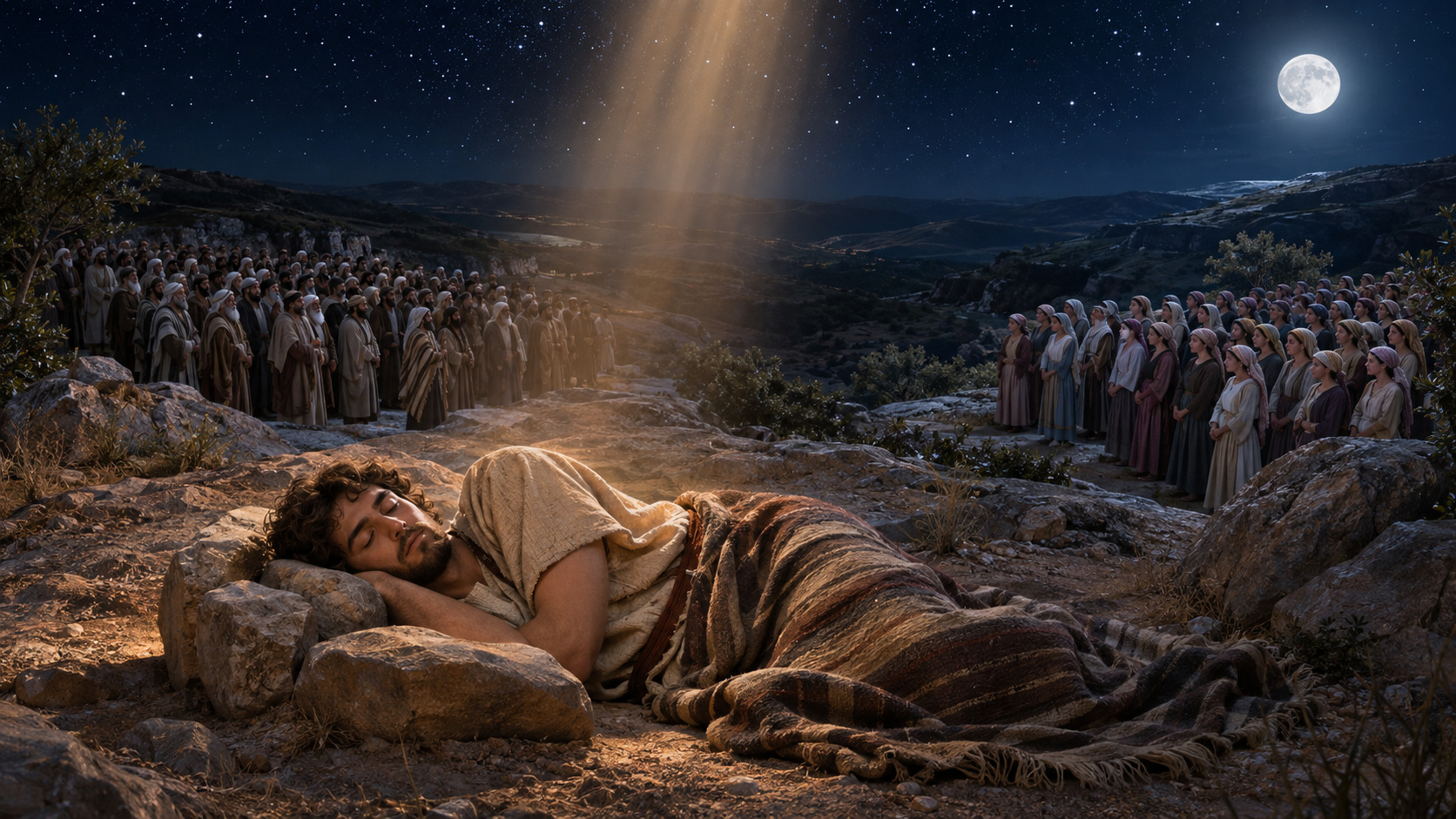
The Stones Around His Head
M. Himi opens with “Yaakov went out from Be’er Sheva and went toward Charan”: the departure of a tzaddik leaves its mark, and “vayetze” spelled out equals 247 — ziv, hod, hadar. And why also “vayelech,” he went? Because Yaakov listens to his father — go calmly to find a wife — and to his mother — flee from Esav, whose sins were forgiven when he married Machalat. Then “he encountered the place”: Yaakov had already reached Charan, and “the earth contracted for him” — he returns to Mount Moriah, the place from which Adam was created, and whose head was taken from the Land of Israel. The Patriarchs repair Adam’s three sins: Avraham, idolatry; Yitzhak, bloodshed; Yaakov, immorality. And Yaakov places stones around his head, because it was the head that sinned; the “wild beasts” are the inclinations. “Even,” the stone — the bet of Bereshit and the nun-aleph of Na’aseh Adam: the Ten Days of Teshuvah, in the merit of “I will surely give a tenth to You.” “The land on which you lie” — the whole earth, for he lies on the Foundation Stone. Finally, the snakeskin garment of Adam and Chava: inside, humility and repair; outside, you are Hashem’s child, and you are protected.
Words of Torah do good when they are shared. Send this shiur to your family and friends on WhatsApp.
📲 Send on WhatsApp👥 Join the Gueoula groupWe are in Parashat Vayetze, with Hashem’s help. “Yaakov went out from Be’er Sheva and went toward Charan. He encountered the place and spent the night there, for the sun had set; he took of the stones of the place, put them at his head, and lay down in that place.” He went alone — apart from the angels — on foot, alone.
The question that jumps out at everyone: why does it need to say “Yaakov went out from Be’er Sheva and went toward Charan”? If he went out, obviously he went somewhere. Rashi asks another question: it should only have said “Yaakov went toward Charan” — because it is already written in the previous parasha that he listened to his father and mother and went to Paddan Aram. We already know he went out. Why mention his departure?
Rashi says: it tells us that the departure of a tzaddik from a place leaves its mark. When he left Be’er Sheva, everyone felt that something was missing. What? The impression he left on the place. While the tzaddik is in the city, he is its glory, he is its radiance, he is its splendor.
As they say in Moroccan, all the “hiba” of the place: the tzaddik gives the place its “hiba.” The moment he leaves, that “hiba” goes with him — the whole atmosphere of righteousness. He went out from there — its glory departed, its radiance departed, its splendor departed. That is why it matters that it says “vayetze,” he went out.
And now see how sweet our Torah is, even according to the sod — this is the warm-up of the shiur. There is what is called milui, spelling out each letter: vav is vav-vav; yud is yud-vav-dalet; tzadi is tzadi-dalet-yud; aleph is aleph-lamed-peh.
Vav-vav: 12; yud-vav-dalet: 10, 6 and 4, which is 20; tzadi-dalet-yud: 90, 4 and 10, which is 104; aleph-lamed-peh: 1, 30 and 80, which is 111. Altogether: 247.
And what does Rashi say? When the tzaddik leaves, its glory (hod), its radiance (ziv) and its splendor (hadar) depart. Hod: 15; ziv: 23; hadar: 209 — 247! It is no coincidence: this “vayetze” spelled out is what filled the city — its “hiba”: ziv, hod and hadar.
Rashi explained why it says “vayetze.” But why does it also need to say “vayelech,” he went? Here we learn a chiddush that really made me dance when I understood it.
In the previous parasha Rivka tells Yitzhak: I don’t want Yaakov to stay here, because the daughters of the land are wicked — that he should not, heaven forbid, marry a Canaanite. But what is the real reason? “It was told to Rivka.” At the end of the previous parasha Yaakov receives the blessings instead of Esav — and what is Esav’s reaction? “Esav hated Yaakov because of the blessing with which his father had blessed him, and Esav said in his heart: the days of mourning for my father are approaching, and I will kill Yaakov my brother.”
No one heard it — he was talking to himself. But the Matriarchs were prophetesses: ruach hakodesh reveals to her what is going through Esav’s heart. “She sent and called Yaakov, her younger son, and said to him: behold, Esav your brother consoles himself about you by planning to kill you. Now, my son, listen to my voice: arise, flee to Lavan my brother.”
But she does not tell Yitzhak this reason, so as not to cause him pain. She does not say to him: Esav is very angry that you blessed Yaakov in his place, and he is planning to kill him. A wise woman — what does she tell him? Yitzhak, you know that here there are only Canaanite women, and it is forbidden to marry Canaanite women. The proof: your father Avraham sent Eliezer to bring me to you. So Yaakov too, the tzaddik, must be sent to Paddan Aram to take a wife.
And then “Yitzhak called Yaakov and blessed him, and commanded him and said: you shall not take a wife from the daughters of Canaan. Arise, go to Paddan Aram” — “and may El Shaddai bless you” — “Yitzhak sent Yaakov away, and he went to Paddan Aram, to Lavan.”
When we hear the word “vayelech,” it sounds relaxed — walking at ease. And “vayetze”? Under pressure, in haste. As with Yosef when he fled from Potiphar’s wife: “he fled and went outside.” “Vayetze” is under pressure; “vayelech” is at ease.
So it says: “Yaakov listened to his father and his mother and went to Paddan Aram” — he walks calmly. But his mother told him that Esav wants to kill him! So he said: I am not panicking, because together with Yitzhak telling me to go, he also blessed me. What can Esav do to me? I walk at ease.
But right after that the Torah tells us: “Esav saw that the daughters of Canaan were evil… Esav went to Yishmael and took Machalat, the daughter of Yishmael.” Our Sages say: from here we learn that a groom who marries — his sins are forgiven. “Machalat” — from mechilah, forgiveness of sin.
And what does Yaakov now understand? That if Esav’s sins were forgiven, he starts with a clean slate — and it may be that now he really is in danger! So now: “Yaakov went out from Be’er Sheva”! Before, it said “he went to Paddan Aram” — getting organized slowly, no pressure. But the moment he saw that Esav takes Machalat and his sins are forgiven — even Esav — he hurries: “Yaakov went out.”
A new page — and with a new page, Esav now has Divine providence with him. You don’t take chances. That is why “Yaakov went out.”
And now see what we have gained: “Yaakov listened to his father and his mother and went to Paddan Aram.” By his father’s word he “goes,” because his father told him: go, find a wife. By his mother’s word he must flee, because she told him that Esav wants to kill him.
So to honor his father and his mother, he does both — both “vayetze” and “vayelech.” “Yaakov went out from Be’er Sheva” — because he listens to his mother; “and went toward Charan” — because he listens to his father. Do you see why we need to dwell on the verse?
I owe a debt to whoever asked me what “vayifga bamakom” means. Rashi dwells on it: like “it reached Jericho,” “it reached Dabbeshet” — and our Rabbis explained it as an expression of prayer. From here we learned that Yaakov our father instituted the Arvit prayer.
But I have a problem: if the Torah already says in the first verse “Yaakov went out from Be’er Sheva and went toward Charan,” he had already reached Charan. And now “he encountered the place” — where is this place? Mount Moriah, Beit El! And the dream, and the ladder, and “behold, Hashem stood over him,” and “all that You give me I will surely give a tenth to You” — all of this is on Mount Moriah. How do you bring him back in reverse to the Land of Israel? Something doesn’t fit.
In order, I would have said: “Yaakov went out from Be’er Sheva and encountered the place” — because from Be’er Sheva, going north, you first reach Beit El. He sleeps in Beit El, gets up in the morning, brushes his teeth, puts on his shoes — and continues to Charan. So why tell me from the start that he is already in Charan?
Let us see what the Gemara says — Rashi brings it — in tractate Chullin, page 91b: “Yaakov went out from Be’er Sheva and went toward Charan,” and it is written “he encountered the place.” When he reached Charan he said: is it possible that I passed the place where my fathers prayed and I did not pray?! As soon as he set his mind to return — the moment he had this good thought — Hashem made him a miracle, a shortening of the way: the earth contracted for him, and immediately “he encountered the place.”
After he prayed — Arvit, on Mount Moriah — he wanted to go back: now I want to return, I have a mission, I don’t waste time. Hashem said: this tzaddik has come to My lodging place, and he should leave without staying the night?! At least let him sleep, rest a little. Immediately the sun set.
Then it says “he took of the stones of the place,” and it says “he took the stone” — teaching that all those stones gathered together. In the morning he sees that all the stones have joined into one — that is the Foundation Stone, the Even HaShtiyah. And this proves that we are on Mount Moriah, no less.
And what was so special about his sleeping? We learn from here that for the fourteen years he studied in the beit midrash of Shem and Ever, he never slept a full sleep.
That is a bit difficult: if a person says “I vow not to sleep for three days,” his vow is void — as if he said nothing, like vowing to eat sand. A person cannot survive three days without sleep. So what does it mean that he did not sleep? If he wanted to rest, he would doze in the chair, then get up and keep learning — he did not sleep stretched out at full length. And here, specially, Hashem pampers him: you may sleep — lying down.
And now — this is the heart of the shiur — what was so important about this sleep on Mount Moriah, and why did he have to come precisely here?
First we must understand what this place is. The Rambam brings in the Laws of the Chosen House: it is a tradition known to all that the place where David and Shlomo built the altar, on the threshing floor of Aravna, is the place where Avraham built the altar and bound Yitzhak on it; it is the place where Noach built when he came out of the ark; it is the altar on which Kayin and Hevel offered; there Adam offered a sacrifice when he was created — and from there he was created! Man was created from the place of his atonement.
“Hashem Elokim formed man, dust from the ground” — he was created from the place of his atonement, as it says: “an altar of earth you shall make for Me.” Hashem said: I am creating him from the place of his atonement — may he endure. (And the Garden of Eden? No — the entrance to the Garden of Eden is in Chevron, a little to the south-east.)
How did Hashem create man? “Dust from the ground.” As I always explain: imagine that, so to speak, Hashem, after creating the world, took dust from the whole world and kneaded it — He made the “cake,” and that is Adam — “and He breathed into his nostrils the breath of life.”
So an interesting question arises: if he is made from the dust of the whole world, which part of the world is the head? And the belly? And the hands and feet? Jerusalem — the center! And we are not inventing it: it was taught, Rabbi Meir would say — in tractate Sanhedrin, page 38a — Adam’s dust was gathered from the whole world. His body from Babylon, his head from the Land of Israel, his limbs from the other lands.
And Rashi explains: his body from Babylon — because it is deep, a hollow; his head from the Land of Israel — because it is higher and more important than all the lands; his limbs, hands and feet, from the other lands. It is explained: in the body there is the heart — the heart understands, understanding is in the heart — and in Babylon there was wisdom, which is why the Babylonian Talmud developed there. But holiness and wisdom are in the head, in the brain — and that is the part of the Land of Israel, for the air of the Land of Israel makes one wise. And the head is at the place of the altar.
Now we begin to understand. Yaakov wants to sleep — what does he do? He takes stones and puts them at his head, around his head. Why? Rashi says: to protect himself from wild beasts.
But excuse me, I don’t understand: if a lion comes, it will eat his head, his legs, his belly. What good did it do to put the stones precisely around the head, while the whole body is exposed? If he wanted protection, he would have gone into a cave, or built an igloo to protect his whole body. What use is my head if a snake bites my foot? We must understand that there is a much deeper symbol here.
It is not for nothing that I brought that Adam was created from the dust of the whole world. When Adam sinned, he damaged the whole world: his body is made of the whole world, of the four elements — earth, air, fire and water — and when he sinned, he damaged the whole perfection of the world.
And when he sinned, he damaged idolatry, immorality and bloodshed. Idolatry — the snake said to the woman: “you will be like God, knowing good and evil”; to think a person can replace Hashem is idolatry. Immorality — the snake cast its filth into the woman. Bloodshed — the moment Adam sinned, death came down to the world.
Hashem had told him: “on the day you eat of it you shall surely die.” Why didn’t he die that day? Because a day for Hashem is a thousand years — “for a thousand years in Your eyes are like yesterday.” Adam was supposed to live a thousand years; he died at 930, because he gave seventy years as a gift to King David.
How do we repair Adam’s sin? The holy Zohar says: in the three Patriarchs, Adam came down again — he damaged three things, and corresponding to them came the three Patriarchs to repair them.
Avraham our father repaired idolatry: he broke Terach’s idols, he stood against idolatry — “and the souls they had made in Charan”: Avraham converted the men and Sarah the women. Yitzhak repaired bloodshed: he was ready to be bound on the altar; and some say that Avraham even made two cuts on him, blood began to flow, his soul flew away — and he came back to life.
And what remains? Immorality — Yaakov our father. Even though he had four wives, our Sages say: his bed was perfect. “The sons of Yaakov were twelve” — all of them spiritually whole; not like Avraham, from whom came Yishmael, or Yitzhak, from whom came Esav. With Yaakov there are no exceptions.
Let us open a parenthesis — there is a hint to this in the parasha too. At the end of the previous parasha it says: “he took Machalat, daughter of Yishmael son of Avraham, sister of Nevayot, in addition to his wives, as a wife.” If I look at the Sefer Torah as it is, without the separation between the parashot, the last word is “le’ishah,” as a wife — and immediately “Yaakov went out from Be’er Sheva”: he went out to look for a wife.
The final letters: vayetze — aleph; Yaakov — bet; mi-Be’er — resh; Sheva — ayin: “arba,” four! He went to find a wife — and came back with four: Rachel and Leah, Bilhah and Zilpah.
One more foundation, and then I will close the whole frame. The Zohar says that Yaakov our father is “the beauty of Adam”: if you wanted to know what Adam’s face looked like, you would look at Yaakov.
And how do we prove it from this parasha? When Yaakov wakes from the dream, he says: “Surely Hashem is in this place, and I did not know.” We learned this a few years ago: when his soul ascended in the dream, it saw the supernal Chariot, and in it four figures — the lion, king of the beasts; the eagle, king of the birds; the keruv, in place of the ox, king of the cattle; and man — Adam. The initials of aryeh (lion), keruv and nesher (eagle) — “achen,” surely.
Yaakov says: I always knew that “surely Hashem is in this place,” but “ve’anochi” — the yud, Yaakov, Adam’s face — “I did not know” that I was there! And Yaakov, the last of the Patriarchs, is the one who completes the repair of Adam’s sin.
Now let us see what work Yaakov does in this place. He did not simply say “I forgot to pray where my fathers prayed.” He understands that his mission is to repair Adam’s sin, and he must do actions connected to it.
Adam was created from the ground where the Foundation Stone, the altar, is — on Mount Moriah. And Avraham, how does he repair in the same place? He builds an altar there and wants to offer Yitzhak as a burnt offering. That is the repair of idolatry: you did not honor what Hashem said? I, Avraham, do exactly what Hashem tells me — to bind Yitzhak, and I bind him. And Yitzhak, what does he do? “Father, tie me tightly to the altar” — to repair bloodshed. Where? In the same place!
So Yaakov understands that he must return to the same place to repair immorality. He will lie on the place of the altar of the binding, where Adam lay when he was created — and he will take stones and put them precisely around his head.
For which part of Adam’s body sinned? The legs? The hands? No — the head! The mouth spoke: the woman talks with the snake, and the snake talks with her. Then “Adam listened to the voice of his wife” — hearing. Eating — the mouth. And the eyes — “the woman saw that the tree was good to eat.” What damaged things in Adam’s sin was actually the head.
So what will Yaakov do, in contrast, to repair it, so that the head is not damaged? He puts stones at his head. It has nothing to do with snakes and scorpions.
Rashi says: to protect himself from wild beasts. But it does not mean he had to fear snakes and scorpions — tzaddikim fear nothing. The Gemara tells of the arod: in one place an arod would come out and bite people. They came to Rabbi Chanina ben Dosa; he said: show me where the hole is. He went, put his foot over the hole and blocked it. The arod came out to bite him — and the arod died!
Or Yosef the tzaddik: why did his brothers throw him into the pit? “The pit was empty, there was no water in it” — but there were snakes and scorpions. The brothers knew Yosef was a tzaddik, and they made a test: first they took off his coat — perhaps it was his protection — and threw him into the pit. If he dies, he is not such a tzaddik; if he is a tzaddik, he will live. And there are stories about the holy Or HaChaim too: a lion escaped from the zoo, and he led it like a cat; the king brought lions, and he sat and learned, and they sat around him enjoying the Torah.
So what are the real “wild beasts”? The inclinations, the desires, the yetzer hara — everything that makes a person stumble. To protect the head that sinned with the Tree of Knowledge, so that we don’t stumble again. And after Yaakov finishes preparing this repair — he can go to Charan and continue on his way.
And after he wakes: “How awesome is this place! This is none other than the house of Elokim, and this is the gate of heaven.” In this place, where he repaired the foundations of Adam’s sin, the nation will arise that will help repair that sin until the days of Mashiach. How?
He says: “And all that You give me, I will surely give a tenth to You.” There is a Midrash Peli’ah that says — I hope I am quoting it correctly — in the merit of Yaakov saying “I will surely give a tenth,” I give his children the Ten Days of Teshuvah. The plain meaning: whatever You give me, I will give a tenth. But the Midrash hears the word “ten.”
What is the connection? The Ten Days of Teshuvah come to repair what we damage all year. When a person sins, he damages all of Creation — man is a small world, and the world was created with ten utterances. All year long we do foolish things — and we are given ten days to repair the world once again.
What is the first of the ten utterances? How many times does it say “vayomer,” He said, in the creation of the world? Nine times. But our Sages say: “Bereshit” is an utterance in itself, because it is the root of everything. And the last utterance — on the sixth day: “Elokim said: let us make man in our image, after our likeness” — Na’aseh Adam.
And if Hashem gave the people of Israel the Ten Days of Teshuvah — which day corresponds to the first utterance, “Bereshit”? Rosh Hashanah — “reshit,” “rosh”! And which to the tenth? Yom Kippur — “Na’aseh Adam”: you become a man after you have done teshuvah.
And now the punchline: “Bereshit” begins with a bet; “Na’aseh Adam” has the initials nun and aleph. Bet, nun, aleph — “even,” stone! And now you will fly to the sky with joy — fasten your seatbelts: “Yaakov rose early in the morning and took the stone that he had put at his head, and set it up as a pillar… Yaakov made a vow… and all that You give me, I will surely give a tenth to You.” In the merit of “I will surely give a tenth,” I give his children the Ten Days of Teshuvah, which are that same “stone.” And this stone is the Foundation Stone, the Beit HaMikdash — from which the complete redemption will come, speedily in our days, amen.
One more point. “The land on which you lie, to you I will give it and to your descendants.” According to the plain meaning, he was not lying on the whole Land of Israel. Rashi: how big is a person’s bed? Four cubits — two meters by half a meter. So what does “the land” mean? The whole Land of Israel — teaching that Hashem folded it, as if He took the map of the Land of Israel, folded it, and placed it under his back.
But let us take a bigger step: “the land” — that is the whole globe! How can I give you the whole earth when you are lying on two meters? But he is lying on the Foundation Stone, from which the whole world was founded — he lies exactly on the seed from which the whole earth came forth.
And why does Yaakov need the whole earth? Because our entire purpose is to repair the world under the kingship of the Almighty — to repair the sin of Adam, who is made of the dust of the whole earth. By doing teshuvah during the Ten Days of Teshuvah, each time anew — and we are the descendants of Yaakov, the last of the Patriarchs who repair Adam’s sins — we are the emissaries who will repair the world and bring Mashiach, with Hashem’s help. Bringing Mashiach means having repaired Adam’s sin and the whole earth.
Our Sages say: if the nations knew that this is how we understand our role in the world — not only to repair ourselves, but to repair the whole world, so that it will be good for them too! If they came to the Musaf prayer of Rosh Hashanah and heard “and of the countries it shall be said on this day: which for the sword and which for peace, which for famine and which for plenty” — we ask for abundance, kindness and peace for the whole world. If they knew this, they would not have destroyed our Temple, and they would wrap us in silk gloves.
And here we need a little mussar, to be fair: we do not always behave like people who see this role. But the moment a non-Jew sees a Jew going all the way with his truth, he respects him. There were stories not long ago in the tunnels: when the Arabs saw that the hostages insisted on not desecrating Shabbat, or on receiving a siddur, they respected it: you fight for what you believe in, I respect that. The moment we are truly a light unto the nations, they will receive that light.
And it is not for nothing that Yaakov does all these deeds: the deeds of the fathers are a sign for the children. He laid the foundation for us for the complete redemption.
And further: “and He gives me bread to eat and a garment to wear.” Why precisely these two things? Now that we have learned something new — what is the connection to what he did, to the repair of Adam’s sin? “Bread to eat” — to repair the eating: the forbidden eating of the Tree of Knowledge.
And “a garment to wear”? What happened after the sin? Before, they did not need to get dressed, because they were clothed in “garments of light” (or, with an aleph) — a Divine light clothed them. The moment they sinned: “Hashem Elokim made for Adam and his wife garments of skin (or, with an ayin) and clothed them.” “May He give me a garment to wear” — a garment I am worthy of. And in the word “beged,” garment, you also hear “boged,” traitor: that I not be a traitor in Hashem’s eyes but faithful — that I bring back the Divine light that Adam had.
And since we are speaking of Adam’s garment — what did Hashem make it from? It says “they sewed fig leaves and made themselves belts”: right after they ate — “the woman saw that the tree was good to eat… she took of its fruit and ate” (we don’t know which fruit it was, but our Sages say it may have been a fig) — “the eyes of both of them were opened, they knew they were naked, and they sewed fig leaves.” But they did not walk around afterwards in fig leaves.
After Hashem judges and rebukes them: “Hashem Elokim made for Adam and his wife garments of skin and clothed them” — Hashem sews their clothes and dresses them. Skin of what? Of the snake!
Rashi says: there are words of aggadah that say they were smooth like a fingernail, attached to their skin — a garment of scales, like our fingernail; and our fingernails are remnants of the suit Adam and Chava wore — which is why we do this at Havdalah. Others say: something that comes from skin, like rabbit’s wool, which is soft and warm. And there is a Midrash that says the skin was the snake’s skin.
And with this we will finish. Adam and Chava walk around dressed in snakeskin — with what feeling, twenty-four hours a day? A bad feeling! All the time they are dressed in their sin: “What is this? Snakeskin — the snake deceived me and I ate.” A reminder of sin always with them — a mark of shame.
On the other hand, we know that this garment of Adam passed to Nimrod, and from Nimrod to Esav. And its special power: all the animals were afraid of it. So on one hand, a mark of shame; and on the other — like Kayin: “Hashem set a sign for Kayin, so that none who found him would strike him.” Kayin asked: if You are driving me out, give me protection — and that is protection. This garment protects them, so the animals cannot harm them. So is it good or not good?
And here is the point, and I think it is something we can take for ourselves: there are two states here at once. Deep inside, for himself, a person must always feel that he has room to improve — the humility to understand that he is not perfect, that he must work on himself. What will remind him of it? He is dressed in snakeskin, and the snake reminds him of the sin.
But toward the outside — he is the man Hashem created, and Hashem wants him to endure, not to be eaten by wild beasts, to have children, raise a family and pass on his tradition. He has a mission in the world — you are Hashem’s child, you are protected!
And this is the spiritual, inner movement we must always have: on one hand, to feel that within us there is something to repair; on the other, to feel safe and good, because Hashem is our Father, He is the King, and He is the One who watches over us. True, we are dressed in skin — but if we do good work, we can bring back our inner light. That is Yaakov’s aspiration: “and He gives me bread to eat and a garment to wear” — and we will return here and build the Beit HaMikdash at the place of the Foundation Stone, the light of Mashiach will shine forth, redemption will come to the world, and all the worlds will be repaired. Blessed is Hashem forever, amen and amen.
Genèse / Genesis / בראשית 27,41–28,22
Rachi sur Genèse / Rashi on Genesis / רש״י על בראשית 28,10
Rachi sur Genèse / Rashi on Genesis / רש״י על בראשית 28,11
Rachi sur Genèse / Rashi on Genesis / רש״י על בראשית 28,13
Sanhédrin / Sanhedrin / סנהדרין 38a
Rambam, Lois de la Maison d’élection / Laws of the Chosen House / הלכות בית הבחירה 2
Words of Torah do good when they are shared. Send this shiur to your family and friends on WhatsApp.
📲 Send on WhatsApp👥 Join the Gueoula groupTest yourself
Five questions on the shiur. Choose an answer.
Result
Shalom Bayit — The Mouth at Home
My covenant of peace — peace begins at home. Reveal a Shalom Bayit card.
Gematria — Rav Ménaché
Shalom, Mashiah, Yisamech — secrets of the letters by Rav Ménaché zatsal.
🔢 Gematria CourseTorah Study
Go deeper into Rashi on Genesis 28:10–11 and 28:13: “he went out,” “he encountered the place” and “the land on which you lie” — and the Gemara in Sanhedrin 38a: “his head from the Land of Israel.”
📝 Beith HamidrachAll Parashot
All shiurim of M. Yéhouda Himi — from Bereshit to Devarim and the festivals.
📚 All ParashotBooks
Torah wisdom in thriller format — Éditions Gueoula.

Guardians of the Rift
Forty-nine gates open — the fiftieth hides in a single moment. An ancient secret resurfaces, and one man stands between the rift and the world. Drawn from Talmud and Kabbalah.
📖 Read the free excerpt · Book $9.90