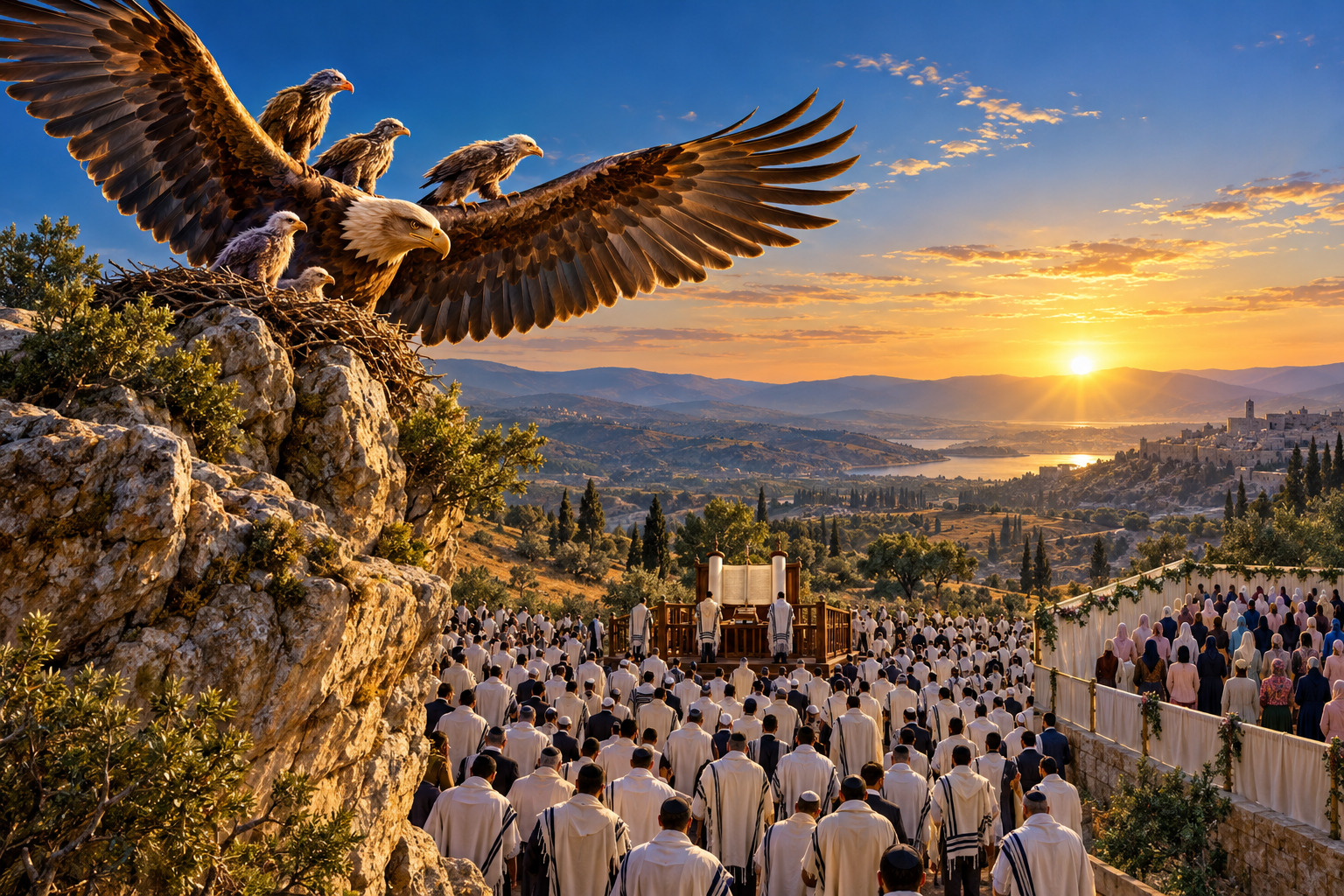
“As an eagle stirs its nest”
Shabbat Haazinu always falls before Yom Kippur. The result: everyone speaks about Yom Kippur and the parasha is left aside. This shiur takes the parasha itself.
The eagle does not drop onto its nest all at once: it makes noise among the branches so its young have the strength to receive it. That is how Hashem revealed Himself to Israel — by degrees.
Nor does it seize its young in its talons as other birds do: it carries them on its back. It alone fears only the arrow — “better that it enter me and not my children”.
But how do the eaglets get onto that back? He spreads his wings, and they climb. That is itaruta diletata: the first step is ours. You want parnassa? Go to work. You want Torah? Open the book.
Second subject: the last of the 613 mitzvot is to write a Sefer Torah — and the first is “peru urvu”. The circle closes: study too gives birth.
Today is the fourth of Tishrei, inside the ten days of teshuva.
And we have said it before: we always read parashat Haazinu at this moment, Shabbat Haazinu always falls before Yom Kippur. The result is that everyone speaks endlessly about Yom Kippur and the parasha is neglected: Haazinu itself is hardly discussed.
So we shall learn something about the parasha itself. Two subjects.
“As an eagle stirs its nest, hovers over its young, spreads its wings, takes it, bears it on its pinion.” — Devarim 32:11
In the shirat Haazinu, Moshe Rabbenu compares the Holy One blessed be He to an eagle in His dealings with the people of Israel.
And this verse holds two distinct elements. The first part — kenesher yair kino, al gozalav yerahef — is one behaviour of the eagle. The second — yifros kenafav yikahehu, yisaehu al evrato — is another. Two very particular habits belonging to that bird. That is the mashal; the nimshal is the Holy One’s relation to Israel.
Picture the scene. The eagle comes back to the nest. Its wingspan is two metres. And in the nest there are tiny chicks. To them, even though this is their father or their mother, what arrives is an enormous creature landing on the nest. It is terrifying. An infant cannot withstand such a thing: a whole aeroplane touching down on its house.
So what does the eagle do so that the little one is not thrown into that fright? Here is what Rashi explains in the name of the Midrash.
“He led them with mercy and pity, like this eagle which is merciful to its young and does not enter its nest suddenly: it beats its wings and makes noise above them, from tree to tree, from branch to neighbouring branch, so that its young awaken and have the strength to receive it.” — Rashi on Devarim 32:11
He makes a little noise beforehand. He passes among the trees so they notice that something is approaching. He does not come with all his force, but gently, so they can absorb him little by little.
And the continuation of the verse: al gozalav yerahef — “he does not press his full weight upon them, but hovers, touching and not touching”.
Rashi continues: so too the Holy One blessed be He. When He came to give the Torah, He did not reveal Himself to them from one direction only, but from four — “Hashem came from Sinai, He shone forth from Seir…”.
In other words: even when He reveals Himself to Israel, He does not come all at once in the full majesty of His glory, so that they may absorb that divine light without collapsing.
The Holy One blessed be He takes our weakness into account. He does not come to us with all His force; but He comes with the force we are able to receive.
This teaches us something: we have the capacity to receive the divine light according to our strength, each according to his own. For if we received that light all at once we would burst; we could not stand it.
So, drop by drop.
The second part of the verse: yifros kenafav yikahehu, yisaehu al evrato.
The eagle is not like other birds. When it wants to move its young from place to place, it does not take them in its talons as the others do. It does not grip them by the feet to carry them.
It spreads its wings — and they climb onto its back.
Why the difference? Because all other birds fear the eagle, which flies higher than they do and can fall on them from above. So they carry their young beneath them, to shield them from what comes from the sky.
But the eagle is the king of birds: nothing flies above him. He fears one thing only — the hunter’s arrow, which comes from below.
“He said: better that the arrow enter me and not my children.” — Rashi on Devarim 32:11
So he places his young on his back, above him: if an arrow comes, it will strike him and not them.
Where did we see the Holy One blessed be He act this way with Israel? At the exodus from Egypt, when they reached the sea.
“The angel of God who went before the camp of Israel moved and went behind them… and it came between the camp of Egypt and the camp of Israel.” — Shemot 14:19-20
The cloud that went before them passed behind them and stood like a wall between Israel and the Egyptians. The Egyptians shot arrows — and everything came back upon them. The Holy One blessed be He placed Himself as a rampart between the arrows and His children.
And here is the thing that must really be pictured, the most important of the whole image.
We said the eagle does not take his young with his talons. So how do the eaglets reach his back? He does not seize them and throw them up there. Something has to happen.
This is not a detail. It means that if you want the Holy One blessed be He to protect you and set you on His back so the arrows do not reach you, the one who must take the first step is the eaglet.
The eagle says: here, I have spread my wings, start climbing. If the young one answers “I do not feel like it” — then he stays below. Your chance of being saved lies in this: that you act, and make the effort, a great effort, to climb along the wing. Then you will be on the back.
This principle has a name: itaruta diletata, the awakening from below. A man must awaken from below, take the first step — and only then does the awakening from above come, and the Holy One blessed be He brings mercy down upon him. But the first step is required of us.
— I want parnassa. Very well: go to work. You are not going to sit at home with a coffee thinking someone will knock at your door with a thousand-shekel note. That will not happen. Go out and work — and then I will help you receive a good parnassa. But go out first.
— I want to become a talmid hakham. Very well. You will sit and the Holy One blessed be He will pour Torah into your head? No: open the book, break your head over it, try to understand — and He will open the gates of wisdom to you.
Second subject. What is the last of the 613 mitzvot?
It is found at the end of parashat Vayelech, which is joined to Haazinu.
“And now write for yourselves this song and teach it to the children of Israel, put it in their mouths, so that this song may be a witness for Me among the children of Israel.” — Devarim 31:19
On the plain level, which song is meant? Shirat Haazinu — the last verses of Vayelech say that Moshe wrote this song that day and taught it to the children of Israel.
But our Sages say: ein shira ela Torah — “song” means the Torah. And from here the mitzva of writing a Sefer Torah is learned. It is the 613th, the last of the mitzvot: every man must write a Sefer Torah.
Now here is what is striking in the prayers. On Rosh Hashana, after kaddish titkabal, the hazan says: may Hashem open for us all the gates — the gates of light, the gates of blessing… and among them the shaarei periya urviya, the gates of fruitfulness.
Now there are nusahot in which it is not written simply shaarei periya urviya, but shaarei periya urviya baTorah — the gates of fruitfulness in the Torah. What fruitfulness is, we know. But what is fruitfulness in the Torah?
Consider this. What is the first of the 613 mitzvot?
“Be fruitful and multiply, and fill the earth.” — Bereshit 1:28
That is what the Holy One blessed be He said to Adam and Hava: a man must multiply, take a wife, have a son and a daughter to fulfil the mitzva of periya urviya.
What is the connection? One must know that when a man studies Torah, the breath that leaves his mouth brings about unions in the upper worlds. And every union brings down a flow — just as from the union of a man and a woman a child comes out, the unions above bring down abundance.
“Were it not for My covenant day and night, I would not have set the laws of heaven and earth.” — Yirmeyahu 33:25
And what is “My covenant”, if not the Torah? Were Israel not studying the Torah, heaven and earth could not stand. The whole existence of the world depends on the Torah that the people of Israel study.
How does it work? When we study, we renew the work of creation. The Holy One blessed be He pours out abundance again and creates the worlds anew. The Torah itself sustains the world.
It has been said — I no longer recall in whose name — that one of the reasons Israel is scattered across the whole world is this: the hour is not the same everywhere. Here it is night and we are going to sleep; in the United States it is day.
The Jews who wake there rise to study and to pray. So, twenty-four hours a day, Torah never stops in the world — and that is what holds and sustains it.
And when all Israel is gathered here? Then it will be the time of Mashiah, and he is the one who will sustain the world: the world will already be repaired, everything returned to its place, and it is Israel, from the land of Israel, with the Beit Hamikdash, that will send the abundance out to the whole world.
“For out of Zion shall go forth Torah, and the word of Hashem from Jerusalem.” — Yeshayahu 2:3
The galut therefore serves to scatter Israel through the world so that Torah is studied there without interruption; when Mashiah comes and the Beit Hamikdash is rebuilt, it is the ketoret going out from it that will sustain the entire world.
This is why, on Rosh Hashana, we pray not only for the fruitfulness of the body, but also for the fruitfulness of the soul.
🎯 Test yourself
Five questions on the shiur. Click an answer.
Result
Shalom Bayit — The Mouth at Home
My covenant of peace — peace begins at home. Reveal a Shalom Bayit card.
Gematria — Rav Ménaché
Shalom, Mashiah, Yisamech — secrets of the letters by Rav Ménaché zatsal.
🔢 Gematria CourseAll Parashot
All shiurim of M. Yéhouda Himi — from Bereshit to Devarim and the festivals.
📚 All ParashotBooks
Torah wisdom in thriller format — Éditions Gueoula.
Guardians of the Rift
Forty-nine gates open — the fiftieth hides in a single moment. An ancient secret resurfaces, and one man stands between the rift and the world. Drawn from Talmud and Kabbalah.
📖 Read the free excerpt · Book $9.90