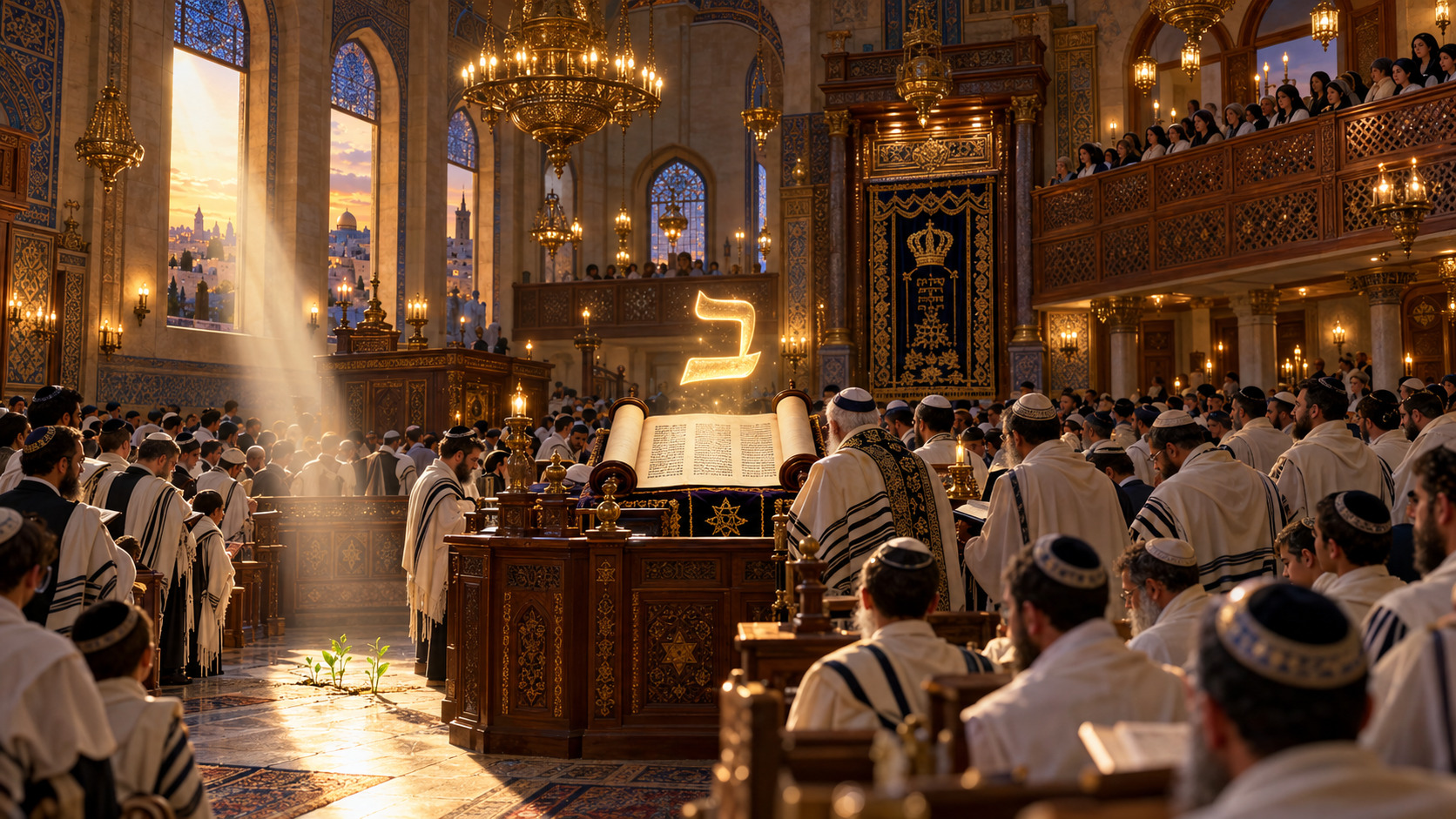
“Let Us Make Man”
Yesterday we learned: Bereshit — with wisdom, koach mah; the world was created through the power of humility. Today we continue on the same foundation. “Let us make man” — in the plural: God consults the angels. Moshe did not want to write it, lest people say there are two powers; God told him: write, and whoever wishes to err will err. To teach that even the greatest consults and takes permission from the small.
The angels split into factions: Kindness says, let him be created; Truth says, let him not; Righteousness says, let him be created; Peace says, let him not. God took Truth and cast it to the ground. Truth is the Torah — God’s seal; He casts it to the earth so that Israel will learn it, and it becomes the antidote to both falsehood and strife. “Truth shall spring up from the earth.”
That is why the Torah opens with bet: starting from alef, adding the letters in threes and reducing to small gematria, you always get 6 — like sheker, falsehood (600); starting from bet, you always get 9 — like emet, truth (441). And the final letters of “Bereshit bara Elokim” and of “bara Elokim la’asot” spell emet.
When God brought the animals before Adam, he named them by their roots — ox, donkey, horse, camel. “And you, what is your name?” — “I am fit to be called Adam, for I was created from the adamah, the earth.” And he called God Adonai, for He is Master of all His creatures. The one who knows he is dust of the earth is the one who can reach “a little less than God”. So too Moshe, humblest of all men, from whose throat the Shechinah spoke.
Good evening. With God’s help we will continue with Parashat Bereshit. Yesterday we said: what is Bereshit? The Zohar says — with wisdom, as it is said, “the beginning of wisdom is the fear of Hashem”. And we said that the word chochmah is made of two words: koach mah. And mah — in fact, nothing: that is humility. God created the world through the power of humility; the foundation of everything is the power of humility.
(The previous shiur: “And He Brought Her to the Man”.) We continue with the same idea — that God wants to teach us humility.
“And God said: Let us make man in our image, after our likeness.”
“Let us make man” — in the plural. He does not say “I will make man”. On the face of it, from this wording it would seem there is someone else making man together with God.
And the Midrash relates: when God dictated the Torah to Moshe Rabbeinu — “write: In the beginning God created” — and reached this verse, “let us make man”, Moshe said: I will not write it. Why should I write “let us make man”? What will everyone think — that there are, Heaven forbid, two powers in Heaven, that there is someone else with You? If You wish, I am ready to write “I will make man”. God said to him: write “let us make man” — and whoever wishes to err, let him err.
What did God want to teach us with this? The trait of humility. That even a person as great as can be, before doing something, must consult. In the end he will do what he wants — but at least let him consult. Not that God, Heaven forbid, needed the angels’ advice; rather, He teaches us the principle that one must take counsel. And Rashi brings:
“‘Let us make man’ — from here we learn the humility of the Holy One, blessed be He… Although they did not assist Him in forming him, and there is room for heretics to rebel, Scripture did not refrain from teaching proper conduct and the trait of humility: that the great should consult and take permission from the small.”
The angels did not help Him form man — it even seems they opposed it. And there is room for heretics to come and say: there are two powers, Heaven forbid. And yet God was willing, as it were, to sacrifice this — that someone might think there are two powers in Heaven — just so that we learn the foundation of humility: that one must take counsel with every person.
So God asks the angels: what do you say — shall we make man or not? And what do the angels answer? The Midrash says:
“When the Holy One, blessed be He, came to create the first man, the ministering angels formed into groups and factions; some said, let him not be created, and some said, let him be created — as it is written: Kindness and truth have met; righteousness and peace have kissed.”
Factions, in other words. One party says “let him not be created”, and another says “let him be created”.
Kindness says: let him be created — for he will do acts of kindness. Truth — the group of angels that stands for truth — says: let him not be created, for he is all lies; this man about to be created will be a great liar. The debate goes on. Righteousness says: let him be created — for he will give charity; it is worth creating him for the charity he will give. Peace says: let him not be created — for he is all strife; quarrels and conflicts from here to India.
What did God do? So says the Midrash: He took Truth and cast it to the earth. What had Truth said? “Let him not be created” — right. So He takes it and throws it to the ground:
“And truth was cast to the ground.”
The ministering angels said before God: Master of the worlds, why do You disgrace Your seal? You take Truth and throw it on the floor? Let Truth rise up from the earth — as it is written:
“Truth shall spring up from the earth.”
What did God want to show with this act? We know that truth is, in essence, the Torah — and that is God’s seal. When God created the world, He looked into the Torah and created the world; the Torah was the beginning of His way. That is: even before there was a world, the Torah already existed — and it is the most precious thing to God. So why throw it to the ground?
To say: you say not to create man because he is all lies, and Peace says not to create him because he is all strife. What shall I do? I will take the Torah and cast it to the earth; and Israel will come and learn the Torah, which is called “truth”, and it will be the remedy — both to refrain from lying and not to come to strife. As our Sages said:
“I created the evil inclination; I created the Torah as its antidote.”
The evil inclination is what makes a person lie, and what brings him to strife. And the Torah is the spice that refines a person’s soul and makes him a finer human being — one who will come neither to strife nor to falsehood. That is why He casts Truth to the earth: so that it will be given to the people of Israel, spring up from the earth, and become redemption for the world.
And the Torah is indeed a Torah of truth, as it is written:
“Buy truth, and do not sell it.”
And we bless: “who gave us a Torah of truth”. Truth is God’s seal, as the angels say, and the Torah is a Torah of truth.
This gives one of the beautiful answers, by allusion, to the question: why does the Torah begin with the letter bet and not with alef? There is a Midrash — the Otiyot of Rabbi Akiva — telling that all the letters debated: with which of them would the Torah begin? All the letters lined up and held, as it were, an “audition” before God; each presents itself and says why the Torah should begin with it.
And the Midrash begins precisely from tav — to make it interesting, suspenseful. Tav says: it is fitting to begin with me, for I am the letter with the highest number, and so on. And they are turned down. Shin — the word sheker, falsehood, begins with you, so no. Resh, and so on — and so they go backwards. And bet sits to the side, quietly. Alef comes and says: I — Anochi, the Master of the world, Elokim, Echad.
And in the end God chooses the letter bet — for with it begin baruch and berachah, “blessed” and “blessing”; and with alef begins arur, “cursed”, and it would not be fitting for the Torah to begin with that. And alef He kept to open something very lofty in the Torah: the Ten Commandments — “Anochi Hashem your God”.
There is another answer too: the shape of the bet is open to the front — look forward. What is above and what is below — you have no business probing; backwards — you will never understand; look forward.
But according to the principle we have just said — that God’s seal is truth and the Torah is a Torah of truth — there is a very beautiful allusion: had we begun the Torah with alef, we would have been stuck in falsehood; by beginning with bet, we begin with truth. How do we prove it? Stay with me a moment, it is a bit of arithmetic. We add the letters three by three and reduce them by small gematria — that is, we add the digits until a single digit remains (or drop the zeros):
That is, had we begun with alef, we would always get six, six, six. And the word sheker in gematria: shin three hundred, kuf one hundred, resh two hundred — six hundred, six. All falsehood.
Let us see what happens if we begin with bet:
We always get nine, because we began with bet. And nine is also the small gematria of the word emet: alef one, mem four, tav four — nine. That is: because the Torah begins with bet, and the seal is a seal of truth — we always get nine.
And indeed, the first words — “בראשית ברא אלוקים” — their final letters: tav-alef-mem, אמת, emet. And what was there on the last day? “The heavens and the earth were finished… which בָּרָא אֱלֹהִים לַעֲשׂות, God created to make” (Bereshit 2:3) — the final letters: alef-mem-tav, emet.
One more idea, and with it I will finish. Since we are speaking of humility — for everything begins with it; “the humble shall inherit the earth” (Tehillim 37:11); humility is the trait that truly acquires everything for us — let us see what happened with the first man.
We know that God brought all the animals before him. But this was in fact a test: Adam naming all of creation — God tested man in order to prove to the angels that he had been worth creating. This too is a Midrash:
“Rabbi Acha said: When the Holy One, blessed be He, came to create man, He took counsel with the ministering angels and said to them: Let us make man. They said to Him: This man — what is his nature? He said to them: His wisdom is greater than yours.”
This creature You are about to create — what is his story, what are his qualities, what will come of him? “His wisdom is greater than yours” — an answer to the angels. They said: prove it to us. He brought before them the cattle, the beasts and the birds, and said to them: this one — what is its name? He showed them an ox. They know it is an animal — but what is it called? They did not know.
Now for the trial: He passed them before the man and asked him the same question: what is its name? He said: this is an ox, this is a donkey, this is a horse, this is a camel.
How did he know? Because God implanted in man this wisdom — to see the root of every creature above. By it he knew that this is a shor, an ox — shin, vav, resh: in its essence, it is shor. And this is a chamor, a donkey — chet, mem, vav, resh: all chomer, matter. For every creature has its root above, as we say in Patach Eliyahu: everything that exists below has its root above.
Then God says to the first man: And you — what is your name? He said to Him:
“I am fit to be called Adam, for I was created from the adamah, the earth.”
Could we have looked at that scene at that moment, we might imagine God giving him a kiss on the forehead for that answer. Why? Because he could have given a different answer. He could have said: I am a god! I am the crown of creation, You have set me above all the cattle and beasts, I am king of the world. And the first man, in his humility and modesty, understood his worth and said: I am “Adam”, for I am from the earth.
It is said, “You have made him a little less than God” (Tehillim 8:6) — man lacks only a little of the divine; and some read in the name Adam: adameh le-Elyon, “I will be like the Most High”. But the first man did not feel that he lacked only a little of the divine — he felt his own worth: dust of the earth. And that is what is called “Adam”.
God was so delighted with the answer that He asked him: And I — what is My name? Give Me a name too. He said to Him:
“‘You are fit to be called Adonai, for You are Master of all Your creatures.’ Rabbi Acha said: ‘I am Hashem, that is My name’ — that is My name, which the first man called Me.”
This is a novel point: who gave God His name? Adam gave God the name — the Name of Lordship, alef-dalet-nun-yud. That is why, when we read the Name Havayah, which we may not pronounce as it is written, we call Him by the name the first man gave Him. So far does “a little less than God” go.
And the one who truly proved this to all sides is Moshe Rabbeinu. On the one hand:
“Now the man Moshe was very humble, more than any man on the face of the earth.”
And on the other hand — he is the one who merited to be the clear lens, aspaklaria ha-me’irah, who truly passes the word of Hashem through his throat, without any barrier, without anything at all. Why? Because of himself he has nothing. And so he is the one fit to be the channel that carries the Divine into the world.
May we merit, with God’s help, a thousandth of a thousandth of Moshe Rabbeinu, and so bring redemption to the world. And let us say: amen.
🎯 Test yourself
Five questions on the shiur. Click an answer.
Result
Shalom Bayit — The Mouth at Home
My covenant of peace — peace begins at home. Reveal a Shalom Bayit card.
Gematria — Rav Ménaché
Shalom, Mashiah, Yisamech — secrets of the letters by Rav Ménaché zatsal.
🔢 Gematria CourseAll Parashot
All shiurim of M. Yéhouda Himi — from Bereshit to Devarim and the festivals.
📚 All ParashotBooks
Torah wisdom in thriller format — Éditions Gueoula.
Guardians of the Rift
Forty-nine gates open — the fiftieth hides in a single moment. An ancient secret resurfaces, and one man stands between the rift and the world. Drawn from Talmud and Kabbalah.
📖 Read the free excerpt · Book $9.90