Chayei Sarah —
“See Where I Have Come From”
Where did Yishmael come from at the Akedah? He had been sent away with Hagar, he had settled in the wilderness of Paran, and his mother had taken him a wife from Egypt. Yet at the Akedah, Avraham takes “his two young men” — Yishmael and Eliezer, says the midrash — and according to Rashi, a quarrel between Yishmael and Yitzhak about the brit milah comes just before the test. M. Himi does the arithmetic: Yishmael was sent away at sixteen, when Yitzhak, just weaned, was at risk of falling under his influence; at the Akedah Yitzhak is thirty-seven, Yishmael fifty-one, Sarah no longer fears anything, and Yishmael has come back to Avraham. At the foot of Mount Moriah, Yishmael and Eliezer see nothing — “stay here with the donkey” — and argue over the inheritance. Sarah, who went to Kiryat Arba to ask a giant where her family was, dies on hearing of the Akedah. The Torah records not a single word of Avraham’s eulogy: the eulogy is “Avraham came” — he had come from the Akedah. What kind of mother must one be to raise a son who asks to be bound tightly?
Today, with God’s help, we continue on the seam between the two parashiot: parashat Vayera and parashat Chayei Sarah. We finished Vayera with the binding of Yitzhak, and yesterday we asked a question: where did Yishmael come from at the Akedah?
Why do we ask this question? Because we know that Sarah says to Avraham: “Drive out this maidservant and her son, for the son of this maidservant shall not inherit with my son, with Yitzhak.” And it is written that Avraham listens to Sarah’s voice: he rises early in the morning, takes bread and a skin of water, gives them to Hagar together with the boy and sends her away, “and she went and wandered in the wilderness of Beer Sheva.”
In other words, Yishmael and Hagar really were sent away from the camp of Avraham our father.
Then it is written that God opened Hagar’s eyes and she saw a well of water; and then: “God was with the boy, he grew up, he lived in the wilderness and became an archer.” Where is Yishmael? He lives in the wilderness of Paran, “and his mother took him a wife from the land of Egypt.”
Hagar was the daughter of Pharaoh. We know this: when Avraham goes down to Egypt, Hashem strikes Pharaoh with great plagues, and Pharaoh says to Avraham: why did you tell me “she is my sister,” when she is your wife? And as a gift, he gives him his daughter Hagar as a maidservant. He said to himself: better she be a maidservant in Avraham’s house than a princess in Egypt.
So Hagar is close to the royal house of Egypt. And when Yishmael is in the wilderness of Paran, his mother, who has her connections, takes him a wife from the land of Egypt.
Then comes the story of Avimelech, and right after it: “It came to pass after these things that God tested Avraham.” If we know that Yishmael is now in the wilderness of Paran, married and far from Avraham our father, how is it written at the Akedah: “Avraham rose early in the morning, saddled his donkey and took his two young men with him”?
The midrash asks: who are these two young men? One is Yishmael and the other Eliezer. How do we suddenly find Yishmael at the Akedah? He was sent away; he should not be there.
Another question makes the first one even stronger. It is written: “It came to pass after these things” — which things? The Torah does not tell us. Rashi brings two explanations.
The first: after these words — the words of the Satan, who came before the Holy One, blessed be He, and said: did You see? Avraham our father made a great feast on the day Yitzhak was weaned, he invited many important people, and he did not offer a single sacrifice; he did not even say thank You. The Holy One, blessed be He, answers him: know that if I ask him to offer not a sacrifice but Yitzhak himself, he will agree. — Really? Then let’s bet, as we would say. “It came to pass after these words” — this exchange between the Satan and the Holy One, blessed be He — “that God tested Avraham” and said to him: “Take your son, your only one.”
The second explanation Rashi brings, and this is the one that concerns us: Yitzhak and Yishmael began to argue, and Yishmael boasted before Yitzhak. He said to him: you had your brit milah at eight days old. That is no great feat: at eight days a baby feels nothing, he cannot object. I was thirteen when they gave me the brit, and still I did not object. So I have greater mesirut nefesh than you.
Yitzhak answers Yishmael: you think you can frighten me with one limb? If the Holy One, blessed be He, told me now to offer my whole self before Him, I would not hold back. “It came to pass after these words”: God tested Avraham.
From this conversation between Yishmael and Yitzhak, it appears that Yishmael is still around. Yet we said he had been sent away.
So we need to know how old Yishmael was at the Akedah. Yitzhak was thirty-seven. And since the age gap between Yitzhak and Yishmael is fourteen years, Yishmael is fifty-one at the Akedah, and Yitzhak thirty-seven.
When the Torah says “na’ar,” “ne’arim,” it does not mean young lads as we understand it today — twelve, thirteen, sixteen, the silly teenage years, as they say. They were men of a respectable age.
What was the reason Sarah told Avraham “drive out this maidservant and her son, for he shall not inherit with my son, with Yitzhak”? Because she had seen Yishmael “metzachek” with Yitzhak. What does metzachek mean? The word tzechok refers to gilui arayot, avodah zarah and shefichut damim.
She saw how Yishmael played with him with a bow and arrows, trying to kill him. And it is also a sign of avodah zarah: he was trying to draw him into serving idols, for the word “metzachek” is the word of the sin of the golden calf: “the people rose up letzachek” — letzachek means serving idols. So Sarah says to Avraham: listen, I do not want this; he is leading him astray, he has an influence on him.
How old were they at that time? Yitzhak was, let us say, two years old, since it was the day Yitzhak was weaned; and Yishmael was sixteen. That is a dangerous age: Yishmael can then influence Yitzhak and lead him astray. Sarah says: send him away.
In other words, when Yishmael is sent away, he really is a “na’ar”: sixteen, seventeen, something like that. He reaches the wilderness of Paran and marries. Once he is married, a good many years pass, and by the time of the Akedah he is already fifty-one.
According to this, Yishmael has already come back to live near Avraham our father, and it no longer bothers Sarah; his presence no longer frightens her. Why? Because in the meantime Yitzhak has grown up. He is thirty-seven, he has learned some Torah from his father — in any case, thirty-seven years with Avraham our father. What influence could Yishmael still have on Yitzhak?
That is why, at the time of the Akedah, Yishmael is nearby: he accompanies Avraham our father, and they go together to perform the Akedah. But one has to think these things through. If you follow the story in sequence, you say: this is not logical, where did he come from? Well, we know that he came, and that he was close to Avraham our father.
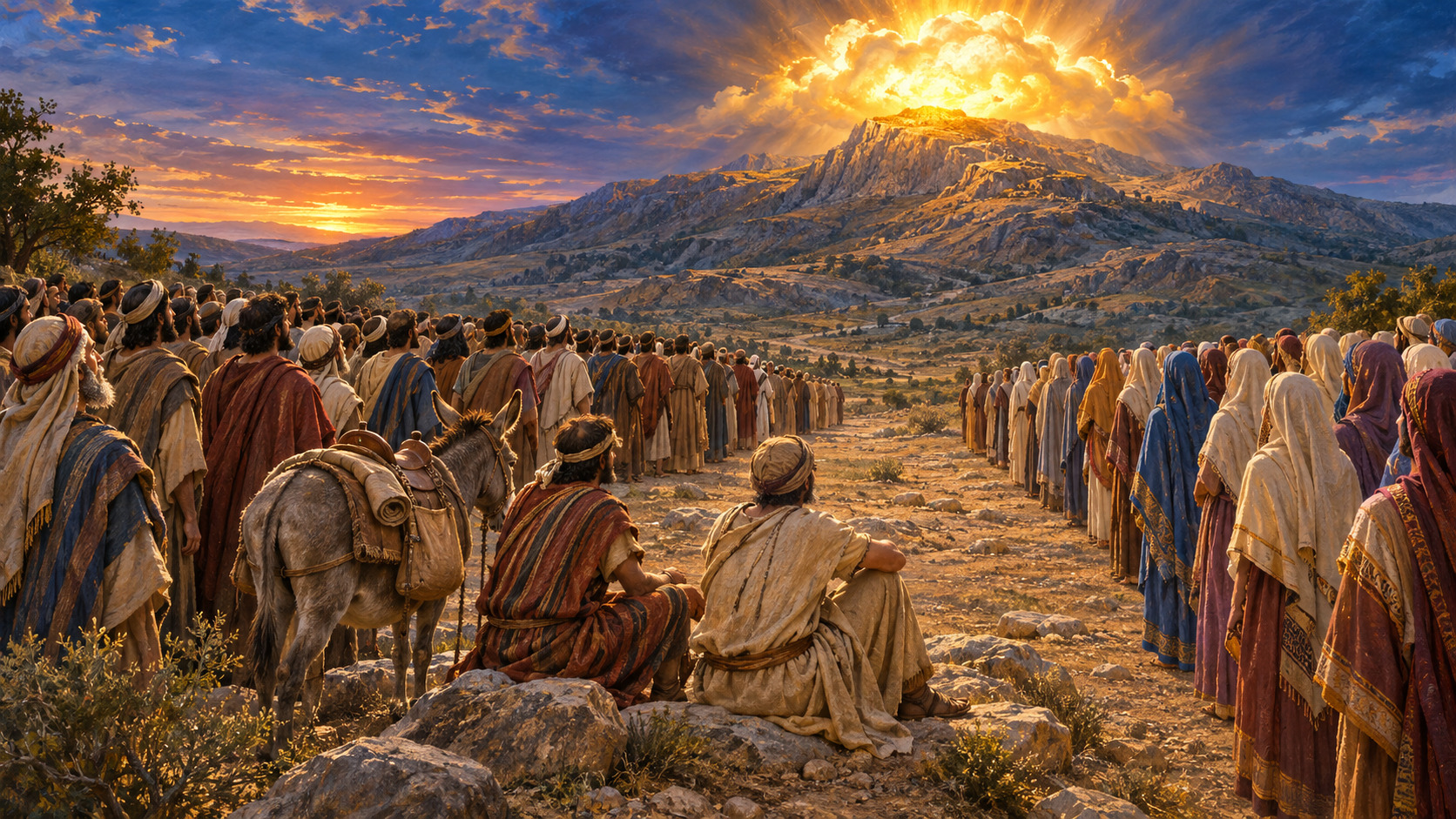
There is even a discussion, a quarrel, between Yishmael and Eliezer. When they reach Mount Moriah, Avraham asks them: do you see anything? They answer: we see nothing. And Avraham our father sees the Shechinah resting on the mountain.
For this place of the binding of Yitzhak is the place of the even hashtiyah, the place of the Beit HaMikdash; it is also from there that the Holy One, blessed be He, made Adam HaRishon. It is a holy place, not just any place. He says to them: do you see anything? — We see nothing. So, as it is written at the Akedah: “Stay here with the donkey” — with those who are compared to the donkey. They see nothing.
While Eliezer and Yishmael sit waiting for Avraham to come back from the Akedah with Yitzhak, a quarrel breaks out between them. Yishmael says to Eliezer: now everything is fine. Avraham is about to slaughter Yitzhak, and I am Avraham’s son: I will inherit him. Eliezer answers him: not at all! You are the son of a maidservant, nothing is due to you. I, Eliezer, the faithful servant of Avraham our father, obviously I am the one who will inherit him.
So they argue, and while they are arguing, Avraham comes back — with Yitzhak, according to one midrash. According to another midrash, Avraham comes back, and Yitzhak spends three years in another place; we will not go into that. In any case, this is something hidden in the midrashim, behind the story.
In the end, Yitzhak our father — “do not lay your hand on the boy” — was not slaughtered. But for Sarah it did not help much: right after the Akedah we come to our parasha, “These were the years of Sarah’s life,” and “Sarah died in Kiryat Arba, which is Chevron.”
One asks: how did Sarah reach Chevron? “Avraham returned to Beer Sheva”: they lived in Beer Sheva. How is it that Sarah dies in Chevron?
The midrash says that when Sarah got up in the morning and saw that Avraham was not there, Yitzhak not there, Yishmael not there, Eliezer not there, she grew anxious: I must know what is happening to them. How could she know? No Interpol, no police, no drones. She went to Kiryat Arba.
What is in Kiryat Arba? Giants. Why is Kiryat Arba called Kiryat Arba? One explanation: after the four couples buried there. But at that time no one is buried there yet, apart from Adam and Chavah. So there is another explanation: after the four giants who lived there. Kiryat Arba is where the giants are.
She turns to one of them: you are very tall; look into the distance and tell me, please, if you see Avraham and Yitzhak — I have lost them. He looks: I see them, I see them on Mount Moriah, and right now Avraham is raising the knife, he is about to slaughter Yitzhak. When Sarah heard this, her soul flew away. That is why it is written here: “Sarah died in Kiryat Arba, which is Chevron.”
When Avraham returns to Beer Sheva: where is Sarah? They tell him she went to Kiryat Arba to look for you. Then “Avraham came to eulogize Sarah and to weep for her”: he reaches Kiryat Arba, buys the cave there from Efron, and buries Sarah there.
This is interesting. It is written: “Avraham came to eulogize Sarah and to weep for her.” What eulogy did he give? It is not written. Sarah our mother, with all the honor due to her — the Torah does not record a few words, “and Avraham said” something? Nothing. Not a word.
Later in the parasha, when Avraham sends Eliezer to bring a wife for Yitzhak, the story is told twice: the Torah goes on and on. What is happening here, that you are so sparing and do not say a single word of eulogy for Sarah?
So Avraham’s eulogy for Sarah is in the verse itself. Where is it written? In a small word? No. “Velivkotah”? That is even smaller: not only is there no eulogy, but in the word “velivkotah” the kaf is even written small.
So where is the eulogy hidden? And with this I will conclude: “Vayavo Avraham” — Avraham came. That is the eulogy. What do I mean? Avraham arrives, and Sarah has died. They ask him: Avraham, where were you? “Vayavo Avraham”: where have you come from? I have come from the Akedah.
That is the greatest eulogy one could give Sarah. This woman, Sarah, educated and raised a child named Yitzhak until the age of thirty-seven. The Holy One, blessed be He, commanded me to bind him, and he did not resist the Akedah. When I tied him, he said to me: tie me well, so that by instinct I do not struggle. He was ready to be bound and to offer himself for this mitzvah. What kind of mother must one be to raise such a child?
That is the greatest eulogy, the finest eulogy one could say: see where I have come from. You only need to understand where I have come from to know who this woman was, Sarah our mother — through whom, and through the education she gave Yitzhak, it was even possible to think of and imagine the Akedah.
And I want to reveal to you one more little secret; not everyone knows this midrash. It is said that Sarah died because the giant told her: one more second and he slaughters him. She thought he had slaughtered him, and she died of it, right? That is how we are used to thinking.
There is a midrash that says: she asked him — tell me, so did he slaughter him in the end? He answered: no. And it was from that “no” that she died: from the disappointment that the Akedah did not go all the way. That was her heartbreak.
This is truly a thought one cannot grasp. You say: what, have you gone mad? Avraham has gone mad, Sarah has gone mad? You wanted it to happen so much? How can you want it so much?
There is only one explanation. Avraham and Sarah knew that if the Akedah were carried out all the way, the world would be repaired. It would have repaired the sin of Adam HaRishon, the world would have returned to its repaired state; and as a result there would have been the resurrection of the dead, there would have been Mashiach, there would already have been the repair of the world under the kingship of Shaddai. That is what Avraham and Sarah wanted to reach.
But “for My thoughts are not your thoughts”: the thought of the Holy One, blessed be He, is that there are no shortcuts. Six thousand years are needed; we will go through six thousand years. Baruch Hashem, we have merited to be already near the end of this time. With God’s help we will reach the complete redemption, and Yitzhak — as I said yesterday, in the future tense: “Then our mouth will be filled with laughter, and our tongue with song.” Blessed be God forever, amen and amen.
Genèse / Genesis / בראשית 21,8–21
Rachi sur Genèse / Rashi on Genesis / רש״י על בראשית 21,9
Genèse / Genesis / בראשית 12,17–19
Rachi sur Genèse / Rashi on Genesis / רש״י על בראשית 16,1
Genèse / Genesis / בראשית 22,1–5
Rachi sur Genèse / Rashi on Genesis / רש״י על בראשית 22,1
Rachi sur Genèse / Rashi on Genesis / רש״י על בראשית 22,3
Genèse / Genesis / בראשית 22,12–19
Test yourself
Five questions on the shiur. Choose an answer.
Result
Shalom Bayit — The Mouth at Home
My covenant of peace — peace begins at home. Reveal a Shalom Bayit card.
Gematria — Rav Ménaché
Shalom, Mashiah, Yisamech — secrets of the letters by Rav Ménaché zatsal.
🔢 Gematria CourseAll Parashot
All shiurim of M. Yéhouda Himi — from Bereshit to Devarim and the festivals.
📚 All ParashotBooks
Torah wisdom in thriller format — Éditions Gueoula.
Guardians of the Rift
Forty-nine gates open — the fiftieth hides in a single moment. An ancient secret resurfaces, and one man stands between the rift and the world. Drawn from Talmud and Kabbalah.
📖 Read the free excerpt · Book $9.90