Chayei Sarah —
Three Years in Gan Eden
Why does Yitzhak not come back with Avraham from Mount Moriah? Why does he not come to weep for his mother? Why is he comforted for her death only three years later? How does he know the scent of Gan Eden? And why does Rashi teach us, at the beginning of chapter 24, that Avraham had a son? M. Himi gathers all these questions into a single answer: at the Akedah, Yitzhak’s soul flew away — says Pirkei DeRabbi Eliezer — and up there it met the soul of Sarah, which had just flown away when she heard of the Akedah. Yitzhak sees his mother in great sorrow; he understands that he must repair it, and he returns for three years to be with her in Gan Eden, until Rivka, born that very day, is three years old. The shiur opens with Yishmael’s age at the Akedah, the two parashiot named for “life,” Yosef and Musaf, the small kaf of “velivkotah,” and the eulogy hidden in “vayavo Avraham”; it passes through Rabbi Chaim Vital’s Sefer HaChezyonot, and ends with Avraham who says little and does much, Efron who says much and does nothing, and Eliezer who keeps silent under the insult.
Words of Torah do good when they are shared. Send this shiur to your family and friends on WhatsApp.
📲 Send on WhatsApp👥 Join the Gueoula groupToday, the 25th of Cheshvan, we read, with Hashem’s help, parashat Chayei Sarah. I have a small debt to one of our friends, who is not here today; we will pass the answer on to him. It was a fine question.
In last week’s parasha we had the Akedah of Yitzhak, and we know it is written that Avraham took two young men with him: “Avraham rose early in the morning, saddled his donkey, and took his two young men with him.” The midrash asks: who are these two young men? It was Yishmael — not Yitzhak, who is the one being bound — Yishmael and Eliezer. They are “his two young men with him.”
According to this, Yishmael was at the Akedah. And the question that arises is: how can that be? Before that there was the whole matter of Hagar: Sarah says “send away this maidservant,” for the son of this maidservant shall not inherit with my son, with Yitzhak; Hagar goes off and wanders in the wilderness, and so on. And after her problem of water is solved: “God was with the boy, he grew up, he lived in the wilderness and became an archer; he lived in the wilderness of Paran, and his mother took a wife for him from the land of Egypt.” In other words, they separate from Avraham, they go to the wilderness of Paran; Hagar, who was Pharaoh’s daughter, as we remember, marries Yishmael to a woman from the land of Egypt — and we have parted from Yishmael. How, all of a sudden, do we see Yishmael appear at the Akedah? We need to understand this point.
We must know that in fact, when Sarah became alarmed at Yishmael being around, it was because she feared he would lead Yitzhak astray. She saw him “metzachek” — making sport — and that word means avodah zarah, gilui arayot and shefichut damim. She became alarmed.
How old was Yitzhak at the time of that episode? I am not speaking of the Akedah; I am speaking of when Sarah becomes alarmed and says: “Send away this maidservant.” It is written “vayigamal” — he was weaned: so he was two years old. If he was two, what is the age difference between Yishmael and Yitzhak avinu? Fourteen years, to be precise. Why? Avraham avinu performs the brit milah at ninety-nine, right? And at that time Yishmael was thirteen — that is why the Yishmaelim circumcise at thirteen. Yitzhak was not yet born at Avraham avinu’s brit, when Yishmael was thirteen; afterwards Yitzhak was born. So the age difference between them is fourteen years. The boy, Yishmael, is sixteen, Yitzhak is two, and he tries to corrupt him. Sarah says: send away the maidservant’s son. Very good.
Now comes the Akedah. How old is Yitzhak avinu at the Akedah? Thirty-seven. We know the calculation. Why? Because, as we will read in the parasha, with Hashem’s help, here in Chayei Sarah, she dies at one hundred twenty-seven, and she dies as a result of the event of the Akedah. Yitzhak was born when she was ninety: so Yitzhak was thirty-seven at the Akedah. And if the age difference between them is fourteen years, how old is the young man Yishmael at the Akedah? Fifty-one.
That is the point: after Hagar and Yishmael are exiled from Avraham’s house, the years go by, he marries, he already reaches the age of fifty-one. By then he is already coming back with his wife to the tent. There is no longer any problem with him being in Avraham’s camp; Sarah is no longer alarmed. Why? Because Yitzhak is already a man, a real man: at thirty-seven, no one can influence him any more.
And Yishmael — as Hashem told Avraham avinu in chapter fifteen, verse fifteen; easy to remember: fifteen-fifteen, always remember this word, “tu-tu,” chapter fifteen, verse fifteen — “And you shall come to your fathers in peace; you shall be buried at a good old age.” What is “you shall be buried at a good old age”? What was he told? Rashi says: he was told that Yishmael would do teshuvah in his lifetime, and also that Esav would not go off the path in Avraham’s days.
That is one of the reasons Avraham died at one hundred seventy-five and not at one hundred eighty like Yitzhak: five years were taken from him, so that he would not see Esav go off the path, so that he would not have that grief.
But we see from here that already at the Covenant Between the Parts, Avraham avinu is told that Yishmael will do teshuvah. So at fifty-one, Yishmael has already done teshuvah. He is in Avraham avinu’s camp, and then, in the plan of the Akedah, Avraham says to him: come and join me, Yishmael and Damesek Eliezer. They are in fact the two young men who accompany him. So there is nothing surprising in seeing Yishmael.
He did teshuvah, but he is not on the level of reaching ruach hakodesh like Avraham and Yitzhak.
Where do we really see that he did teshuvah, and that Avraham was buried at a good old age? Further on in parashat Chayei Sarah, it is written that Avraham dies, “and Yitzhak and Yishmael, his sons, buried him.”
Seemingly it should have said “Yishmael and Yitzhak,” since Yishmael is the firstborn. This teaches that he did teshuvah and said: I know my place; Yitzhak is the true firstborn, the firstborn in essence. That is why the Torah puts Yitzhak before Yishmael.
So that is just a small aside, to close this point.
And now we begin the parasha. Two parashiot in sefer Bereshit carry the name of life: one is Chayei Sarah, and the other is parashat Vayechi Yaakov. In both of these parashiot a death is told, and the word “life” is used. We learn from this that tzaddikim in their death are called living.
But the Torah also hides here the matter of the taste of life. The taste of life: it is not only living, it is living with taste. How do we see it? With Sarah: “Vayihyu chayei Sarah.” The word “vayihyu” has the numerical value of thirty-seven, to teach us that the life she truly lived is from the time Yitzhak was born.
Whereas with Yaakov, “vayechi Yaakov”: the numerical value of “vayechi” is thirty-four, to tell you that the years Yaakov truly lived were the first seventeen years — from Yosef’s birth until he was sold to Egypt — and, when he goes down to Egypt and meets Yosef again, from one hundred thirty to one hundred forty-seven: seventeen. That is the true life, when he was precisely in Yosef’s presence.
Why precisely Yosef? Because Yosef is in fact the leg that completes the Avot, as we have learned several times. Yaakov made him the striped tunic because he saw in him the bearing of royalty, and indeed it is from Yosef that Mashiach ben Yosef comes.
And not only that. If you pay attention — we have dwelt on this several times — Yosef is called “avrech,” “av rach”: on one side he is a father, “av,” as we have the three Avot, Avraham, Yitzhak and Yaakov; but he cannot be a father, because in the end he is a son. So he is an “av rach,” a tender father.
And that is why he too has this aspect of a father. If we have said that the prayers correspond to the Avot — the Avot instituted them: Avraham is Shacharit; Yitzhak, Minchah — we will speak of it today: “vayetzei Yitzhak lasuach basadeh”; and Yaakov, the prayer of Arvit. So which prayer does Yosef have? Musaf. And since he is an “av rach,” Musaf is not prayed every day, only on Shabbatot and festivals.
Now we come to the beginning of the parasha: “Sarah died in Kiryat Arba.” We asked: how did she get to Kiryat Arba? For when Avraham returns from the Akedah, “Avraham dwelt in Be’er Sheva”: their place of residence is Be’er Sheva. So how does it come about that Sarah dies in Kiryat Arba?
It is a midrash that says it: she did not know that Avraham’s plan was to bind Yitzhak. And since they do not come back, she said: let us go find someone who can watch from above — a kind of drone that will tell us where they are. They went to Kiryat Arba.
Why is Kiryat Arba called Kiryat Arba? One explanation: because of the four couples buried there. But that answer is a little illogical here, chronologically, because at this point we have only one couple buried there: only Adam and Chavah. So the second explanation: because of the four giants.
She turns to the giant Achiman and says to him: tell me, what do you see? — I see, I see right now Avraham raising the knife, and he is going to slaughter Yitzhak. At the thought that he was now going to slaughter Yitzhak, her soul flew away. Very good; we will come back to it.
And then her soul flew away. And there are those who say — we will read it right away inside — that it was the Satan who came and told her that he had already slaughtered him. How so, he had already slaughtered him? Is that a contradiction? It is not a contradiction.
For it is written, in any case — let us see how it is written, before he is told “do not stretch out your hand against the boy”: “Avraham stretched out his hand and took the knife to slaughter his son.” So the angel said: not only was he about to slaughter him, he actually slaughtered him — and his soul, Yitzhak’s, flew away. That is what we are speaking of: his soul flew away. Very good, gentlemen, his soul flew away.
And then she dies in Kiryat Arba. “Avraham came to eulogize Sarah and to weep for her.” And Yitzhak, where is he? He is her only son! He does not come to eulogize, he does not come to take part in the mourning. We will study it; this is what I want to dwell on today.
Just to close this point: “velivkotah” — you will find here a kaf ze’ira, a small kaf, in the word “velivkotah.” Why a small kaf? There are several reasons.
We also learn from here that one does not mourn the dead too much. What is the problem with mourning the dead too much? That in fact you do not accept the decree: “Hashem gave, Hashem took; may the Name of Hashem be blessed.” One who is sad — true, it is painful — but to weep too much is as though to dig into the decision of the Holy One, blessed be He, to take that person who passed away.
It is also said that Avraham did not weep too much so that people would not say he regretted the Akedah — that he regretted there had been an Akedah: “had I not done it, she would still be alive.”
There is yet another explanation: he was already on the way, and by the time he reached her, the first three days of mourning had passed. And the first three days of mourning are for weeping; after them one weeps little.
To strengthen this point, there is a question: when was the Akedah? On which day of the year? There is a dispute — all the answers are correct: some say it was on Rosh Hashanah, and some say it was on Yom Kippur, at the time of Minchah. That is the reason we read again on Yom Kippur the piyut “Ha’oked vehane’ekad vehamizbe’ach” — we read it on Yom Kippur too, at the Minchah prayer. Why? Because that is the hour at which the Akedah took place.
Pay attention: if that is the hour at which the Akedah took place, we must understand. Where did he do the Akedah? On Mount Moriah. From Mount Moriah he must go back to Be’er Sheva. He reaches Be’er Sheva and finds a note on the fridge — yes, a note on the fridge: “I went to Kiryat Arba.” He reaches Kiryat Arba on the second day; on the third day he conducts the negotiations with the sons of Chet, and so on, and he buries her; that is where the eulogy and the weeping take place.
If the Akedah was on Yom Kippur, we are in fact on the eve of Sukkot. And that is why he had no opportunity to weep much: as soon as one cannot mourn on the festival, the festival interrupts the mourning. And as we have learned, the Avot kept the entire Torah. That is why, already on the eve of Sukkot, it was no longer possible to mourn — and that is why the kaf is small. Very good.
Now — we already asked once, in the previous shiur — what eulogy does Avraham give for Sarah? All the points I am saying now are, like this, an appetizer, so that you have a little more taste for Shabbat.
What eulogy does he give her? Further on in the parasha, when Avraham sends Eliezer to bring a wife for his son, you see the story: it is repeated at least twice. Once the story itself, and a second time when Eliezer tells it: “the conversation of the servants of the Avot is finer” — how much the Torah dwells on this matter! Whereas on Sarah, nothing. Let him say a eulogy, let him say a few words, let the Torah spell out a few words!
What eulogy does Avraham actually give for Sarah? Seemingly it is not written. But it is written. How is it written? The place of the eulogy is where the Torah writes it: “Avraham came to eulogize.” What did he say in his eulogy? I would expect it to be written: Avraham eulogized Sarah, saying one, two, three — what a righteous woman she was, how much she suffered, and so on. But it is written: he came to eulogize and to weep for her. Seemingly there is no eulogy. But there is a eulogy, and the eulogy is two words: “vayavo Avraham,” Avraham came.
What is “vayavo Avraham”? Obviously he came! Why does the Torah say “vayavo Avraham”? Because they asked him: Sir, where are you coming from? Where were you until now? Your wife came here alone, and she died. Where were you? From the fact that it says “vayavo Avraham,” and that he tells where he comes from — that is Sarah’s eulogy.
Why? What is he actually telling them? I come from Mount Moriah. There I bound Yitzhak. Yitzhak is thirty-seven years old. Instead of running for his life, he cooperated and said: father, sharpen the knife well, and tie me tightly, so that I do not flinch like that from fear and reflex.
In other words: this is the woman who raised a son ready to sacrifice his life, to be an offering — to be offered for the sanctification of the Name. Sarah’s eulogy is: where I come from. Where do I come from? From the Akedah of a son who received from this woman an education of such a level that he was ready even to give his life for the sanctification of the Name.
And that is the most wonderful eulogy that can be given for any Jewish mother. A Jewish mother says: my son is in the army. What a great woman! The very fact that you manage to raise a child until he is ready to give his life for the people of Israel — that is the greatest thing there can be; every Jewish mother is proud of it. And that is in fact the chain that carries the people of Israel on from generation to generation. Thanks to the mothers — “in the merit of righteous women the children of Israel were redeemed from Egypt” — and every single day we are redeemed thanks to these mothers. Who gave them this strength to know that one must hold on? It is Sarah imenu.
So “vayavo Avraham”: see where I come from. That is what needed to be said, no more and no less. It says everything about this woman, about this extraordinary mother of the people of Israel.
Now I want to go into the subject a little. You have thrown out a few answers here and there, but I want you to have this as an orderly mishnah.
“Avraham was old, advanced in days, and Hashem blessed Avraham bakol” — in everything. What does Rashi say? “Bakol”: some say he had a daughter. True, there are those who want to say that Avraham avinu had a daughter named Bakol, because we know he had a son, and the blessing is to have both a son and a daughter. Very good.
And by the way, one minute, look into this matter: “Avraham came to eulogize Sarah and to weep for her, velivkotah” — take away the kaf ze’ira, that small kaf, and what remains is “ulevitah”: and her daughter. He came with his daughter to eulogize Sarah.
But what does Rashi say on “Hashem blessed Avraham bakol”? Let us see what he says. Pay attention, this is very surprising: “bakol” has the numerical value of “ben,” son. Wait, is that right? “Bakol” is bet, kaf, lamed: fifty-two. How much is “ben”? Bet and nun: fifty-two. Very good. “And since he had a son, he needed to marry him off.”
What are you telling us that is new, Rashi? What story are you coming to tell us here? I need to do gematria to understand — when he speaks to me of Yitzhak, we know he has Yitzhak! Why do you need to say: Hashem blessed Avraham “bakol,” that is, with a son, it comes out by gematria, and now that he has a son — as if we did not know it — he must be married off? What is new here?
If I did not know the whole story, I would learn from here that Avraham had a son, because it is a gematria. But why all this reasoning? Say: Hashem blessed Avraham, he has a son, Yitzhak; now he must be married off. How is it that all of a sudden you reveal to me that he has a son? What, until now he had no son? That is the headline question. We will get to it at the end, all right?
But along the way we asked a few more questions. We asked: “Avraham came to eulogize Sarah.” And let us take one more question. After Eliezer goes and brings Rivka, we come to the dramatic meeting — we have a dramatic meeting between Yitzhak and Rivka. And then Rivka asks the servant: who is that man, “halazeh”? Let us see it.
There is something else in the Torah with “halazeh”: “here comes that dreamer, halazeh” — right? “Halazeh.” But let us see what she sees here. “Rivka lifted her eyes, she saw Yitzhak, and she fell from the camel.” First: “she saw Yitzhak” — how does she know it is Yitzhak? That is a question. “And she said to the servant: who is that man walking in the field toward us?”
Now they ask: since when? This is not like her at all. What, you are looking at men? They are bringing you now to get married! What impression are you giving? You look, you open your eyes to see men in the fields, this and that? That is not her way.
The midrash says she saw a kind of angelic vision. She saw an extraordinary sight: she saw a halo of light upon Yitzhak. And that is what in fact awakened in her the question: where does this halo come from, where does this light upon Yitzhak come from? What is this story with the light?
We will ask one more question that we all know. When Yitzhak blesses Yaakov — you know it, everyone knows this story — what does he say? “He came near, he kissed him, he smelled,” and he said: “See, the scent of my son is like the scent of a field that Hashem has blessed” — in Gan Eden. What scent did he smell? The scent of Gan Eden.
But first of all, how does Yaakov carry the scent of Gan Eden? He had put on Esav’s precious garments. These garments — this jacket — were previously with Nimrod. Nimrod was the strongman; he behaved like Superman: you cannot beat me, you cannot beat me. The midrash says Esav came and said to him: what, I cannot beat you? Of course — you have the Batman suit, the Superman suit! Take it off, and let us face each other. All right? As soon as he took it off, Esav took it from him, and killed him. Very good.
And where did Nimrod get this jacket? From Adam harishon. And Adam harishon walked around with it in Gan Eden. So the scent clung to this suit, to this jacket, and that is how it passes to Nimrod, from Nimrod to Esav, from Esav to Yaakov who disguises himself in it; and then he smells: “like the scent of a field that Hashem has blessed.”
How does Yitzhak know this scent of Gan Eden? Apparently because he was there. All right? Apparently he was there. How long was he there? Three years. But why precisely three years? That is a fine question. And what did he do there? Why did he go there? I told you that you know these things, but today we are studying them a little as an orderly mishnah.
So, friends: Pirkei DeRabbi Eliezer, chapter thirty-one. Rabbi Yehudah says: when the sword reached Yitzhak’s neck, Yitzhak’s soul flew away and went out — truly, because he really died. His soul flew away.
And when he heard the voice of the Holy One, blessed be He, from between the cherubim, saying to Avraham, through the angel, “do not stretch out your hand against the boy,” his soul returned to his body, all right? Yitzhak rose and stood on his feet, and Yitzhak knew that this is how the dead will come back to life. Yitzhak understood from this what the resurrection of the dead means. He opened his mouth and said: “Blessed are You, Hashem, who revives the dead.”
All right? From this you also understand: we have the first three blessings — right? — Magen Avraham, Mechayeh hametim and HaEl hakadosh. Now you have understood where this one comes from, in the prayer of the eighteen blessings: “Blessed are You, Hashem, who revives the dead.”
And one who goes to the cemetery and has not been there for more than a month recites this blessing, “mechayeh hametim,” on the resurrection of the dead. Very good. So you now also understand what “mechayeh hametim” is.
What have we understood so far? That Yitzhak’s soul flew away, and a voice came out from between the cherubim, in the Temple above, and said: “do not stretch out your hand against the boy”; his soul returned, and he came back down. But that is only half the story. Now, the real story.
When he was up there — yes, at that moment, during that time, until the voice was heard from between the cherubim saying “do not stretch out your hand against the boy” — there was a meeting there, an encounter of the third kind, as they say: Yitzhak meets the soul of his mother Sarah.
For the Satan — now all the stories connect for you — the Satan had announced to her: there, there, he has slaughtered him. When he said “he has slaughtered him,” Yitzhak’s soul flew away, and Sarah’s soul also flew away — at the same moment.
How do we understand that it was at the same moment? “Vayihyu chayei Sarah”: from the juxtaposition we understand that this is what caused her death. The Torah does not tell us; it is the midrash that tells us. But the midrash has the courage to tie the two stories together, very simply, because the story ends there: “Avraham returned to his young men… and Avraham dwelt in Be’er Sheva” — that is the Torah’s story — and then “vayihyu chayei Sarah.” From here we learn that she died of it. And so, they meet.
One of the questions that is really asked: we said that “he returned to his young men” — and Yitzhak, where is he? Everyone asks: where is he?
The simple answer is that he went to Be’er Lachai Ro’i. Right? And how do I know he went to Be’er Lachai Ro’i? Because when Rivka sees Yitzhak, where does she see him? She does not see him in Be’er Sheva, but at Be’er Lachai Ro’i. What is Yitzhak doing at Be’er Lachai Ro’i? What are you doing there? Yitzhak went to bring Keturah — that is Hagar — for his father. Since Sarah had died, he took care to find a match, to rebuild a home for Avraham avinu. He went to Hagar to tell her: come, my mother has died, I do not want to leave him alone; come and join him.
How do I know? Because between the story of the Akedah and parashat Chayei Sarah there is a passage of a few verses, right? Pay attention to what is written: “Avraham dwelt in Be’er Sheva,” and “after these things it was told to Avraham: behold, Milkah too has borne,” and so on — all these were born, and “Tachash and Ma’achah”: all these were born. In other words, the family there is growing. So Avraham avinu too — can we not bring him Keturah, Hagar, bring her to his father?
But the answer that is now classic, which we study in this shiur and renew, is that he did not come back. Why? Because when he met her — the souls met up there — he sees his mother in very great sorrow.
Why are you in such great sorrow? — Me? All my life I hoped to have a child. You were born when I was ninety, you reached the age of thirty-seven, I already had the hope that here, from you, the people of Israel would begin — and you were slaughtered. Everything is against me. She had great sorrow.
Now Yitzhak says: I am not to blame. For it is not Yitzhak, it is not he who caused her death, chas veshalom. But he understands that because of him — let us call it “begrama,” indirectly — his mother died. All right?
And then he says: I must repair this matter of Sarah’s death. That is why, after his soul returns to him, he rises, stands on his feet and says: “Blessed are You, Hashem, who revives the dead” — and he understands that he must go back to Gan Eden and be there in his mother’s presence, study there, and so on, and give her contentment: three years.
Why three years? At the same time, at the very moment that Sarah dies and his soul rises, one more thing happens: Rivka is born. Yes? The Holy One, blessed be He, prepares the remedy before the blow: before Sarah has even died, Rivka is already born.
But one cannot marry Rivka at age zero; at least at three. Those three years, all right? When Yitzhak is forty, she is three. Then the time has come when he can marry her, and so he comes back down below. Before that, there is nothing to talk about.
Now see how sweet this is. Rashi — it is written: “Yitzhak brought her into the tent of Sarah his mother; he took Rivka, she became his wife, he loved her, and Yitzhak was comforted after his mother.” Pay attention to what Rashi says; see how deep and beautiful everything is.
What is “vayinachem,” he was comforted after his mother? “It is the way of the world: as long as a man’s mother is alive, he is bound up with her; and when she dies, he is comforted by his wife.”
That is: you marry and your mother is still alive — it is a segulah for quarrels, right? The mother-in-law and the daughter-in-law. But apart from that, why is there all this tension between the mother-in-law and the daughter-in-law? What does the daughter-in-law say? Yes, you only like your mother’s cooking, you are always at your mother’s… Right? So he is not really attached to his wife, because he still has a foot at his mother’s. But as soon as the mother passes away, that is it, he has nothing else to cling to; he is compelled, in his great goodness, to cling to his wife at last. That is what is written here: as long as a man’s mother is alive he is bound up with her, and when she dies he is comforted by his wife.
So Yitzhak is in fact comforted when his mother has died. But what — his mother died three years ago! Have you understood the point? What are you telling me now, “Yitzhak was comforted,” as if she had only just died? For it says “he was comforted after his mother”: so his mother died now? She died three years ago!
But according to the explanation we have given, Yitzhak remained bound up with his mother for three years in Gan Eden; he had not yet separated from her. Now that Rivka arrives, it is now, as it were, that she dies — and now he is comforted after his mother. Have you understood? That is a chiddush. If it is not understood, I will explain it once more. Very good, it is understood, baruch Hashem.
So here we see the point. Now I want to bring you from inside what I have just said, all right? There is a midrash called Midrash Sechel Tov, and it says this: Yitzhak’s soul flew at the time of the Akedah to Gan Eden, and there he saw the soul of Sarah his mother, who had died when she heard from the Satan the news of the Akedah. All right?
Rabbi Yehudah says: when the sword reached his neck, his soul flew away in Gan Eden, and he saw the soul of Sarah his mother, who had already died, for Samael had gone and informed her and said to her: wretched one, the son who was given to you in your old age — his father has already slaughtered him; she cried out, and her soul went out. And when the Holy One, blessed be He, made His voice heard from between the cherubim and said “do not stretch out your hand against the boy,” his soul returned to his body; his father untied him, he stood on his feet and said: “Blessed are You, Hashem, who revives the dead.”
So now Yitzhak comes down, and he goes back for three years to be in his mother’s presence in Gan Eden. And then all the questions we asked earlier are resolved. That is why Yitzhak did not come to weep for Sarah or to eulogize her: because he is up above. That is also why he is comforted after his mother only after three years, all right? And he did not come back with the young men — the young men, and where is Yitzhak? Yitzhak is in Gan Eden. And this whole process in fact takes us up above.
Now pay attention to what we are saying. That is why we also understand that he smells “the scent of my son like the scent of a field”: because he was in Gan Eden. All these questions in fact converge on the same place.
Do you remember what the headline question I asked at the beginning was? What did I ask? “Avraham was old, advanced in days, and Hashem blessed Avraham bakol.” “Bakol” — what are you telling me that is new, that he had a son?
Now we understand: because until then he did not have the son. Where was he? In Gan Eden. That is, it is not for nothing that the Torah now emphasizes: now he has a son. How? He came back; it is like a renewed life. For three years he was not with me; now that he has come down, this “bakol” teaches that he has a son. Now that he has a son, the time has come to marry him off — after those three years have passed. And then he sends the servant to bring Rivka, and so on.
Now, what is the surprise I prepared for you? Did Avraham avinu know about Rivka? I will answer you from the text. So, at the end of the previous parasha, what I read to you: “After these things it was told to Avraham.” By the way, who told him? Who told him? One answer is ruach hakodesh, yes? That Milkah had borne, and so on.
On his return from Mount Moriah, Avraham was reflecting and saying: had my son already been slaughtered, he would have gone without children; I should have married him to a woman from the daughters of Aner, Eshkol and Mamre. The Holy One, blessed be He, announced to him — He tells him, He reveals to him: behold, Rivka, his partner, has been born. On the very day Sarah dies — yes, that day — the Holy One, blessed be He, lets him know: behold, Rivka has been born.
And then it says: “behold, Milkah too has borne sons to Nachor your brother,” and so on, the whole list — Yidlaf and Betuel — “and Betuel begot Rivka; these eight Milkah bore to Nachor, Avraham’s brother.” That is, we already have the solution to the problem on the very day the Akedah took place. Very good.
Now, I brought you from here — there is a book called Sefer HaChezyonot, the Book of Visions, written by Rabbi Chaim Vital, the Maharchu, the disciple of the holy Arizal. It is a book that gathers visions: dreams he dreamed, or that others dreamed, and so on, and he put them in writing. The book was also called “Shivchei Maharchu.” We are speaking of the end of the sixteenth century.
I will bring you one vision among those told there. Rabbi Chaim Vital relates: in the year mentioned — the year 1590 — my wife Chanah fell gravely ill, and one Shabbat she lay dying without any sensation. And on the night of Motzaei Shabbat they drew near her to see her soul depart. They were sure she was going to die; everyone gathered around her to see her soul depart.
And suddenly she opened her mouth, her eyes closed, and recited the blessing over fragrant woods. I asked her: what is this, why are you reciting this blessing now? She answered in a low voice — this is how he describes it: “like a ghost out of the earth, her voice,” really like a last breath — and said: know that just now they led my soul to Gehinnom. I saw them rekindling the fire that had gone out on Shabbat, and I smelled a strong smell of fire and sulphur.
Afterwards they led my soul, and other souls, to a field that lies before the entrance to Gan Eden, where there are myrtle trees, so that we would smell a good scent — to remove the smell of the sulphur of Gehinnom. And then I recited “borei atzei vesamim.”
Afterwards — she goes on telling; she is speaking now, yes, in that state of Shabbat, before her passing: I implored those who were there, the attendants of Gan Eden, to lead me into Gan Eden too, to see the place of my husband, Rabbi Chaim. I wanted to see where my husband will still live when he dies: what place, what row, what seat he has there. I am reading to you.
They led me to Gan Eden and brought me into a great courtyard. You have here an authentic description of Gan Eden, all right? Not from those who imagine. She has no reason to invent. The book is called Sefer HaChezyonot, and all kinds of extraordinary things are gathered in it; it is the vision she sees, but she tells it live, all right?
They brought me into a great courtyard, all planted with fragrant trees and good fruit. And in the middle of the courtyard a great pool of water — imagine — from which living water springs. And in the middle a tall jet, through which the waters springing from below rise up into the air with force — yes, a jet from a fountain in the middle of Gan Eden — and fall back, come down and fill the pool. That is the vision.
And in this jet, “shishiyot” — like apples, good fruit — like vessels of glass of gold and silver, rising and falling in those waters. Like apples of gold in settings of silver; that too is an expression. She asks them: what are these? What are these fruits that rise and fall?
And they tell her: these fruits are the souls of your children who died young. It is known that the Maharchu lost several children who died young. These fruits are the souls of those little children of yours, rising and falling in this jet, and always standing in the water of their father’s pool in Gan Eden. That is, the pool is in fact your husband’s, because this whole great courtyard, and everything in it, is their father’s portion in Gan Eden. She wanted to see where his place is in Gan Eden: so this pool, with the jet and their souls — that is it.
Afterwards I saw, on one side of the courtyard, a very tall ladder, by which one goes up to an upper chamber, up above, on that side. That is, one can climb it and reach a place from which one can look far away. And it is an exedra, covered with a roof, with three walls; the fourth wall, on the courtyard side, is open, with no wall, so that one can see from there the delights of the trees of the courtyard.
And many talmidei chachamim sit in that upper chamber and learn with my husband. And I saw one talmid chacham wrapped in a tallit sitting there; I asked who he was, and they told me: this is our teacher Rav Yitzhak Ashkenazi, your husband’s master, the holy Arizal.
And I said to them: and how is it that he is not in a yeshivah of his own? What is he doing there? He should be elsewhere, in a yeshivah of his own. They told me: because there, in Gan Eden, he always holds his yeshivah together with your husband — just as he learned with him here, there too he learns with him.
And I wanted to go up the ladder to see my husband’s place, where he sits — if he is learning with my husband, I want to see it now, live — and they did not let me. Why? Because he has not yet passed away. And they told me: you have no permission to enter, even into any of the houses in the courtyard, nor into this upper chamber, because they are all your husband’s portion, here in Gan Eden. And were it not that you merited to be his wife, they would not even let you into the courtyard alone; let that be enough for you. There.
And behold, Rav Gedalyah Levi came, and he wanted to go up the ladder. And my husband became angry with him, rebuked him and said to him: go, get down from here quickly, for you have no permission to come up here. And he went down and left.
And when she finished speaking — I am finishing already — she fell silent as at first, until the morning. She finished saying all these words and fell silent. Where are we? Motzaei Shabbat. Good. And then she opened her eyes and came back to herself. And they asked her whether she remembered the words she had said on Motzaei Shabbat, and she said she did not remember at all. Nothing.
And Rabbi Chaim Vital writes: it seems to me, in my humble opinion, that this was on account of Rabbi Gedalyah, because in those days I was angry with him, and so on.
So here you see: there is an original testimony here of an encounter in Gan Eden. And why did I bring you all this? First, so that we are in a good mood: there is life after life. Do not think that it all ends here.
The second thing, in the context of Yitzhak and Sarah: such a reality exists. We know this reality; it appears many times in the Gemara. There is Rabbi Yehoshua ben Levi, who had a whole affair there with the angel of death and stole his sword — you know these stories. The dove that brought the olive leaf: where did it bring it from? From Gan Eden. Real things, from Gan Eden.
That is, there is a reality of the Gan Eden above; there is an interface, there is an interface between the worlds. If we do not really merit to experience it, or to really receive these encounters, it is because we are small, because we are small. But these things exist, living and real. And that is what we see here. Very good.
So that is the point I wanted to take. Two more points, which we know, and I want us to strengthen ourselves in them, all right? We will finish two ideas, and with that we will let you go. Although I say these things are known, I want us to strengthen ourselves in them.
Of one it is said that he said much and did little. And there is one who said little and did much. The one of whom it is said that he said little and did much is Avraham avinu. Where do we see it, do you remember? When the angels came, he said: “Let a little water be brought, wash your feet, and rest under the tree.” That is: I am not going to hold you up too long; just drink a glass of water, I am not going overboard, and we are not going to go overboard; sit under the tree, rest, and go on. As soon as they sat down, he laid a table for them: three tongues with mustard — yes, tongues with Dijon mustard. There were probably capers there too, and maybe mushrooms, something. “A little water” — and he laid a table for them.
By the way, why did he offer them a little water? Go figure — why are you so stingy? Do you have an idea? Why did he offer them a little water?
We know from our parasha: where does one go to fetch water? From the well. And it is a great effort, right? How do we know it is a great effort? It was Rivka’s test: to see whether she would also draw for the camels. From this we know that bringing water is not opening the tap; it is not a water dispenser. It means going to the well, drawing water and bringing it, yes? It is no small thing, right?
And who is it that went to fetch the water? Yishmael. And since Avraham knows he has to put someone to work to bring this water, he sent him to bring “a little water.” It is written: the young man. That is, the young man, his assistant, has to go to trouble now. So if it means trouble — go now and bring three buckets to wash their feet and give them to drink — you can be generous at your own expense, not at someone else’s expense. That is why he says: “let a little water be brought.”
You can be a big hero and say: I am inviting ten friends home, I am surprising my wife after prayers with an apéritif. Well done, you were a man! Did you ask your wife whether she is ready for it, whether it is not too much trouble for her? She knows it in advance, she knows it in advance — but you cannot be generous at someone else’s expense. That is why: “let a little water be brought.”
But from this we learn that Avraham avinu, whatever the case, said little and did much.
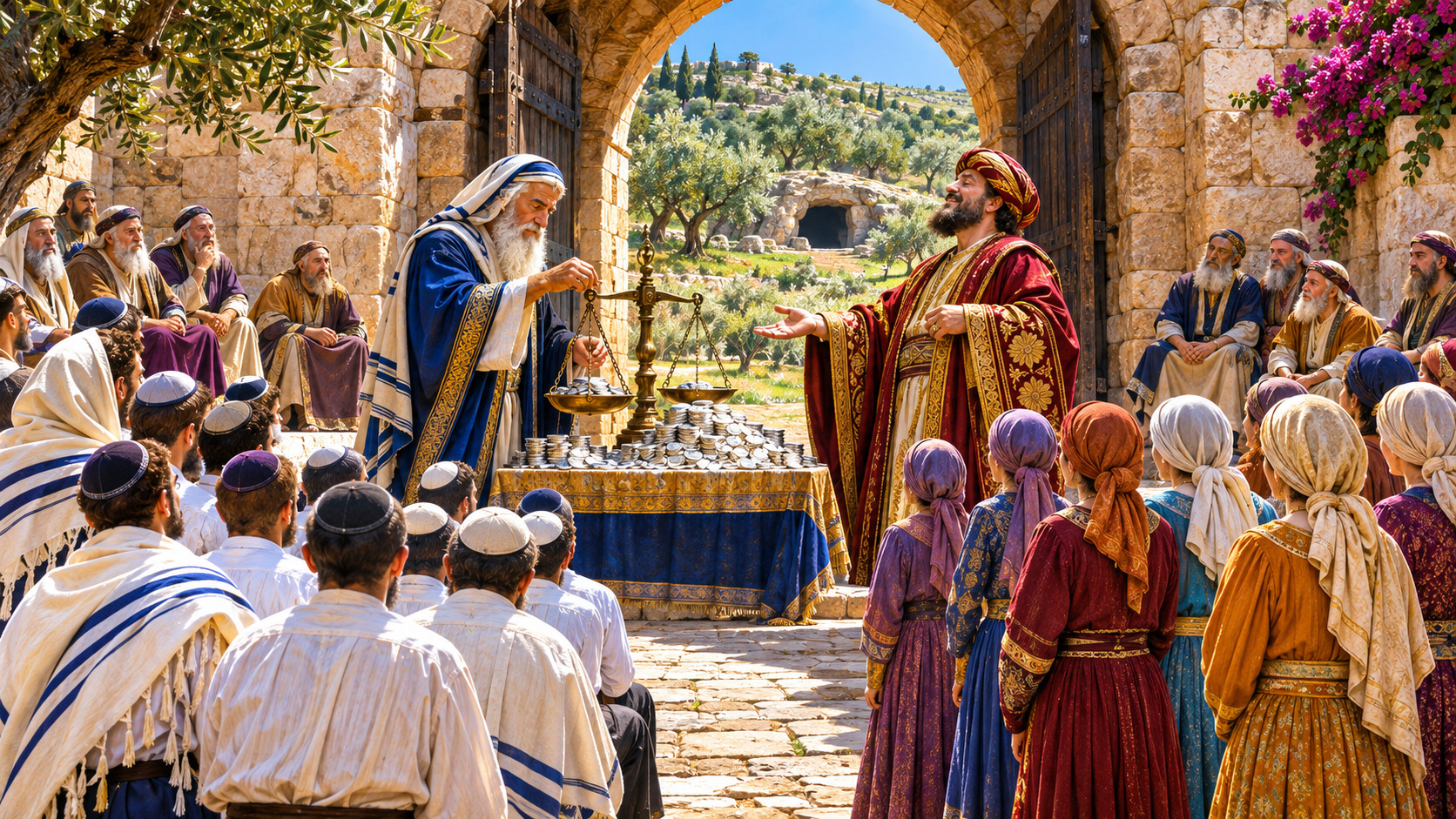
Efron the Hittite said much and did little. How do we see it? At the start of the discussion, what does he say? Free of charge! Whatever you want — the field, the cave — free of charge, it is already given. Avraham insists; Avraham wants to pay. And then, when Avraham avinu insists with him, in the end he says: you know what? “A land worth four hundred shekels of silver, between me and you, what is that?” Very good.
That is, at the beginning he said: free of charge; and in the end he asked him for the check, that man. No, all right, I insist on paying — fine, then give me five shekels, give me ten shekels, give me a hundred — four hundred!
And the notion of four hundred, by the way — why precisely four hundred? Four hundred is a notion that indicates a lot. Where do we see it? When Esav comes to meet Yaakov: four hundred men with him. We always hear: four hundred is a lot. You also hear the word: a lot, a lot.
I just want to close this point. So what did the Torah do? It fined him. You, Efron, you boasted, yes, and in the end you did little; so I will diminish your name. The Torah diminished his name: just as you said much and did little, measure for measure, I erase part of your name.
Where do we see it? If you follow the passage, everywhere it is written Efron, it is written with a vav — “vaydaber el Efron be’oznei am ha’aretz,” still with the vav, all with the vav; “vayishma Avraham el Efron,” with the vav — and only the last time, where the four hundred shekels of silver are mentioned: “vayishkol Avraham le’Efron,” without a vav.
And why precisely did they take away his vav? Because if I take the word Efron without a vav, it is the gematria of four hundred. Ayin is seventy and peh is eighty: together, how much? One hundred fifty. Resh is two hundred: together three hundred fifty. And the final nun, fifty: four hundred. You wanted four hundred? Gematria four hundred, without the vav.
That is why, there, the word “le’Efron” is written without a vav: to fine him. Why? He said much and did little — his name was diminished. And it is precisely there, where the four hundred shekels are counted out for him, that it is written without a vav. Very good.
Now we have one more idea I would like to develop a little — briefly, but briefly. Why in fact does Avraham not propose Yitzhak for Eliezer’s daughter? Eliezer had a daughter.
Damesek Eliezer — why is he called Damesek? “Doleh umashkeh mitorat rabo”: he drew and gave others to drink from his master’s Torah. And Eliezer in fact hoped that his daughter would marry Yitzhak. Where do we see this hint? The first time, when the story is told, it is written “ulai” — perhaps the woman will not want; and when he reaches Lavan and tells it, “ulai” is written without a vav, and one can read it “elai”: to me — that the woman come to me. Very good.
But why, in fact, is Avraham not willing to marry him to her? Avraham avinu says to him: “one who is cursed does not cleave to one who is blessed.” You are cursed. Why are you cursed?
For who in fact was Eliezer? Eliezer was the son of Nimrod. Nimrod is a descendant of Canaan, about whom Noach said — he cursed Cham — “cursed be Canaan; a slave of slaves shall he be to his brothers.”
That is, when Noach curses Cham, he curses him in that his fourth son will be cursed. Cursed — just as you did not want me to have a fourth son. For Cham had castrated Noach, so that he would not have a fourth son. Noach, when he wakes from his wine, curses Cham’s fourth son, who was Canaan. From Canaan came Nimrod. And Nimrod, when he wanted to kill Avraham, threw him into the fiery furnace; and he saw that in fact he was not succeeding, because the angel Gavriel came down to cool it. So he gave him Eliezer as a gift. Very good.
That is why you are cursed, and one who is cursed cannot marry my son, who is blessed. For he cursed Canaan: all the Canaanites are cursed. That is why: “you shall not take a wife for my son from the daughters of the Canaanite among whom I dwell.” You cannot bring a wife from the daughters of the Canaanite, because they are cursed — and you too are cursed. And if you cannot marry my son to a Canaanite girl, you cannot marry him to your daughter either. And likewise Yitzhak sends Yaakov: where does he go? To Charan, to bring from there daughters of Lavan — Rachel and Leah — so that he should not take Canaanites, daughters of the land where I dwell.
So a question arises: if Eliezer is to such an extent unworthy to marry his daughter to Yitzhak because he is cursed, how is he counted among those who entered Gan Eden with body and soul, in their lifetime? Only tzaddikim, great tzaddikim, can be like that. How does one who is cursed reach Gan Eden?
Pay attention to the answer. The answer is that when Eliezer came and said to Avraham: I want Yitzhak to marry my daughter, Avraham said to him: you are cursed, and one who is cursed does not cleave to one who is blessed. There is no greater wound than that. There is no greater wound than that. Avraham! This is what you tell me, after all the years I have served you, when the Torah testifies of me that I draw and give others to drink from my master’s Torah — I, Damesek Eliezer, the faithful servant of all his house, yes? The faithful servant — as Moshe rabbenu is to the Holy One, blessed be He, Eliezer is the faithful servant of Avraham avinu — and you tell me that I am cursed all the same?
He kept silent. He kept silent. Eliezer’s reaction should have been: I am hurt, I am leaving, I am dropping everything. After these words Avraham says to him — he puts him down, tells him you are cursed, and sends him on a mission — he goes out on the mission with a clean heart, as though he had said nothing to him. So he both overlooks his own honor — which, as it were, Avraham wounded — and also carries out the mission faithfully. He goes and says: I am not speaking, I am not willing to eat or drink until I have said what I have to say. Why? I must fulfil my mission. He was not hurt; and he had sworn to him.
He did not spoil his mission. For this, for revealing the trait of humility — he was ready to absorb this criticism without changing anything in his mission — he merited, even though he is a Canaanite, even though he is cursed, to enter Gan Eden, body and soul.
See, then, the merit of one who overlooks his own honor: he keeps silent, he does not disappear, he holds his tongue. And not only that: his mission was not damaged by it. He goes with a whole heart, without any personal interest — even though he has one.
He could have said — for what does Avraham avinu say? If the woman does not want to follow you, you are released from my oath. It would have been enough for him to drop one word. He says: listen, Yitzhak, yes, but he is a little… look, he is older, he is forty, take that into account; and he is also very, very spiritual, he was in Gan Eden, this and that. It would have been enough to drop one word that could have spoiled the matter, and she would have said: I do not want to go with him! What do you mean? What, have I lost my mind, to go and marry someone of forty who was in Gan Eden — probably an astronaut! What do I need that for?
No. He does not spoil his mission; he goes all the way to the end. And by this he merits to be in Gan Eden with his body and soul. All that remains for us is to draw a kal vachomer for ourselves, yes?
So one will ask Avraham avinu: how can you hurt this man? In fact, by telling him this, Avraham did him a great chesed. I have no way to repair you, because you are cursed by Noach. The only way I have to repair you is to put you down, to belittle you; and if you withstand the test, you leave the curse and enter the blessing — not in this world, in the world to come.
So Avraham avinu too does this not, chas veshalom, to belittle him, but he says: you deserve to be repaired. How will I repair you? I will say that you are cursed. I said “cursed” — at once he becomes blessed; not here, already in the world to come. And he enters; he merits to enter body and soul.
So there is a win-win here, from every side. From Avraham avinu’s side, who is not to be suspected of belittling him: he repaired him. And from Eliezer’s side, who says: thank you very much, I have merited what is highest — and by this he in fact became blessed in the world to come. Blessed is Hashem forever, amen and amen.
Genèse / Genesis / בראשית 22,1–3
Rachi sur Genèse / Rashi on Genesis / רש״י על בראשית 22,3
Genèse / Genesis / בראשית 21,8–21
Genèse / Genesis / בראשית 15,15
Rachi sur Genèse / Rashi on Genesis / רש״י על בראשית 15,15
Rachi sur Genèse / Rashi on Genesis / רש״י על בראשית 25,9
Genèse / Genesis / בראשית 23,1–2
Rachi sur Genèse / Rashi on Genesis / רש״י על בראשית 23,2
Genèse / Genesis / בראשית 47,28
Rachi sur Genèse / Rashi on Genesis / רש״י על בראשית 41,43
Rachi sur Genèse / Rashi on Genesis / רש״י על בראשית 24,1
Genèse / Genesis / בראשית 24,62–67
Rachi sur Genèse / Rashi on Genesis / רש״י על בראשית 27,27
Pirké de-Rabbi Eliézer / Pirkei DeRabbi Eliezer / פרקי דרבי אליעזר 31
Midrach Sekhel Tov / Midrash Sekhel Tov / מדרש שכל טוב, בראשית 22,18
Rachi sur Genèse / Rashi on Genesis / רש״י על בראשית 24,62
Rachi sur Genèse / Rashi on Genesis / רש״י על בראשית 24,67
Rachi sur Genèse / Rashi on Genesis / רש״י על בראשית 22,20
Rachi sur Genèse / Rashi on Genesis / רש״י על בראשית 25,20
Genèse / Genesis / בראשית 18,1–8
Genèse / Genesis / בראשית 23,10–16
Rachi sur Genèse / Rashi on Genesis / רש״י על בראשית 23,16
Words of Torah do good when they are shared. Send this shiur to your family and friends on WhatsApp.
📲 Send on WhatsApp👥 Join the Gueoula groupTest yourself
Five questions on the shiur. Choose an answer.
Result
Shalom Bayit — The Mouth at Home
My covenant of peace — peace begins at home. Reveal a Shalom Bayit card.
Gematria — Rav Ménaché
Shalom, Mashiah, Yisamech — secrets of the letters by Rav Ménaché zatsal.
🔢 Gematria CourseAll Parashot
All shiurim of M. Yéhouda Himi — from Bereshit to Devarim and the festivals.
📚 All ParashotBooks
Torah wisdom in thriller format — Éditions Gueoula.

Guardians of the Rift
Forty-nine gates open — the fiftieth hides in a single moment. An ancient secret resurfaces, and one man stands between the rift and the world. Drawn from Talmud and Kabbalah.
📖 Read the free excerpt · Book $9.90