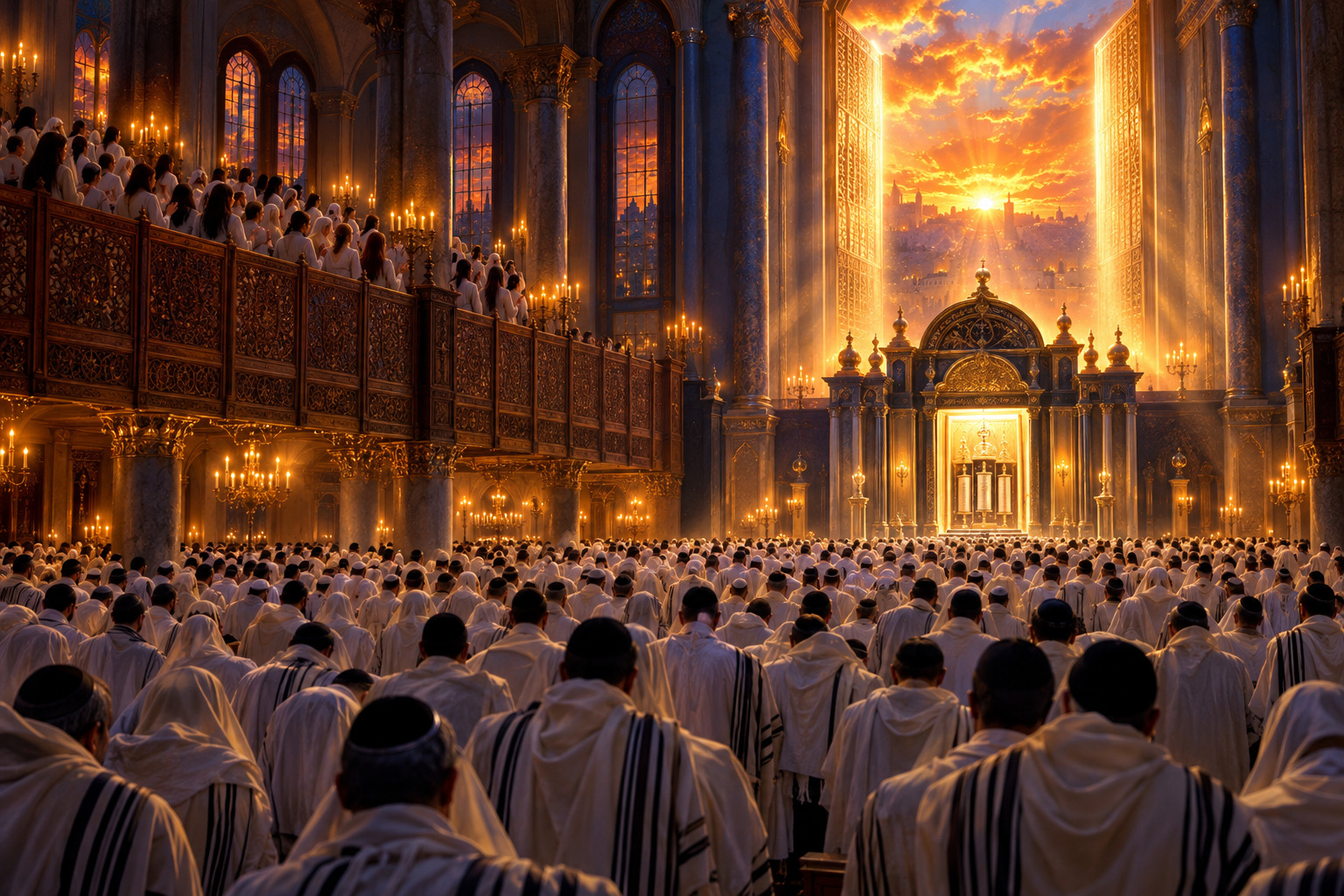
“He locks the door behind us”
On Rosh Hashana everything we do serves to sweeten the judgment: the simanim, the honey, and above all the shofar. On Kippur we do none of it. So how is the judgment sweetened?
Because there is no one on the other side. Ha-satan is worth 364: he has licence to accuse three hundred and sixty-four days a year. On Yom Kippur he has none (Yoma 20a).
This day was not chosen because Moshe came down on the tenth of Tishrei with the second tablets. It is the reverse: Hashem said salahti on that day because the day had been set apart before the world was created.
Of the 365 prohibitions, one alone was heard from the mouth of the Holy One blessed be He: “you shall have no other gods before My face”. That is the mitzva of Kippur — and its sinew is in the heart. It is the one that cries out at Neila.
And Neila is not what people think. The gates do not shut in front of us: He brings us in, and locks the door behind us. Outside, the accusers. Inside, a father and his children.
Today is the fifth of Tishrei, and we are moving towards Yom Kippur in giant strides. So we shall speak about Yom Kippur.
But to understand what Yom Kippur is, we have to begin with Rosh Hashana.
If you pay attention, everything we do on Rosh Hashana has one object: to sweeten the dinim.
“And it was the day, and the sons of Elokim came to present themselves before Hashem, and the Satan came among them too.” — Iyov 1:6
The holy Zohar asks: what is “and it was the day”? And it answers: that day is Rosh Hashana.
In other words: on Rosh Hashana the Satan too presents himself, in the upper worlds, among the sons of Elokim. And what does he come to do? To accuse the people of Israel.
We know that this is the day the world was conceived, the day Adam was created, sinned and did teshuva. That is why this day was fixed as the day of judgment: all who come into the world pass before Him like sheep being counted.
And since it is a day of judgment, a hard day, we perform all sorts of acts meant to soften its severity.
The most obvious of these acts: the apple and the honey. May the year be sweet, may it be good and sweet.
Why? Because the Satan accuses and wants to do us harm. So the severities we bend, we break — through the simanim, the honey, and the rest.
But the most powerful instrument, the one with which we fight the Satan, is the shofar. There are whole fields here; we shall touch only one or two.
We know that the Name Elokim is the measure of severity, and that the four-letter Name is mercy. Elokim, then, is severity — and it must be broken.
The word Elokim is worth 86. Now look at the word shofar: at its centre, the vav and the peh come to exactly 86 — the measure of severity itself.
A Name can also be counted “in its fullness”: each letter written out in full. The aleph is written aleph-lamed-peh, the lamed lamed-mem-dalet, and so on. Counted that way, Elokim gives three hundred — the value of the shin that opens the word shofar. And the resh, two hundred, corresponds to one further degree of that unfolding.
More than that: we know there are five severities on Rosh Hashana — five gevurot.
And the hand that holds the shofar: yad is worth fourteen. Why is the hand called yad? Because it has fourteen joints. Look: each finger has three — one, two, three — except the thumb, which has only two. Three times four is twelve, plus two: fourteen.
The one who blows, holding the shofar in his hand, thus reaches the count of the five severities.
Here is what I was getting at: on Rosh Hashana we perform all sorts of acts to subdue severity.
But what happens on Yom Kippur? We do none of it. We eat no honey. We blow no shofar.
Who brought us the judgment on Rosh Hashana? The Satan. On Yom Kippur there is no Satan.
The only one sitting in judgment is the Holy One blessed be He Himself. He judges us alone. We and He, face to face. The Satan does not interfere: he has no entry at all.
“Rami bar Hama said: ha-satan is in gematria three hundred and sixty-four — for three hundred and sixty-four days he has licence to accuse; on Yom Kippur he has no licence to accuse.” — Yoma 20a
There are three hundred and sixty-five days in the year, and he has three hundred and sixty-four of them. There is one day, one only, on which he has no right at all. He is on leave. He does not enter the beit haknesset, he does not enter the heavens. The Holy One blessed be He sits with us, one to one, and judges us.
One might ask: why take precisely that day from him?
Because on that day, thank God, we are all righteous. Who says so? The angels. They say to the Holy One blessed be He: look at Israel, they are exactly like holy angels. They do not eat, they do not drink, they are dressed in white, they stand all day long as the angels stand. No marital union, no conversation, no food, no drink: all in prayer.
Everyone tends to think it is because on that day the Holy One blessed be He said to Moshe salahti kidvarekha, “I have forgiven according to your word”.
You remember: after the sin of the calf, Moshe Rabbenu went up a third time and came down with the tablets in his hands. On what day did he come down? The tenth of Tishrei. And that, people say, is why this day was fixed as the day of pardon, of mercy and of atonement.
Where do we learn this from? From a verse in Tehillim, where David Hamelekh speaks of Adam.
“Your eyes saw my unformed substance, and in Your book all of them are written — days were formed, and not one among them.” — Tehillim 139:16
What does “and not one among them” mean? Rashi explains: in the end, many days were destined to be created, and not one of them had yet been created.
And on “days were formed”: the Holy One blessed be He showed Adam the days to come. And He set one apart for Himself — the day of Shabbat. Another explanation: it is the day of Kippur.
How many mitzvot do we have in the Torah? Six hundred and thirteen: three hundred and sixty-five prohibitions and two hundred and forty-eight positive commandments.
And who gave them to us? It is written: “Torah tziva lanu Moshe” — Moshe commanded us the Torah. Now Torah is in gematria six hundred and eleven. So Moshe commanded us six hundred and eleven of them.
And the other two? We heard them from the mouth of the Holy One blessed be He Himself, at Mount Sinai: Anokhi Hashem Elokekha, and lo yihye lekha elohim aherim al panai. As we explained yesterday, at hearing them their souls flew from them; they said to Moshe: you listen, and explain it to us.
Let us go back. Three hundred and sixty-five prohibitions: that recalls the three hundred and sixty-five days of the year. And among those days, one is Yom Kippur.
So which mitzva, among the three hundred and sixty-five prohibitions, corresponds to Yom Kippur? Lo yihye lekha elohim aherim al panai — the one we heard from the mouth of the Holy One blessed be He in person.
We also know that the three hundred and sixty-five prohibitions correspond to the three hundred and sixty-five sinews of the body, and the two hundred and forty-eight commandments to the two hundred and forty-eight limbs.
So which sinew, among the three hundred and sixty-five, corresponds to “you shall have no other gods before My face”? Our Sages say: the one that is in the heart.
And now you understand what happens on Kippur, at the Neila prayer. People appear whom no one has seen in the beit haknesset all year. They come for Neila. With a kippa, without a kippa, with earrings, a ponytail, no matter. And they all cry out: Shema Yisrael, Hashem Elokenu, Hashem ehad. Hashem hu haElokim.
One more idea, and I will let you go. Why is Neila called Neila? Everyone answers: the closing of the gates. It is the last prayer, the one that closes the day.
But what picture do we have in mind? We imagine this: we are all outside; there is a palace, the infinite palace of the Holy One blessed be He, where the King sits on a high and exalted throne; and the gates of that court are about to close. A minute before they shut, we try to squeeze the ball through, as it were: to cry out, to pray, to push in as many prayers as possible before the door is shut in our face.
That is indeed the picture we have, is it not? Well — no. That is not it.
And at that moment, so to speak, He says: whoever has grievances against My children can go and look at himself. I have locked the door. I am no longer willing to hear anything bad about My children.
That is what Neila is. What you should feel on reaching it is the most intimate and closest moment with the Holy One blessed be He, one to one. We are at His place, in His house, and there is nothing besides Him — and He says: there is nothing besides My children.
So the gates are indeed locked. But against whom? Against the accusers, outside. Inside there is no accuser left: there is no longer a judge, there is a father holding all his own close, at home.
Notice what happens the moment it all ends. We say Shema Yisrael, then Barukh shem kevod malkhuto, then Hashem hu haElokim seven times: we accompany the Shekhina back through the seven firmaments.
And from there, God willing, we run straight off to build the sukkah. We give no one the slightest chance to slip in between us and the Holy One blessed be He.
May it please God that all our prayers be received with favour, and that we all be sealed for a good year.
🎯 Test yourself
Five questions on the shiur. Click an answer.
Result
Shalom Bayit — The Mouth at Home
My covenant of peace — peace begins at home. Reveal a Shalom Bayit card.
Gematria — Rav Ménaché
Shalom, Mashiah, Yisamech — secrets of the letters by Rav Ménaché zatsal.
🔢 Gematria CourseAll Parashot
All shiurim of M. Yéhouda Himi — from Bereshit to Devarim and the festivals.
📚 All ParashotBooks
Torah wisdom in thriller format — Éditions Gueoula.
Guardians of the Rift
Forty-nine gates open — the fiftieth hides in a single moment. An ancient secret resurfaces, and one man stands between the rift and the world. Drawn from Talmud and Kabbalah.
📖 Read the free excerpt · Book $9.90