“The Sukkah, a Wedding House”
“For in sukkot I made the children of Israel dwell.” But they were on the move, and Bilam sees only tents. And if it means the Clouds of Glory, which surrounded Israel for forty years, any day of the year would do. So why the 15th of Tishrei?
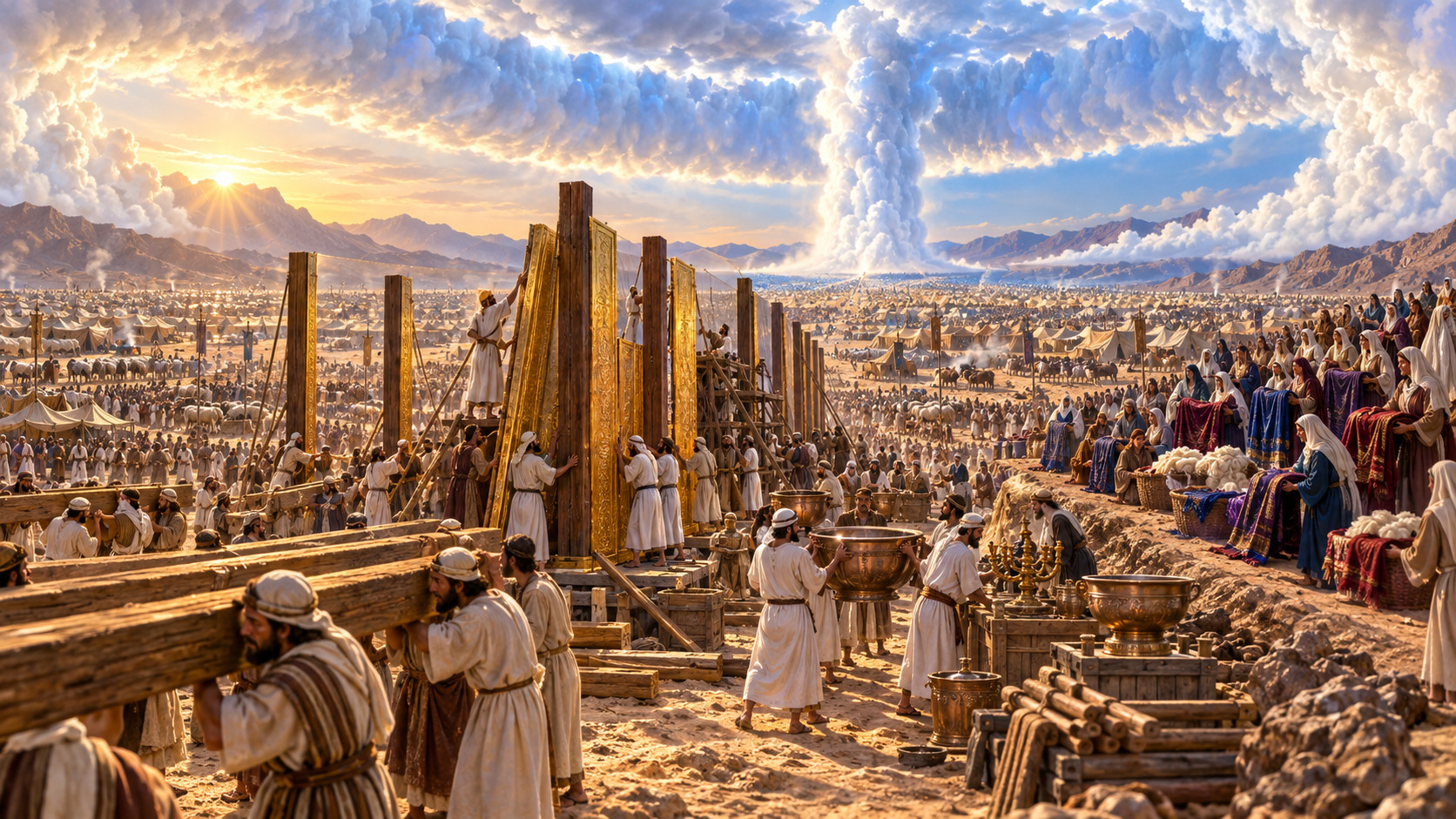
The answer lies in the calendar. On Yom Kippur, the Holy One, blessed be He, forgives with joy, and Moshe comes down with the second Tablets. The next day, the 11th of Tishrei, Moshe gathers the people — Vayakhel — for the Mishkan. Two mornings of gifts, and on the 15th the building begins. That is the day we build the sukkah.
After the first Tablets, Moshe went up for forty days and the bride was left alone: the golden calf. This time, the bride is not left alone. A wedding house is built, and there are seven days of feasting, each with “new faces”: the seven ushpizin.
Where do we put all the light of Yom Kippur? In the sukkah, tzila dimheimnuta, the shade of faith. Sukkah = 91 = the Name Havaya and the Name Adnut together = amen. “His left hand under my head”: Rosh Hashanah and Yom Kippur. “And His right hand embraces me”: Sukkot.
With God’s help, today is the 11th of Tishrei. It is a very, very special date. And to understand it, let us begin with a very well-known question: why do we build a sukkah?
The question seems simple. It is written in the Torah:
“You shall dwell in sukkot seven days… so that your generations may know that I made the children of Israel dwell in sukkot when I brought them out of the land of Egypt.” — Vayikra 23:42-43
Let us check. We say it, and it slips past the ear. Is it true that the Holy One, blessed be He, made the children of Israel dwell in sukkot when He brought them out of Egypt?
First of all, to dwell you have to be settled somewhere. You do not dwell in the middle of a journey. And “when I brought them out” — we are on the move. How can you say “I made the children of Israel dwell in sukkot” if they were travelling?
You might say: at every encampment, they built a sukkah. Apparently so. But we have a witness who tells us exactly how Israel lived in the desert: Bilam. He looks out and says:
“How goodly are your tents, O Jacob, your dwellings, O Israel!” — Bamidbar 24:5
Our Sages discuss this:
“‘For in sukkot I made the children of Israel dwell’: these were the Clouds of Glory — the words of Rabbi Eliezer. Rabbi Akiva says: they made themselves actual sukkot.”
Rabbi Akiva says: actual sukkot. We will need to understand what “actual sukkot” means, since historically we see that they lived in tents.
The other opinion says: it is in memory of the Clouds of Glory. And that is true, that is the reality: the people of Israel walked inside a sukkah made of Clouds of Glory. Four clouds on the sides; a cloud above, shielding them from sun and rain; a cloud below, levelling the ground so they would not be bitten by scorpions and snakes — six clouds; and the seventh, the pillar of cloud that went before them to show them the way.
If that is true — and it certainly is — a question arises: why do we make sukkot precisely in the month of Tishrei, on the 15th of Tishrei?
If it is in memory of the Clouds of Glory that surrounded Israel and went with them for forty years in the desert, then any one of the 365 days of the year would be suitable. Every day of the year, they walked with those clouds.
Our Sages answer: we want to make the sukkah precisely in Tishrei. Why? The way of the world, when summer begins, is to leave the house for the balcony, to sit under a shelter for the breeze, for air. But the people of Israel, to show their love for Hashem, go out precisely at the start of winter, which begins in Tishrei — on Simchat Torah we already mention the rain. Israel leaves the house and enters the sukkah to show that we go out because we are fulfilling Hashem’s command.
Fine. But why the 15th? Any day in Tishrei could work. And by this reasoning, Marcheshvan would suit even better: on Simchat Torah we only mention the power of the rains; we do not yet ask for rain. When do we begin to ask? On the 7th of Marcheshvan. So let us start in Marcheshvan — build the sukkah when we ask for rain!
Our inquiry begins at Mount Sinai. At Sinai the people of Israel received the Torah, on the 6th of Sivan. And we know what happened: the sin of the golden calf. Moshe Rabbeinu comes down and breaks the Tablets. He goes up again, forty days of prayer. He comes down and goes up once more on Rosh Chodesh Elul, forty days.
And the fortieth day is Yom Kippur. Rashi writes:
“On the 10th of Tishrei, the Holy One, blessed be He, was reconciled with Israel, with joy and with a whole heart… ‘I have forgiven’; He gave him the last Tablets, and he came down and began to command them concerning the work of the Mishkan.”
And the next day? At the start of Parashat Vayakhel:
« לְמָחֳרַת יוֹם הַכִּפּוּרִים כְּשֶׁיָּרַד מִן הָהָר » — Rashi
“Moshe assembled the whole congregation of the children of Israel” — “on the day after Yom Kippur, when he came down from the mountain.”
The day after Yom Kippur, the 11th of Tishrei — like today: Moshe gathers the whole people and tells them: now we must collect contributions for the Mishkan. We return to the original plan, the plan of Terumah, Tetzaveh, Vayakhel, Pekudei.
“And they kept bringing him gifts, morning after morning.”
“Morning after morning”: two mornings. In two days, the 12th and 13th of Tishrei, they brought everything needed for the Mishkan, until Moshe told them: enough, we have what we need and more. On the 14th, everything is in the hands of the craftsmen. And on the 15th, they begin to build the Mishkan.
The Midrash says that in fact it is a tikkun. What is being repaired?
After Sinai and the Ten Commandments, Moshe Rabbeinu tells the people: I am leaving you now for forty days and forty nights. You have heard the Commandments; I am going up to receive the Torah for you, and I will bring it to you.
What do you expect of that bride, at the height of her emotion, longing so much to be with her husband — and he gets up and leaves? What a hard trial those forty days are for a bride left alone in the hotel suite. How could she not make the golden calf? That is what the Midrash says: how could she not be unfaithful?
So, as it were, the Holy One, blessed be He, says to Moshe Rabbeinu: this time, when you bring down the second Tablets, we will make sheva berachot. This time the bride is not left alone. We rejoice together, sheva berachot as they should be.
And Moshe comes down with the second Tablets and says: now build a wedding house. Build a place where the groom and the bride can sit and rejoice for the seven days of feasting as they should, so that this union succeeds beautifully and they set out on a new and beautiful path.
“They shall make Me a sanctuary, and I will dwell among them.”
Now we do the same. We were at Sinai: Yom Kippur is, in spiritual feeling, the day closest to Sinai. We are like angels: we do not eat, we do not drink, we stand all day long, dressed in white, occupied only with prayer. There is no Satan and no evil encounter. We are one-to-one with the Holy One, blessed be He. An immense presence of the Shechinah.
Yesterday, nobody wanted to leave the Beith Haknesset. Perhaps the congregation was in a hurry to drink, to break the fast — but the feeling of attachment is so strong that you say: I want to keep going. They send you out of the Beith Haknesset: go, eat with joy.
Where was all the energy of Sinai hidden? In the Mishkan: “and I will dwell among them.” Make a Mishkan, and there My Shechinah will rest.
We walk exactly the same path. Moshe Rabbeinu comes down with the second Tablets; we, after Yom Kippur, prepare within four days a sukkah, which is in truth the Mishkan into which we enter with the Shechinah. There is tzila dimheimnuta, the shade of faith, and there we carry forward the spirituality, the elevation we received on Yom Kippur.
And now this reason answers every question. We asked: why precisely at the start of winter? It has nothing to do with winter. It is simply tied to the date of the 15th of Tishrei, which comes after the 10th of Tishrei, Yom Kippur.
And the descent happens in stages. What are these four days between Yom Kippur and Sukkot?
The mekubalim explain that these four days correspond to the four letters of the Name Havaya: י־ה־ו־ה.
That is how we carry the spirituality from the summit where we stood on Yom Kippur and bring it into the sukkah. That is the idea.
And when the Sages discuss “for in sukkot I made the children of Israel dwell when I brought them out of Egypt,” which sukkot are meant? The Clouds of Glory, the Shechinah. That is what we walked with.
But that Shechinah vanished with the sin of the golden calf. From the sin of the calf until the 15th of Tishrei, the Clouds of Glory had withdrawn. It was even one of the signs that Israel stood rebuked because of the calf: the Clouds of Glory had departed. When did they return to Israel? When they began to build the Mishkan.
And when it is written “in sukkot I made them dwell” — actual sukkot? Yes, actual sukkot. For what is a sukkah? Let us calculate.
How is sukkah spelled? סוכה: samech, vav, kaf, heh. Let us do the gematria, just so the ear can hear it.
Ninety-one is the Name Havaya and the Name Adnut together:
When we sit inside the sukkah, we are surrounded by the Name Havaya and the Name Adnut together. That is tzila dimheimnuta.
And what is tzila dimheimnuta, the shade of emunah? In the word emunah you hear the word amen. And what is the gematria of amen?
That is what the Holy One, blessed be He, says, as it were: with the first Tablets, the bride was left alone. Moshe Rabbeinu goes up the mountain, the people of Israel are left alone — what will they do? With the second Tablets there is no room for that. Now you build a wedding house.
The seven days of Sukkot correspond to the seven days of feasting, the sheva berachot that a groom and bride celebrate after the wedding. And at sheva berachot, each day requires panim chadashot, new faces. Who are our new faces?
On this we find the verse in Shir HaShirim:
“His left hand is under my head, and His right hand embraces me.” — Shir HaShirim 2:6
What is the hint in this verse? The left, as we know, is gevurah, judgment. The right is chesed. The left pushes away and the right draws near. The left is always more the attribute of strict justice.
“His left hand is under my head” — what is “my head”? You hear the word rosh: Rosh Hashanah. On Rosh Hashanah the Holy One, blessed be He, leads the world with His left: judgment, gevurah, days of judgment, the Yamim Noraim. That is how it is.
And where is the hint of this? Let us return once more to the word sukkah. How many walls does a kosher sukkah need?
The most meticulous: four walls, like the samech ס. Three full walls are also possible: that is the letter kaf כ, three sides. But even with two walls and a tefach — that is the heh ה, two walls and a tefach — the sukkah is kosher.
And this sukkah, which looks the flimsiest and the simplest, is the one that protects. Why? Because what protects is the Holy One, blessed be He, Himself.
“Unless Hashem guards the city, the watchman keeps vigil in vain.” — Tehillim 127:1
And from there, with God’s help, we also draw strength and energy for the whole year. May we merit a good and long life, with God’s help, until we merit the sukkah — the fallen sukkah of David:
“On that day I will raise up the fallen sukkah of David.” — Amos 9:11
May it rise again, with God’s help, and may the Beit HaMikdash be rebuilt, with us. Amen.
🎯 Test yourself
Five questions on the shiur. Click an answer.
Result
Shalom Bayit — The Mouth at Home
My covenant of peace — peace begins at home. Reveal a Shalom Bayit card.
Gematria — Rav Ménaché
Shalom, Mashiah, Yisamech — secrets of the letters by Rav Ménaché zatsal.
🔢 Gematria CourseAll Parashot
All shiurim of M. Yéhouda Himi — from Bereshit to Devarim and the festivals.
📚 All ParashotBooks
Torah wisdom in thriller format — Éditions Gueoula.

Guardians of the Rift
Forty-nine gates open — the fiftieth hides in a single moment. An ancient secret resurfaces, and one man stands between the rift and the world. Drawn from Talmud and Kabbalah.
📖 Read the free excerpt · Book $9.90