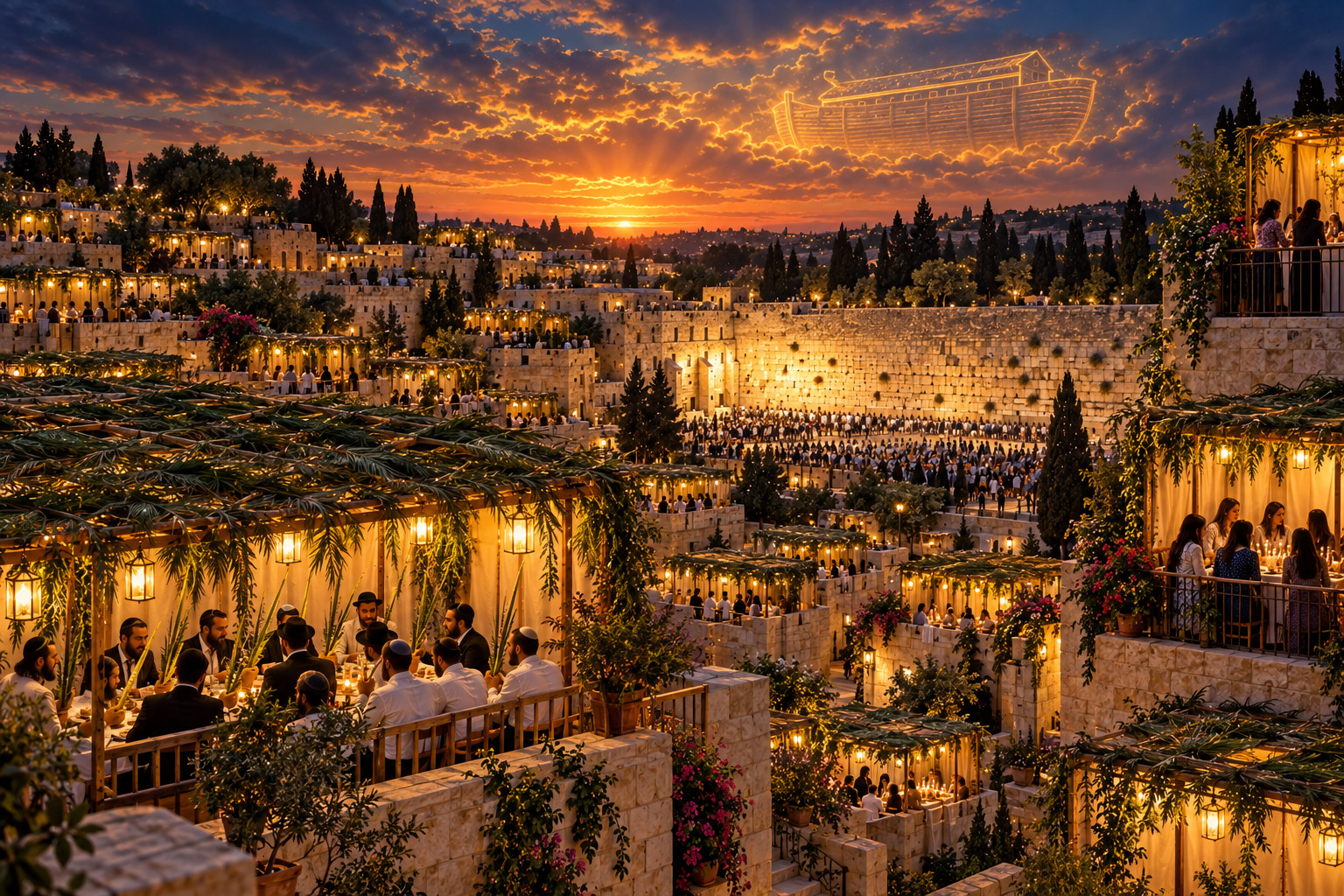
“Inside the Ark, Under the Schach”
The four days between Yom Kippur and Sukkot are among the highest of the year. It was in this season that King Solomon dedicated the First Temple: fourteen days of celebration — and that year, Israel did not fast on Yom Kippur.
The piyut says it as a riddle: “the Name, as it is written and as it is read, adds up to sukkah.” Havaya 26 + Adnut 65 = 91 = sukkah. Multiply the letters of the two Names, and you get the measurements of Noah’s ark: three hundred, fifty, thirty. After Yom Kippur we enter the ark, sheltered from the accusers.
The schach makes the sukkah, and schach equals 100 — like the two letters of the Satan’s abbreviated name. On Rosh Hashanah, a hundred blasts against him and one more to subdue him; on Sukkot, we sit beneath the hundred of the schach.
The four species are really seven, like the seven ushpizin. Moshe and Aharon are the two aravot, with neither taste nor scent — because they lowered themselves like water. And it is the aravah that seals the festival: ערבה = 277 = זרע, the seed of the whole year.
With God’s help, today is the 12th of Tishrei, as we approach Shabbat and the festival of Sukkot — may it come to us for good. Yesterday we touched a little on the matters of the sukkah; today we continue with a few more gems and allusions that cannot be skipped when we reach Sukkot.
But first, as we said: these four days between Yom Kippur and Sukkot are very, very elevated days. And one of the reasons for their height is that this was the time of the dedication of the First Temple.
When King Solomon built the First Temple and completed its construction, the celebrations began. The dedication began on the 8th of Tishrei, and the Tanakh tells us that Solomon held this celebration for seven days and then another seven days: fourteen days of dedication in all.
“Solomon held the festival at that time for seven days, and all Israel with him, a very great assembly… On the eighth day they held a solemn assembly, for they had kept the dedication of the altar seven days and the festival seven days. And on the twenty-third day of the seventh month he sent the people away to their tents.”
Notice what this means: seven days of dedicating the altar, from the 8th to the 14th of Tishrei, then the seven days of the festival, up to the 22nd; and on the 23rd of Tishrei he sends the people home. The account also appears in the Book of Kings (I Kings 8:65-66), and Chronicles gives the dates more precisely.
The Gemara relates that afterwards they became afraid: how could this be? A day of the Torah had been cancelled!
“Israel did not keep Yom Kippur that year, and they were worried… A heavenly voice came forth and said to them: all of you are destined for the life of the World to Come.”
Heaven approved what King Solomon had decided. If Solomon decided that the joy of the Temple — the Shechinah descending into the Temple — was on so high a level that it outweighed even Yom Kippur, then that joy truly stood in place of Yom Kippur.
So we know that the worth of these days is very high — and of course that of Sukkot too, as we said yesterday.
There is the piyut Sukkah ve-Lulav, which everyone sings on Sukkot. The whole song is written like a riddle, with very lofty secrets. We will study only one stanza, and decode it according to Kabbalah. It says:
“The Name, as it is written and as it is read — its number rises to the count of sukkah.”
It sounds like a riddle. So let us crack it.
What is “the Name”? The Name of Hashem. “As it is written”: how do we write the Name? Yud, heh, vav, heh. But how do we pronounce it? We say the Name Adnut: alef, dalet, nun, yud. So “as it is written” is י־ה־ו־ה, “and as it is read” is א־ד־נ־י.
If I add the Name as it is said to the Name as it is written, what do I get?
ס 60 + ו 6 + כ 20 + ה 5 = 91
א 1 + מ 40 + ן 50 = 91
Ninety-one: the gematria of amen, and also the gematria of sukkah, as we learned yesterday. That is what is hidden in “the Name, as it is written and as it is read, adds up to sukkah.”
But this is no mere game. We said yesterday, in the first shiur on Sukkot, that when we sit in the shade of the sukkah we are in tzila dimheimnuta, the shade of faith. And in the word emunah, faith, we hear the word amen — which is also 91: Havaya and Adnut together.
But it does not end there. We say that when the people of Israel enter the sukkah, it is like Noah entering the ark to shelter from the Flood.
The accusers are not content that the Holy One, blessed be He, forgave Israel on Yom Kippur. What do you mean, He forgave them? And they lie in wait for a way to accuse Israel. What does the Holy One, blessed be He, say to Israel? Get into the sukkah quickly, and everything will be fine.
But if this idea has substance, it has to be proven; one does not just say things. What is the connection between the sukkah and Noah’s ark?
Let us see a beautiful secret revealed to us by the Arizal. What were the measurements of the ark?
“Three hundred cubits the length of the ark, fifty cubits its width, and thirty cubits its height.”
There is a concept in the Zohar called haka’ah, “striking” one Name into another; in today’s language we would say multiplying. Let us multiply the Name Havaya by the Name Adnut. Picture yud, heh, vav, heh written on one side and alef, dalet, nun, yud on the other, letter facing letter:
ד 4 × ה 5 = 20
נ 50 × ו 6 = 300
י 10 × ה 5 = 50
So I have 10, 20, 300 and 50. Ten plus twenty is thirty: the height of the ark. Three hundred — the nun times the vav — is the length. And fifty — the yud times the heh — is the width.
And what did we say? The sukkah is Havaya and Adnut together, as we just learned: the Name as it is read and as it is written rises to the number of sukkah. The sum of the two Names is the sukkah; their product is the measurements of Noah’s ark.
There is one precise requirement: the sukkah must have schach. The whole essence of the sukkah is named after its schach. That is why the Gemara in Tractate Sukkah says:
“A sukkah higher than twenty cubits is invalid.”
Why invalid? What is the problem? It is actually splendid, large, dignified. The problem is that if it is higher than twenty cubits, then as the sun moves across the sky, at a certain point the shade inside the sukkah will be the shade of the walls. Because the walls are so high, the shade comes not from the schach but from the walls.
“Up to twenty cubits, a person sits in the shade of the sukkah; above twenty cubits, a person does not sit in the shade of the sukkah but in the shade of the walls.”
Notice: this connection between Rosh Hashanah, Yom Kippur and Sukkot does not stop. It is all one unit, one single block.
How many blasts do we sound on Rosh Hashanah? A hundred and one. Why precisely a hundred and one? It is said: in memory of the sobs of Sisera’s mother — « בְּעַד הַחַלּוֹן נִשְׁקְפָה וַתְּיַבֵּב אֵם סִיסְרָא », “through the window she looked, and the mother of Sisera sobbed” (Judges 5:28). The Midrash says she wept a hundred sobs. And because of the doubt — what is a sob, what is a wail — we combine all the possibilities and arrive at a hundred.
There is also a Midrash which says it is not in memory of the sobs of Sisera’s mother but of the weeping of Sarah when she heard that Yitzchak was going to the Akeidah. That sounds better — that the memory be of a mother of Israel and not a woman of the nations: a hundred sobs of Sarah.
On Rosh Hashanah we do all kinds of things to subdue the Satan. We sound blasts standing and blasts seated, to confuse him, to mix him up: all kinds of manoeuvres we play on him.
Who, in essence, is the Satan? He has an abbreviated name. His full name is not said aloud; he is called by two letters: samech, mem — ס״ם. Samech-mem is the sitra achra, the Satan. What is the gematria of samech-mem?
Where do we do this same work on Sukkot? When we lay the schach. What is the gematria of schach?
Everything connects. We do not separate these things: it is all one work, meant to guard the people of Israel from adversaries and accusers. That is why there is value in staying in the sukkah as much as possible, and enjoying the Shechinah woven into it.
And didn’t we already subdue him with the shofar? Yes — we already subdued him with the great teruah on Rosh Hashanah. Now we are already sitting in the shade, inside. He has no way to come near, no way to reach us. That is how this answers to the work of Rosh Hashanah — and why the shade must come from the schach itself.
Now let us speak a little about the four species; it is with them that we will close.
In truth, there are not four species on Sukkot: there are seven. How? We have three hadassim and two aravot: that is five; plus the etrog and the lulav: seven. And these seven correspond to the seven ushpizin. The Sages draw the parallel like this:
The two aravah branches: Moshe and Aharon.
The lulav: Yosef.
The etrog: David.
The parallel is also drawn with the limbs of the human body.
The three hadassim are the eyes: their leaves have the shape of an eye. And it is written “im me-einei ha-edah”, “the eyes of the congregation”: the elders of the congregation, its sages. Who are the elders of the people of Israel? Avraham, Yitzchak and Yaakov.
The two aravah branches correspond to the two lips, and that suits Moshe and Aharon. Why? What is on the lips? The learning of Torah. And who gave us the Torah? Moshe and Aharon. The Torah sometimes says “Moshe and Aharon” and sometimes “Aharon and Moshe”: Rashi explains that this teaches they are of equal weight (Rashi on Exodus 6:26). If I speak of Moshe, I speak of Aharon; if I speak of Aharon, I speak of Moshe.
The lulav corresponds to Yosef: the lulav runs from the head down to the yesod, which is the covenant — Yosef HaTzaddik, who guarded the covenant. It is the foundation of everything.
And the etrog is the heart: King David. The king is the heart of all Israel.
There is another parallel: the four species are also the gathering of all Israel.
The lulav, from the date palm, has taste but no scent.
The hadassim have scent but no taste.
The aravot have neither taste nor scent.
Among the people of Israel there are great tzaddikim who have both Torah and good deeds. There are Jews who have good deeds — “I’m Jewish at heart” — but no Torah. There are those who have Torah. And there are, Heaven forbid, those with neither taste nor scent: that is the aravah. And yet, even they:
“Even the empty ones among you are full of mitzvot like a pomegranate.”
It is very hard to say. The etrog for David is very flattering; so is the palm; so are the hadassim. But how can one say that Moshe and Aharon correspond to aravah branches, with neither taste nor scent?
But let us be reassured: Moshe and Aharon are not troubled by this. Why?
Let us look at the sign that tells us whether an aravah is kosher: it must be arvei nachal, willows of the brook. If it is a tzaftzafah that grew in the natural woodland, it is invalid; the willow of the brook must grow beside the brook.
What is special about the aravah that grows by the brook? It draws water from the brook, and by that it grows. And there is no water but Torah. Why is the Torah compared to water?
“Just as water leaves a high place and flows to a low place, so the words of Torah endure only in one whose spirit is humble.”
And one more reason must be said. If we held an audition now and asked Moshe and Aharon: tell us, we will let you choose whichever species you like — what would you choose? What do you think Moshe and Aharon would choose? They would choose the aravah. “Ve-nachnu mah” — and what are we?
By the power of their humility, it does not bother them if a Jew stands up here and says that the aravot correspond to those in Israel with neither taste nor scent. Moshe and Aharon are not hurt. Why? They nullify themselves. Who am I to say that I am better?
And where do we see this — and with this I conclude? Where do we see who, in the end, raises his head, who wins on Sukkot? The aravot.
At the end of the festival, on Hoshana Rabbah, who is the star that seals the festival? The five aravah branches with which we beat the ground. And what do we say? “According to the custom of the prophets” — minhag nevi’im, as our Sages call it in Tractate Sukkah.
Why? Because aravah, in gematria:
ז 7 + ר 200 + ע 70 = 277
ערבה equals זרע, seed. And that is why we beat it on the ground: it is as if we were striking the earth to sow it, so that when the rain comes down, the whole earth will grow anew. That is the secret of the aravah on Hoshana Rabbah; we will have time during Chol HaMoed to speak of it further.
We beat — so to speak, we sow the ground — five times and no more, corresponding to the letters מנצפ״ך — final mem, nun, tzadi, peh, kaf — which are the letters of din. And we sweeten the din, and bring it about that when the rain comes, which we will mention on Simchat Torah, the earth will sprout, and everything will blossom and rise.
And all this in the merit of those aravah branches which, at the start of the festival, we thought had neither taste nor scent. In the end, it proves that the whole world stands on them. The Torah endures, and the world endures only by the breath of Torah:
“If not for My covenant, day and night, I would not have set the laws of heaven and earth.”
🎯 Test yourself
Five questions on the shiur. Click an answer.
Result
Shalom Bayit — The Mouth at Home
My covenant of peace — peace begins at home. Reveal a Shalom Bayit card.
Gematria — Rav Ménaché
Shalom, Mashiah, Yisamech — secrets of the letters by Rav Ménaché zatsal.
🔢 Gematria CourseAll Parashot
All shiurim of M. Yéhouda Himi — from Bereshit to Devarim and the festivals.
📚 All ParashotBooks
Torah wisdom in thriller format — Éditions Gueoula.
Guardians of the Rift
Forty-nine gates open — the fiftieth hides in a single moment. An ancient secret resurfaces, and one man stands between the rift and the world. Drawn from Talmud and Kabbalah.
📖 Read the free excerpt · Book $9.90