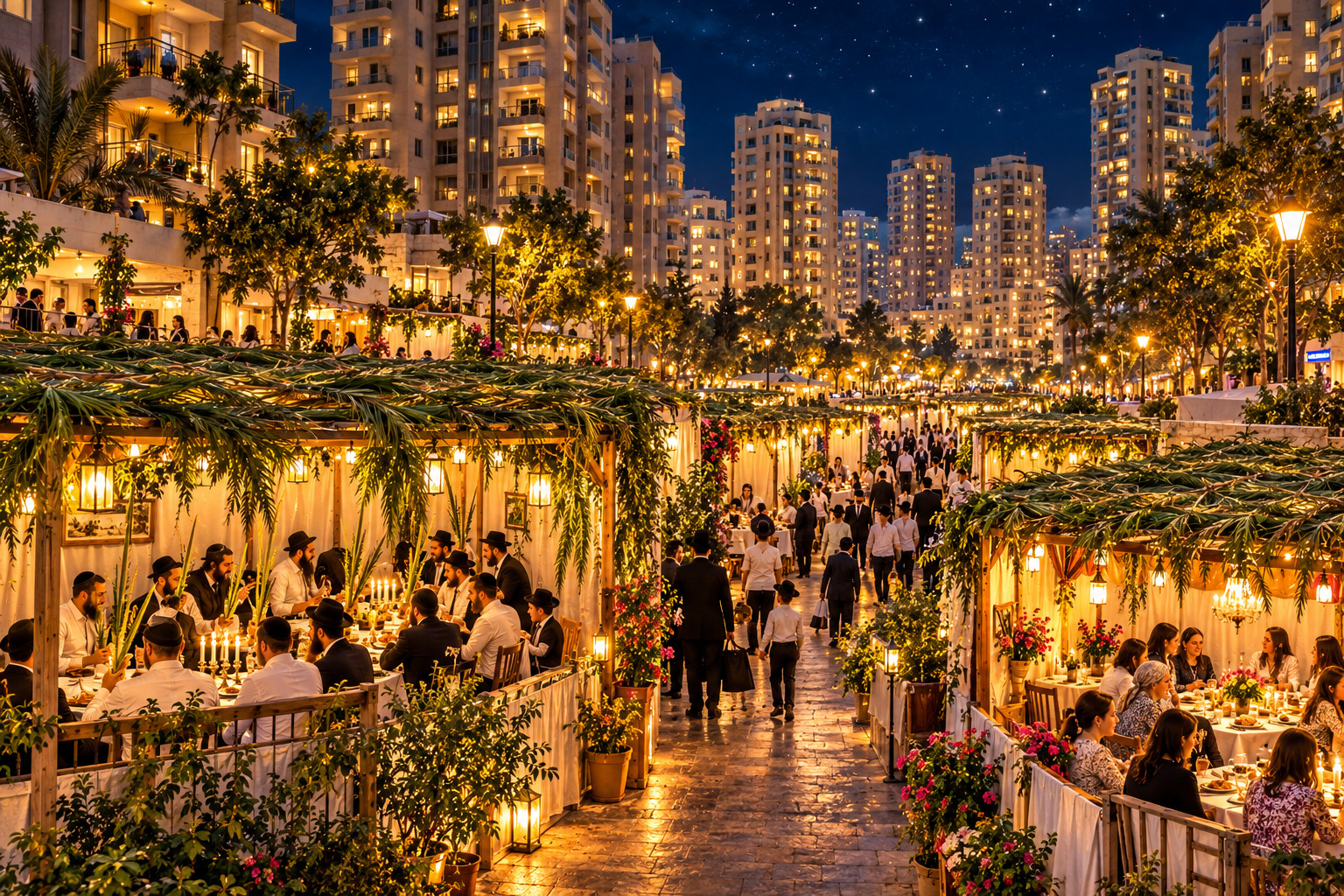
“A House for Himself, Sukkot for His Herds”
The Torah does not say “on the fifteenth of the seventh month, take the four species”; it says “on the first day”. Our Sages explain: first in the reckoning of sins. During the four days between Yom Kippur and Sukkot, all of Israel is busy with mitzvot — building, buying, searching, preparing — and the account is not opened. These four days match the four letters of the Name: they bring the holiness of Yom Kippur down into the sukkah.
Why a sukkah, and why the 15th of Tishrei? Neither “real sukkot” nor “the Clouds of Glory” answers on its own. The answer lies in the story: at Sinai came the first wedding, and the groom went away for forty days; the people sinned with the golden calf. On Yom Kippur Moshe comes down with the second Tablets; on the 15th of Tishrei they begin to build the Mishkan — the wedding house — and the Clouds of Glory return. We build the sukkah to keep, for seven days, the Shechinah we received on Yom Kippur.
Sukkot is also Chag ha-Asif, the Festival of Ingathering: the moment a man is at the peak of his wealth, when “my strength and the might of my hand” can creep in. The Torah takes him out of his house and sits him under a roof of branches, between walls of cloth, among everyone else. Like Jacob: a house for himself, sukkot for his herds.
And we pray for the fallen sukkah of David — the kingship of Mashiach — and for the sukkah made of Leviathan’s skin, when the world returns from skin to light; and we sit beneath the schach, which equals one hundred and filters out the accusers.
With God’s help, we are approaching Shabbat and the festival of Sukkot, which fall together this year. We will learn something of Shalom, and something of Sukkot. We are in the heart of the four days between Yom Kippur and Sukkot. These four days are not ordinary days, and the discussion of what they are begins with a verse we need to understand:
“You shall take for yourselves on the first day the fruit of the hadar tree, palm branches, a bough of the thick-leaved tree and willows of the brook.”
What does “on the first day” mean? We know Sukkot falls on the 15th of Tishrei. The Torah should have written: “on the fifteenth of the seventh month, make sukkot, take the four species.” That is what it does for Pesach: it does not say “on the first day”, it says “on the fifteenth of the first month”, which is Nissan.
“And on the fifteenth day of this month is the Festival of Matzot to Hashem.”
From here our Sages learned: “the first day” — rishon le-cheshbon avonot, first in the reckoning of sins. What does that mean?
“Is it the first? Is it not the fifteenth day? Yet you say “on the first day”! Rather, it is the first in the reckoning of sins.”
The Holy One, blessed be He, says to the people of Israel: we have finished Yom Kippur. To reach Sukkot, you have to prepare. And what do we prepare? We are busy with mitzvot: building the sukkah, the schach, the walls; looking for the four species — the etrog, the lulav, bound, not bound —; the cooking, hosting guests. Everything most of Israel does during these four days is preparation for Sukkot.
But the deeper idea is that these four days are days of passage: the holiness of Yom Kippur comes down, to enter the sukkah, the festival of Sukkot.
These four days correspond to the Name Havaya, yud-hei-vav-hei. The yud corresponds to chochmah among the sefirot; the first hei, to binah; the vav, to the six extremities — chesed, gevurah, tiferet, netzach, hod, yesod; and the last hei of the Name is malchut: that is the last of the four days.
There is also a historical reason: what happened in these days? Nothing less than the dedication of the First Temple. When King Solomon finished building the Beit ha-Mikdash after seven years, and after thirteen more years building his own house, he set the dedication of the Beit ha-Mikdash on the 8th of Tishrei.
How many days did the celebration last? Fourteen days. And inside them is Yom Kippur too. The source is in the Book of Kings, and in more detail in Chronicles:
“Solomon kept the festival at that time seven days, and all Israel with him, a very great assembly… On the eighth day they held a solemn assembly, for they had kept the dedication of the altar seven days and the festival seven days. And on the twenty-third day of the seventh month he sent the people away to their tents, joyful and glad of heart.”
“The eighth day” — not Shemini Atzeret as we know it today, but the eighth day after the first seven. Seven days dedicating the altar, and seven days of Sukkot: fourteen days in all. And on the 23rd of Tishrei — after our Shemini Atzeret today — he sent the people home “joyful and glad of heart for all the good Hashem had done for David, for Solomon and for Israel His people.” So from the 8th of Tishrei, including Yom Kippur, the four days we are speaking of and Sukkot: fourteen days of dedicating the Beit ha-Mikdash.
That year, as we said, Israel did not fast on Yom Kippur. They were in a great festival: the dedication of the Mikdash, with everything that goes with it.
And it is told that the people were seized with great fear: how can we come through this in peace? Whoever does not fast on Yom Kippur is liable to karet, the cutting off of the soul. So all of Israel would be liable to karet?
We saw this passage, with its source in the Gemara, in the second shiur on Sukkot.
From here I want to enter into the building of the sukkah. Why do we build a sukkah? The Gemara brings, in tractate Sukkah, page 11b:
““For I made the children of Israel dwell in sukkot” — these were the Clouds of Glory; these are the words of Rabbi Eliezer. Rabbi Akiva says: they made themselves real sukkot.”
In the Sifra, the same dispute is brought with the names reversed:
“Rabbi Eliezer says: they were real sukkot. Rabbi Akiva says: they were the Clouds of Glory.”
So there is a dispute between Rabbi Eliezer and Rabbi Akiva: which sukkot are meant? The verse in the Torah says:
“So that your generations may know that I made the children of Israel dwell in sukkot when I brought them out of the land of Egypt.”
One says: real sukkot, like the ones we know today, with four walls and schach. The other says: they were the Clouds of Glory. Let us examine both opinions now, and we will see that each one has a difficulty.
First, when the Torah tells us “I made the children of Israel dwell in sukkot when I brought them out”, that means during the going out itself. The sentence does not quite fit. Why? “When I brought them out” is movement. If you are moving, in which sukkot did You make them dwell?
Will you say that after they left, when they camped, they had to build a sukkah to sleep and rest? The Torah does not tell us there were sukkot there. And we have at least two testimonies in the Torah that the children of Israel did not use sukkot.
The first comes from the assembly of Korach. What does Moshe say to the assembly?
“Move away, please, from the tents of these wicked men.”
He does not say: move away from their sukkot. So the children of Israel used tents. And we also have a first-hand witness, not hearsay: Bilam the wicked. He wants to curse Israel, and he blesses them. With which blessing does he open?
“How goodly are your tents, Jacob, your dwellings, Israel.”
Let us go to the second opinion, which says these were the Clouds of Glory. But nowhere have we seen it written “Clouds of Glory”. The most the Torah speaks of is a cloud:
“And Hashem went before them by day in a pillar of cloud, to lead them on the way.”
It does not say “clouds”. But we know from the Midrash that when the children of Israel left Egypt, they walked inside a sukkah of clouds. Imagine five or six million people walking inside an aquarium made of clouds:
the cloud below, which levels the ground for them and kills the scorpions and snakes; the four clouds on the sides, which protect them from outside so that enemies cannot come in and harm them — and it is an air conditioner too, an excellent air conditioner for forty years in the desert; the cloud covering them from above, so the sun does not strike them — it is the desert, after all; and the seventh, the pillar of cloud that went before them to show them the way, and that folded aside when they camped.
But this opinion also has a difficulty. What is it? Not only that the Torah does not mention seven. If it is in memory of the Clouds of Glory — how long did Israel wander in the desert? Forty years. Then every one of the 365 days of the year would suit the festival of Sukkot.
And let us strengthen the question. If it commemorates the Exodus — “when I brought them out of the land of Egypt” — they left in Nissan. It would seem fitting to eat matzah and maror inside a sukkah.
The Tur (Orach Chaim 625), quoted by the Mishnah Berurah (625:1), explains why we nevertheless make the sukkah in Tishrei. Every person, normally, when summer comes, wants to go out into the fresh air; in winter he goes back inside. In Nissan it would be natural to go outside, not to go in. Israel, to show its devotion — that it keeps the mitzvah because the Holy One, blessed be He, commanded it — does the opposite: precisely in winter, when everyone goes indoors, it goes out into the sukkah. That is how it shows its faithfulness, and the kiddush Hashem we make against all odds: we do, as it were, the opposite of what is normal.
“Although we left Egypt in the month of Nissan, He did not command us to make a sukkah at that time, for those are summer days, when everyone makes a sukkah for shade, and it would not be recognisable that we do it at the Creator’s command… But we leave the house to sit in the sukkah: by this it is seen by all that it is the King’s command upon us.”
To answer all these questions, let us go back a little and see what happened here. It all begins with the first wedding.
The first wedding of the people of Israel with the Holy One, blessed be He — on which festival was it? At the giving of the Torah, on Shavuot. It was the stand at Mount Sinai. And we too, in the Beit Haknesset on Shavuot, read the ketubah. It is the great wedding between Knesset Israel and the Holy One, blessed be He. And the ketubah itself — what is it? The Torah. And who is the shoshvin, the best man? Moshe Rabbenu. That is how we read the ketubah.
After the giving of the Torah, Moshe Rabbenu says to the people of Israel: that was lovely; now I am going up for forty days and forty nights to learn the whole Torah from the mouth of the Almighty. At the end of forty days he comes down with the Tablets of the covenant. And what does he see? The sin of the golden calf.
After that, we know, he prayed forty days and forty nights. Then he went up again on Rosh Chodesh Elul, forty days and forty nights, and came down — when? On Yom Kippur, what is today Yom Kippur, the 10th of Tishrei.
What do we understand here? There was a first wedding, the great wedding — and the groom left. The people of Israel were at the height of emotion: they had just stood at Mount Sinai. And what do you do with all that emotion?
“Ulla said: pitiful is the bride who strays beneath her own wedding canopy.”
What do you expect of this bride? How could she not stray? That absence — Moshe Rabbenu suddenly vanishing, the people feeling abandoned while the Holy One, blessed be He, sits alone with Moshe teaching him the whole Torah — the people could not find themselves, and they came to the golden calf. What do you expect? The bride strayed.
With the second Tablets, the Holy One, blessed be He, says, as it were: I have learned the lesson. This time I am not making that mistake. You, Moshe Rabbenu, go down with the second Tablets, and we start the seven blessings right away. That is how bride and groom should be: there was the wedding night, and then the Sheva Berachot begin. And at the Sheva Berachot, what is our custom? We need panim chadashot, new faces.
So Moshe Rabbenu comes down on the 10th of Tishrei — “salachti kidvarecha”, I have forgiven as you asked — with the second Tablets. Rashi writes it in parashat Vayakhel:
““Moshe assembled” — on the day after Yom Kippur, when he came down from the mountain.”
Now, the seven blessings. A wedding house has to be prepared. Where will we hold the Sheva Berachot? A hall must be prepared. And what is the hall? He commands them to build the Mishkan.
“Let them take for Me an offering, from every man whose heart moves him.”
On the 11th, Moshe Rabbenu tells them: take for Me an offering. On the 12th and 13th Israel gathers everything needed, all the donations, to build the Mishkan. On the 14th they take stock, and Moshe Rabbenu tells them: that’s it, there is enough, no more is needed. And on the 15th they begin to build the Mishkan.
We were in Yom Kippur, and we merited to receive the Shechinah here, on earth. We know the Shechinah was here; we felt it. First of all, Yom Kippur is not an ordinary day in any measure. At the end of Yom Kippur, what do we say? “Shema Yisrael”, “Baruch Shem”, and seven times “Hashem hu ha-Elokim” — to bring the Shechinah back up to the seven heavens, to its place, because it was here on earth.
And by the way: why do we not wear leather shoes on Yom Kippur? What is the reason? Because we are like kohanim. The kohanim in the Beit ha-Mikdash walked barefoot. And since the Shechinah comes down to earth on Yom Kippur, the whole world is the floor of the Beit ha-Mikdash: that is why all of us are forbidden to walk in leather shoes, just like kohanim.
What they did in the desert. What did they do with it? Moshe Rabbenu comes down and says: now make a Mishkan.
“Let them make Me a sanctuary, and I will dwell among them.”
Four days they get organized, and on the 15th they begin to build the Mishkan. We too, four days later, build the Mishkan into which the Shechinah we were in on Yom Kippur will enter. That is the festival of Sukkot.
That is why the sukkah is called tzila di-mehemnuta, the shade of faith: we are going to be in the shade of faith. We take all the spiritual energy of Yom Kippur and do not waste it — before we scatter, each to his weekday world, to deal with potatoes.
This answers all the questions I asked. What did I ask? Why precisely the 15th of Tishrei? Because on the 15th of Tishrei they began to build the Mishkan.
And the opinion that says “in memory of the Clouds of Glory”? What do the Clouds of Glory have to do with it? We said the Clouds of Glory were there for forty years in the desert. That is not true. The Clouds of Glory were not there for forty years: there was a period without Clouds of Glory. When? From the moment they made the calf, the Clouds of Glory departed.
That answers the question: why Sukkot precisely on the 15th of Tishrei, and what it has to do with the Clouds of Glory. And the work we do is entering the Mishkan. Which Shechinah is there? The same Shechinah we received on Yom Kippur through the service of Yom Kippur: it accompanies us for the seven days. And what “real sukkot” means, we will see in a moment: it is not four walls and schach.
We said it is like a wedding house. What do we do at the seven blessings? We need new faces, a new face every day. Who are the new faces we have on Sukkot? The ushpizin.
On the first day the new face is Avraham Avinu. Then Yitzchak — we invite them — Yaakov, Moshe, Aharon, Yosef, and David: David, kingship. At the end we have King David himself.
Now, what are “real sukkot”? What is a real sukkah? We learned it once, from the piyut Sukkah ve-Lulav. There is a stanza in that piyut:
“Let Israel rejoice in the shade of his sukkah, let him shelter beneath His wing; the Name, as it is written and as it is read, rises to the number of sukkah.”
It is a code, like a riddle. “The Name” is the Name Havaya. “As it is written”: how do we write it? Yud, hei, vav, hei. But how do we say it, “as it is read”? We say the Name Adnut: alef, dalet, nun, yud.
ס 60 + ו 6 + כ 20 + ה 5 = 91
We worked through this riddle of the piyut in the second shiur on Sukkot.
And since we are here, let us close this point too. Because the sukkah holds Havaya and Adnut together, we can say it is also Noah’s ark, protecting us on Sukkot and all year long, for whoever merits to receive from it. Think of yourself inside a battery that charges you with energy for seven days — and with that you go through the whole year.
How is Noah’s ark connected to the sukkah? We learned it once, and I repeat it, because it is good to put things into our heads. Put yud-hei-vav-hei on one side and alef-dalet-nun-yud on the other. The Arizal says that if you “strike” — that is, multiply — Havaya by Adnut, you get Noah’s ark:
ד 4 × ה 5 = 20
נ 50 × ו 6 = 300
י 10 × ה 5 = 50
“Three hundred cubits the length of the ark, fifty cubits its breadth, and thirty cubits its height.”
Ten plus twenty, thirty: the height of the ark; fifty, the breadth; three hundred, the length. If I add Havaya and Adnut, I get the sukkah. If I multiply them, I get Noah’s ark.
So we understand that this is not just a festival of cloth, poles and planks. There is something far more essential here — precisely in a material that is almost nothing. How much does a sukkah cost? Today it keeps getting cheaper. How long does it take to build? But how great its value is, continuing the work we did on Yom Kippur. This is the thing that can, and should, be preserved.
If I want to grasp the essence of these days — because, as I said, the sukkah seems to contain nothing: cloth, iron, wood, planks, schach, everything looks very simple and temporary — what is being conveyed to us through this temporariness and simplicity?
Before answering, we must know that Sukkot, in the Torah, in Tanach, in its history, is not only what we would call a religious festival in today’s sense: we enter the sukkah, we make the blessing. Sukkot was also an agricultural festival. What does the Torah call Sukkot? Chag ha-Asif, the Festival of Ingathering.
“And the Festival of Ingathering at the turn of the year, when you gather in your work from the field.”
What did they gather? All the crops collected over the summer. Now it is the edge of autumn, of winter: everything is brought in. In winter there will be no wheat; it rains. Most of man’s food grows in the warm months, and it must be brought into the storehouses, the granaries, to keep it so there will be something to eat in winter.
Let us imagine we are all farmers here, and ask: when are we in the best mood? We worked very, very hard at Pesach, in Nissan, Iyar, Sivan, the summer months. And now we bring all our goods into the storehouses; all the merchants come to buy. The peak of our joy — when is it? At Chag ha-Asif. We are in the best position economically, in terms of our material wealth.
At exactly this point the Torah comes and says: the thought of “my strength and the might of my hand” may creep into your head. I am now the strongest, I am set, I have produce, I am a great merchant, everyone comes to buy from me, I lack nothing.
“And you say in your heart: my strength and the might of my hand have gotten me this wealth.”
How do we work on this, so as not to arrive at that trait? The Holy One, blessed be He, tells you in the Torah: at this peak, I have no problem —
“You shall rejoice in your festival… and you shall be only joyful.”
You have every reason to rejoice, since you are at the peak economically. But at exactly this point:
“And your heart grows haughty, and you forget Hashem your God.”
And not only that. When you are in the sukkah, what are the walls made of? Cloth. When the walls are cloth, you hear the street. You hear what is going on outside. You hear if there are people who are missing something, who have nothing. And the other can feel freer, more at ease to approach you.
Imagine for a moment: I just passed by the Yeshurun school. On all the sidewalks around that project they built sukkot, sukkot, sukkot — a magnificent sight. Why am I so excited? People live in four towers of twenty-five, twenty-eight floors. “My strength and the might of my hand” can creep in within a second from the twenty-eighth floor. On Sukkot: come down from there, into the sukkah. And it is not only your sukkah: there are twenty, thirty around it.
Imagine, with God’s help, on Friday night: what a magnificent sight, when in every sukkah they sing Shalom Aleichem and “U-veyom simchatchem u-vmo’adeichem”, and everyone hears everyone else, because everyone is close. It is cloth: you hear one another, you hear that family’s jokes, and you take only the positive from it. Each one with his own quirks — but you hear the people of Israel together.
We experienced it, sadly, in the days of corona. But it was pleasant — forgive me for saying so — to pray outside and see everyone, all together. The Beit Haknesset communities prayed in the street; it was open, and you saw people who would never have thought of going to a Beit Haknesset. One felt free, as if he were walking his dog — he is walking his dog, but he stops to answer along with you, outside in the street.
Someone in the audience remarks that this falls exactly a year after what happened in Tel Aviv around the public Yom Kippur prayer, at that very spot. M. Himi agrees: mass prayers in the streets — it is truly a tikkun for what happened on Yom Kippur, just before October 7.
Where do we learn this principle at its root? From Yaakov Avinu. The word “sukkot” is not a word from the Book of Shemot or the desert. It already appears in Bereshit. In the audience someone recalls “they journeyed from Sukkot and camped at Etham, at the edge of the desert”: that is the Exodus. But this Sukkot in the verse is a known name: where did we meet this place called Sukkot? Who passed there and gave it that name for the first time? Yaakov Avinu, right after he parted from Esav.
“Esav returned that day on his way to Seir. And Jacob journeyed to Sukkot, and built himself a house, and for his cattle he made sukkot; therefore he called the place Sukkot.”
Esav went to Seir — Seir, like the goat sent to Azazel; we have studied that Zohar several times. And Yaakov, where did he go? “Yaakov journeyed sukkotah.” What is sukkotah? It is sukkah with a hei: he brought the Shechinah in there. The Shechinah is inside — it is the last hei of yud-hei-vav-hei — it is within.
And the verse says: “he built himself a house, and for his cattle he made sukkot.” For himself he built a house: I picture a solid house, four proper walls. And for his mikneh, his animals, he made sukkot — true, a sheepfold, a cattle shed, is built like a sukkah.
And this is the most wonderful preparation there could be, after we have passed through Rosh Hashanah, Yom Kippur, the day of forgiveness. You want to start a new page? At the peak of “my strength and the might of my hand”, stop, take proportion, look at reality, start Sukkot.
Having understood this idea of the unity of Israel, under the sign of the unity of Israel, set out on your way — a way of good life and peace. Everything will be fine: now you are balanced. You will know how to listen to the weak, the poor, the stranger, the orphan, the widow.
From here let us take one more idea. We always say: “May He raise up for us the fallen sukkah of David.” Here is another sukkah. In Birkat ha-Mazon we pray: “Ha-Rachaman hu yakim lanu et sukkat David ha-nofelet.” And there is another thing we say: the sukkah of Leviathan’s skin. Let us begin with the fallen sukkah of David. What happened to it? What is this about?
First let us see the source. It is not a slogan: it is an explicit verse, in the prophet Amos, chapter 9. We need to understand in what context it was said. It is a chapter with which one haftarah opens, “Ha-lo ki-vnei Kushiyim”; Moroccans do not read it, Ashkenazim customarily read it for one of the parashiyot of the year, which is why it is not very well known.
“Are you not like the children of the Kushites to Me, children of Israel? says Hashem. Did I not bring Israel up from the land of Egypt, and the Philistines from Caphtor, and Aram from Kir? Behold, the eyes of Hashem God are on the sinful kingdom, and I will destroy it from the face of the earth; yet I will not utterly destroy the house of Jacob, says Hashem.”
The prophet says here that the Holy One, blessed be He, will destroy the sinful nations, but He will not destroy the people of Israel, God forbid. That does not mean He will not punish them or exile them. There will be exile, there will be trials. But destruction — that they should be no more, God forbid — that will not happen.
“For behold, I command, and I will shake the house of Israel among all the nations, as one shakes with a sieve, and not a pebble falls to the ground.”
What does “I will shake” mean? I will move, I will exile the people of Israel, and let them be in exile from place to place. I will not destroy them, God forbid, but there will be exile. Why? Because you are not in order either. And look at the image: He will move us from place to place in the exiles — France, Spain, Morocco, Iraq, Babylon, Yemen. Like what? “As one shakes with a sieve.”
What is a kevarah? A sieve, a sifter: the tool used to sift flour. Amos says that, as it were, He will take all of Israel in this sieve and shake them from place to place, over the whole earth, and sift them: once you are in Morocco, once in Spain, once in Yemen. In the audience someone adds: the Inquisition, the expulsion from Spain. Exactly: He sifts them, He sifts them — He does not destroy them, God forbid.
That is why the prophet opens this way: the others I destroyed; you, no. But I will shake you.
“By the sword shall die all the sinners of My people, who say: the evil shall not come near or overtake us.”
Those who think they can do whatever they want and nothing will happen to them. And here we notice the same precision as in the story of Bruriah, the wife of Rabbi Meir — you know the story. Rabbi Meir complained about a group of troublemakers in the neighbourhood who kept harassing him. One day he came home and said: may these sinners die. His wife rebuked him: what are you saying? What is written?
“Let sins cease from the earth, and the wicked will be no more.”
“Is it written “sinners”? It is written “sins”.”
It does not say chot’im, sinners, but chata’im, sins. Pray for them that they return in teshuvah: let their sins die, but not them. And that is what he did.
And here is the verse:
“On that day I will raise up the fallen sukkah of David, I will close up its breaches, I will raise up its ruins, and I will build it as in days of old.”
The First Temple was a house, not a sukkah. The Second Temple was a house, not a sukkah. But after the Second Temple was destroyed, Israel is in the sieve, as we said, moving from place to place. What state is it in now? It is not in a house. What state? In a sukkah.
But at the beginning — in the first, second, third century — you could still identify: these are of the royal line, this is the family of King David. I go back through the records and can say they descend from King David. It was important to know where the lineage ran, so we would know who will be King Mashiach. But little by little, over time, not only do we have no house — we have a sukkah — but it also became impossible to point to who truly belongs to King David.
What does the prophet Amos promise us? Even when you think there is no chance of pointing to who will be King Mashiach — we cannot identify him today — “on that day I will raise up the fallen sukkah of David, I will close up its breaches”, I will repair the ruins, “and I will build it as in days of old.” Whom is he speaking of? King Mashiach. When we say in Birkat ha-Mazon and in prayer “may He raise up for us the fallen sukkah of David”, we mean King Mashiach.
And the prophecy of Amos ends this way:
“I will return the captivity of My people Israel; they will rebuild the desolate cities and dwell in them, plant vineyards and drink their wine, make gardens and eat their fruit. And I will plant them on their land, and they shall no more be uprooted from their land which I have given them, says Hashem your God.”
You think I am reading verses about the State of Israel? 1948? Here, I am reading: “I will return the captivity of My people Israel” — 1948; “they will rebuild the desolate cities” — even before; “plant vineyards and drink their wine, make gardens and eat their fruit. And I will plant them on their land, and they shall no more be uprooted from their land which I have given them.”
And there, in the sukkah of Leviathan’s skin. What is the sukkah of Leviathan’s skin? Let us picture Leviathan — the one we met with Jonah? It is a kind of fish. What does it mean to sit in the sukkah of Leviathan’s skin? Will its walls be made of Leviathan’s skin and the schach of ordinary branches? Or the schach of Leviathan’s skin and the walls of I don’t know what fabrics? What do we picture?
“In the future the Holy One, blessed be He, will make a sukkah for the righteous from the skin of Leviathan, as it is said: “Can you fill his skin with sukkot?””
In the audience they smile: a fish, the smell isn’t great; you are in the sukkah with a fish smell. And Jonah suffered inside — he says so at the end; he did not really enjoy it there. I think there is a Midrash that it was a female, and she was pregnant, and it was even more cramped for him. In short, as was said here: it is a metaphor. But a metaphor for what?
“Leviathan the fleeing serpent, and Leviathan the twisting serpent.”
If I go back a little, we have what is called the nachash bariach and the nachash akalaton. If I want to picture the Leviathan we are speaking of, it is not the whale we know today; I would say it looks more like a giant eel, a kind of sea monster, a twisting serpent. The metaphor still takes us to the serpent: the serpent we speak of in the Garden of Eden, who made man stumble and brought him to sin.
And the word ‘oro, “its skin”: how does it connect? We learned once that Adam ha-Rishon, before the sin, had a garment not of skin — ‘or with an ayin — but of light — or with an alef. His garment was made of light. As a result of the sin, the light with an alef became material and turned into ‘or with an ayin: a coarser substance than light, which is more spiritual.
“Hashem God made for Adam and his wife garments of skin, and clothed them.”
He clothed them: that means that before, they were clothed in something else — garments of light, with an alef. But these became material, and they were clothed in skin. The serpent caused man to lose his spiritual garment, which became material and turned into skin.
Since our time is nearly up — there is an azkara between Minchah and Arvit, where I will also speak — let us use the five minutes left to talk a little about the schach of the sukkah.
“A sukkah higher than twenty cubits is invalid.”
So if a sukkah is ten metres high, it is invalid. Why? Because its shade comes from the walls and not from the schach. The sun moves across the sky; when the walls are very, very high, the shade falling in the sukkah is, geometrically, the shade of the walls and not of the schach itself. And it matters precisely that we enjoy the shade coming from the schach.
If we picture it well, the schach is a kind of filter: it filters the sunlight, and we receive its shade. What do I need to filter here? If a man sleeps all day, he will not even feel whether it is hot. What needs filtering?
You need to know that the schach is really the continuation of the work of Rosh Hashanah. On Rosh Hashanah we blow a hundred blasts — a hundred and one. Why a hundred and one? It is said to follow the Midrash that Sisera’s mother sobbed a hundred sobs:
“Through the window she looked out, and the mother of Sisera sobbed.”
And there is another Midrash, which few people know, that says it corresponds not to the sobs of that gentile woman, but to Sarah Imenu: when she understood that Yitzchak was going to be offered on the altar, she sobbed a hundred sobs. It recalls Sarah’s sobs, not those of Sisera’s mother. Today we reach a hundred in the count to fulfil every opinion — what is a sob, what is a wail; we will not go into the whole calculation now.
Someone in the audience quotes “one who reviews his chapter a hundred and one times”. A nice associative explanation; but we must connect it to the essence of the days of judgment, which are tied to the blowing of the shofar. What rules on Rosh Hashanah are the dinim — Samech-Mem, the Satan: he keeps trying to accuse. We do all kinds of things to neutralize him — blasts standing, blasts sitting — to sweeten the dinim of the Satan.
ס 60 + מ 40 = 100
To subdue him we blow a hundred and one blasts: a hundred against a hundred — we are arm-wrestling — and the last teruah brings him down completely, it subdues him. This work continues on Sukkot too. Why? Because he lies in wait for Israel and seeks again to accuse: he cannot get over the fact that the Holy One, blessed be He, forgave our sins. And now we reach the four days I spoke of at the start of the shiur, which correspond to yud-hei-vav-hei, between Yom Kippur and Sukkot; and now he wants to start working, to disturb us, precisely during the seven days of the feast, the seven days in which we celebrate our renewed bond with the Holy One, blessed be He, as we learned about the Mishkan.
ס 60 + כ 20 + ך 20 = 100
So we understand that the sukkah is, in the end, our shield and our refuge, with God’s help. The more we nourish ourselves from it during the seven days, the more spiritual strength we will gather, with God’s help, to pass through all the hardships of the time, the flood of life that awaits us after Sukkot — because, as we said, the sukkah is like Noah’s ark.
🎯 Test yourself
Five questions on the shiur. Click an answer.
Result
Shalom Bayit — The Mouth at Home
My covenant of peace — peace begins at home. Reveal a Shalom Bayit card.
Gematria — Rav Ménaché
Shalom, Mashiah, Yisamech — secrets of the letters by Rav Ménaché zatsal.
🔢 Gematria CourseAll Parashot
All shiurim of M. Yéhouda Himi — from Bereshit to Devarim and the festivals.
📚 All ParashotBooks
Torah wisdom in thriller format — Éditions Gueoula.

Guardians of the Rift
Forty-nine gates open — the fiftieth hides in a single moment. An ancient secret resurfaces, and one man stands between the rift and the world. Drawn from Talmud and Kabbalah.
📖 Read the free excerpt · Book $9.90