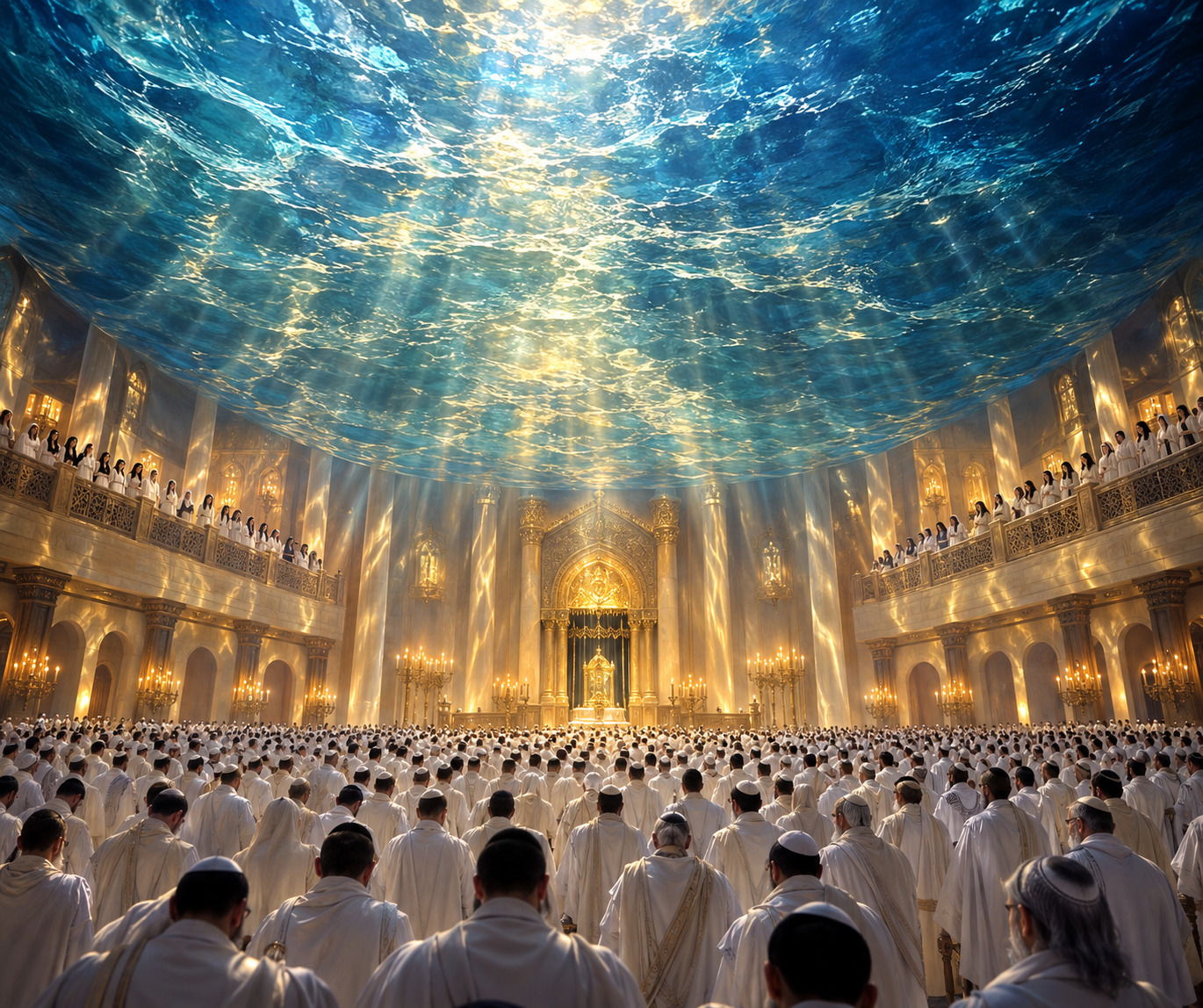
“He is Himself the mikveh”
“For on this day it shall be atoned for you.” Tractate Yoma closes on this verse and draws everything from it: one who says “I shall sin and Yom Kippur will atone” — Yom Kippur does not atone; and what lies between a man and his fellow, Yom Kippur does not atone until the other has been appeased.
Be-etzem ha-yom ha-zeh: the very substance of the day. As there is washing with water and there is dry cleaning, the air of this day cleans of itself. Rabbi takes the idea to its end; the Sages answer that you must still bring something of your own.
And the verse allows another punctuation: “for on this day it shall be atoned” — stop; “it is upon you to purify yourselves of all your sins”. His half, and our first step.
The closing mishna of the tractate is Rabbi Akiva’s: before whom do you purify yourselves, and who purifies you? Mikveh Israel Hashem — He is Himself the bath. And a mikveh purifies by a measure: forty se’ah, nine hundred and sixty log, against the sixteen elements a man is made of. Sixty times over. A man is nullified in it.
Which is why the Torah writes of the Kohen Gadol entering the Holy of Holies: “and no man shall be in the tent of meeting” — while he is standing there. For seven days he trains himself to be no longer there.
Let us learn a few more things in the matters of the day. The verse to which we are very, very closely bound throughout Yom Kippur is this one:
“For on this day it shall be atoned for you, to purify you; of all your sins, before Hashem, you shall be pure.” — Vayikra 16:30
This verse is studied at the end of tractate Yoma, whose subject is precisely Yom Kippur, in the last chapter, the eighth. And from this verse several teachings are drawn.
Here is what the mishna says:
“One who says: I shall sin and I shall repent, I shall sin and I shall repent — he is not given the means to repent. I shall sin and Yom Kippur will atone — Yom Kippur does not atone.”
One who counts on the pardon in advance has already changed the nature of what he is doing.
The mishna continues:
“Transgressions between a man and the Omnipresent, Yom Kippur atones. Transgressions between a man and his fellow, Yom Kippur does not atone, until he has appeased his fellow.”
And from where is this principle learnt? From our very verse. What does it say? “Of all your sins before Hashem, you shall be pure.” What is before Hashem — the sins between a man and the Omnipresent — of those you shall be pure; Yom Kippur atones for them.
From this verse something else is learnt as well. Why does the Torah say “on this day”? The word etzem — the bone, the substance — points to itzumo shel yom: the substance of the day itself atones.
And this is not a manner of speaking. We know that Shabbat is not merely a day: it is a station. The Holy One blessed be He created the world in six days, and on the seventh He ceased and rested. Shabbat therefore has a meaning of its own, an existence of its own, a soul of its own.
So it is with Yom Kippur. The very fact of entering Yom Kippur — in the cosmos, in creation, there is now in the air an atmosphere of Yom Kippur, and that air purifies of itself.
But on this point there is a dispute, and the question is how far it goes.
Rabbi — Rabbi Yehuda HaNasi — takes it to the end: the substance of the day atones. Even a Jew who enters Yom Kippur just as he is, who instead of coming to the beit haknesset for Kol Nidrei made the final meal, could no longer move, lay down and slept twenty-five hours, then woke for havdala — his sins are atoned. Why? Because the day itself washed his sins.
The Sages answer: all that is well and good, you entered Yom Kippur — but if you did not do teshuva, all that air, all that atmosphere will not help you. Teshuva is required.
We said in the previous shiur that Yom Kippur is not just any day. We always think it was chosen as a day of pardon because Moshe Rabbenu came down with the second tablets and the Holy One blessed be He said to him salahti kidvarekha.
But we learnt that the Holy One blessed be He, before the world was even created, chose Yom Kippur to be His day, His alone — and that is what the verse in Tehillim is about, “days were formed, and not one of them”. There is one day in the year that He took for Himself. And that is why on that day there is neither Satan nor accuser: He is with us, one to one.
There is, however, another way to read our verse. One need only place the punctuation elsewhere.
“For on this day it shall be atoned” — and there, a comma. Then: “it is upon you to purify yourselves of all your sins”. And only then: “before Hashem, you shall be pure”.
Did you hear what I just said? Aleichem no longer means “for you”, but “it is upon you”. The day atones, agreed — but it is upon you to purify yourselves.
This is what we said too about the verse in Haazinu:
“As an eagle rouses its nest, hovers over its young — it spreads its wings, it takes him, it bears him on its pinion.” — Devarim 32:11
How do the young ever reach the eagle’s back? We know an eagle is incapable of such a movement: taking its chick and tossing it onto its back — there is no such thing.
So how do they get there? “It spreads its wings, it takes him.” The eagle spreads its wings — no difficulty there. But the young have to start climbing by themselves to reach the back.
And from there, precisely — open for Me an opening like the eye of a needle, and I shall open for you like the gateway of the Temple hall. Here are the words in the midrash:
“Open for Me one opening of teshuva, like the eye of a needle, and I shall open for you openings through which wagons and carriages may pass.” — Shir HaShirim Rabbah 5:2
The opening asked of us is tiny. What is not tiny is the widening.
I am asked: and the order of the prayer, from the beginning of Kippur to the end, all that tefila — is the very saying of it not already a return?
You need it, yes. But the act is something else. You may pray as much as you like: words, words, words. All of it is good — but what is in the heart while you pray?
So what is teshuva? Teshuva is not standing and praying. You got up at half past five in the morning, you made the effort, you prayed, you went into the prayer — and you came out the same man: you have done nothing.
A man recognises his fault. He confesses — the Vaya’avor, the selichot, as many times as he says them through the prayer. And he takes on the future: not to return to that folly.
And it does not hold all the way. What is to be done? We are men, we are not perfect. Do not fall in spirit. The yetzer hara’s proposal is always the same: give it up, you are wasting your time. Do not listen to him.
A second point I would draw from the end of tractate Yoma. The last mishna continues, and it is Rabbi Akiva who speaks:
“Rabbi Akiva said: happy are you, Israel! Before whom do you purify yourselves, and who purifies you? Your Father in heaven.”
And he brings two verses.
“I shall sprinkle pure waters upon you, and you shall be pure.” — Yechezkel 36:25
“Mikveh of Israel, Hashem.” — Yirmiyahu 17:13
Only, how does it work? How does a bath purify, exactly?
A man goes in to immerse. Before, he was impure. After he comes out, he is pure. What happened? What is the mechanism? What is the spiritual technology at work here, that makes a man go in in one state and come out in another? What is in that water that produces the change?
What is the minimum measure of a valid mikveh? Forty se’ah. And one se’ah is twenty-four log.
If each se’ah is twenty-four log, how many log are there altogether in the mikveh? Forty times twenty-four: nine hundred and sixty log.
And what is in those nine hundred and sixty log? Let us understand.
Every man, like every substance in nature, is made of four elements. They are remembered by the word arma:
Four elements in every man. But each element in turn contains the four elements: in fire too there are the four.
So altogether we have sixteen elements.
Now, if I want to take this substance made of sixteen elements and nullify it, according to the rule that a thing is nullified in sixty times its volume, what quantity do I need? Sixty times sixteen.
Nine hundred and sixty. Exactly the contents of the mikveh.
And if you immerse in the sea? It makes no difference, and far more than that: sixty is the minimum. Beyond it, the nullification is only the more complete.
And now what do we get? Mikveh Israel Hashem.
Who is the Holy One blessed be He in this image? The infinite mikveh. He is the Infinite. It is certain that He nullifies us entirely and brings us back to absolute zero.
The word mikveh, in Hebrew, means a place where waters gather. But it is also the word of tikva — hope.
And our hope rests on something very, very strong: the one who purifies us is not flesh and blood. He is not a head of state, he is nobody at all. He is the Holy One blessed be He Himself.
But there is a condition. You must be nullified in sixty. If you are not nullified, it does not work. And there lies the whole secret of Yom Kippur.
On Kippur we come and we say: poor men stand before You today. What does that mean? That I have a million shekels in the bank, or that I do not? That is not what it is about. I am poor in deeds.
Everything I have done, everything I count to my credit — I studied Torah, a little; I gave tzedaka, a little; this, a little; that, a little — everything you do still stands as a zero against what the Holy One blessed be He expects of you.
From where do we learn it? From the Kohen Gadol, in the service of Yom Kippur. We read parashat Acharei Mot, and this is what we do on Kippur in the Seder ha-Avoda. The Kohen Gadol enters the innermost place. And see what is written:
“And no man shall be in the tent of meeting when he comes to atone in the sanctuary, until he goes out; and he shall atone for himself, for his household, and for all the assembly of Israel.” — Vayikra 16:17
And I ask: the Torah is a Torah of truth, is it not? It does not say “no man shall be with the Kohen”, nor “apart from the Kohen”. We know perfectly well that he enters alone — but that is not what the verse says. The verse says: no man shall be.
Not even a spark of a thought. Not one instant of “what joy, what merit is mine, I am the Kohen Gadol, it is through me that the service is now performed, it is the sins of all that pass through my hands”. Nothing. The moment a spark of such a thought enters him, he is consumed on the spot.
And what is he training at for seven days? It is written at the beginning of tractate Yoma that the Kohen Gadol is set apart for seven days and rehearses the service. But he is also working on himself, emptying himself of himself. It is a kind of meditation: emptying out, so that at the moment he enters the Holy of Holies he can say — I am not here, this is not me.
And the whole people of Israel is, in truth, in the condition of the Kohen Gadol. That is why we perform the Seder ha-Avoda: look, we all do it, we read, we prostrate ourselves. Are we kohanim? Why do we do it?
“And you shall be for Me a kingdom of kohanim and a holy nation.” — Shemot 19:6
May we merit, God willing, to enter with that awareness: that we are poor. And may the Infinite answer the poor who stand before Him.
May we be written and sealed for a good life and for peace, we and all the people of Israel, for good and for blessing.
🎯 Test yourself
Five questions on the shiur. Click an answer.
Result
Shalom Bayit — The Mouth at Home
My covenant of peace — peace begins at home. Reveal a Shalom Bayit card.
Gematria — Rav Ménaché
Shalom, Mashiah, Yisamech — secrets of the letters by Rav Ménaché zatsal.
🔢 Gematria CourseAll Parashot
All shiurim of M. Yéhouda Himi — from Bereshit to Devarim and the festivals.
📚 All ParashotBooks
Torah wisdom in thriller format — Éditions Gueoula.
Guardians of the Rift
Forty-nine gates open — the fiftieth hides in a single moment. An ancient secret resurfaces, and one man stands between the rift and the world. Drawn from Talmud and Kabbalah.
📖 Read the free excerpt · Book $9.90